

Nikawa landslide
LCI : JPN1607131731| Main Information | |
| Landslide Name | : Nikawa landslide |
| Latitude | : 34:46:25 N |
| Longitude | : 135:20:23 E |
| Location | |
| City / District | : Nishinomiya |
| Province | : Hyogo |
| Country | : Japan |
| Reporter | |
| Reporter 1 | : Khang Dang |
| Reporter 2 | : Kyoji Sassa |
| Landslide Type | |
| Material | : Earth |
| Movement | : Slide |
| Velocity (mm/sec) | : Rapid |
| Depth (m) | : Deep-Moderate |
| Slope (degree) | : Moderate |
| Volume (m³) | : Large-Moderate |
| Date of Occurence | |
| Date of Occurence | : Jan 17, 1995 |
| Other Information | |
| Land Use |
Source area : Forest Run-out/deposition area : Urban area |
| Other Activity | : Active in the past |
| Triggering Factor | : Earthquake |
| Death(s) & Missing | : 34 |
| Houses and other structural damage | : - |
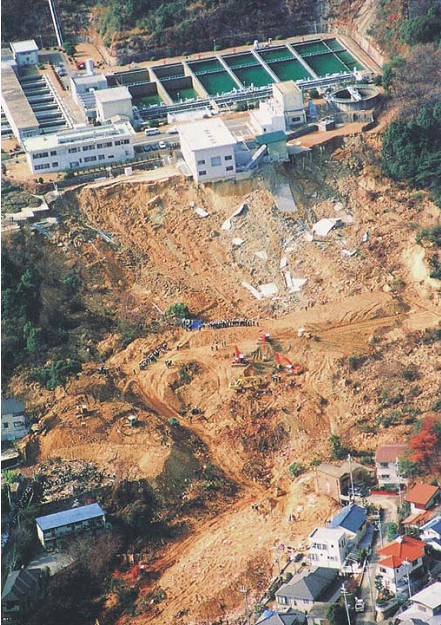
| Photo of landslide | : ![]() |
| Google earth kmz file | : Nikawa landslide.kmz |
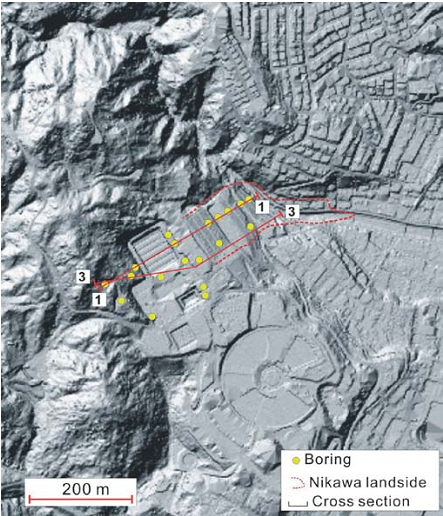
| Plan of landslide | : ![]() |
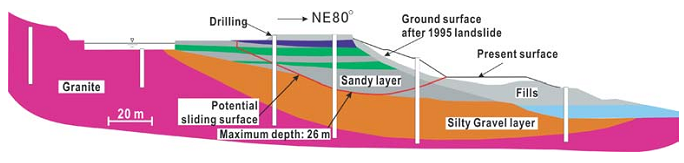
| Cross section of landslide | : ![]() |
| Reference (paper/report) | : https://www.jstage.jst.go.jp/article/sandf1995/40/1/40_1_35/_article |
| Testing graph | : Testing Graphs-Nikawa.docx |
| Monitoring graph | : Seismic Record.JPG |
| Video of moving landslides including 3D simulation | : - |
| Description | : |
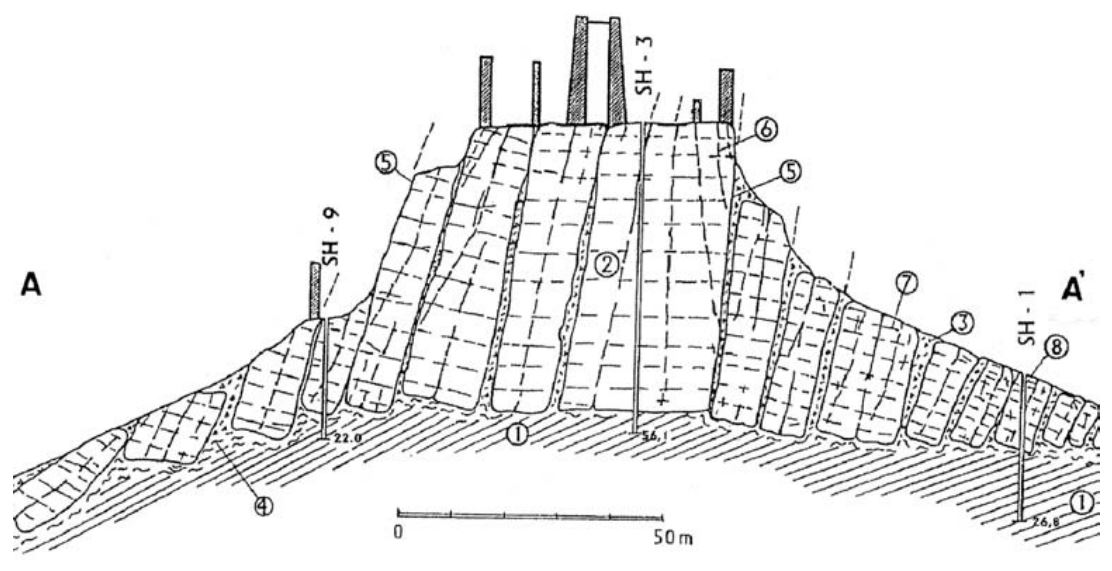
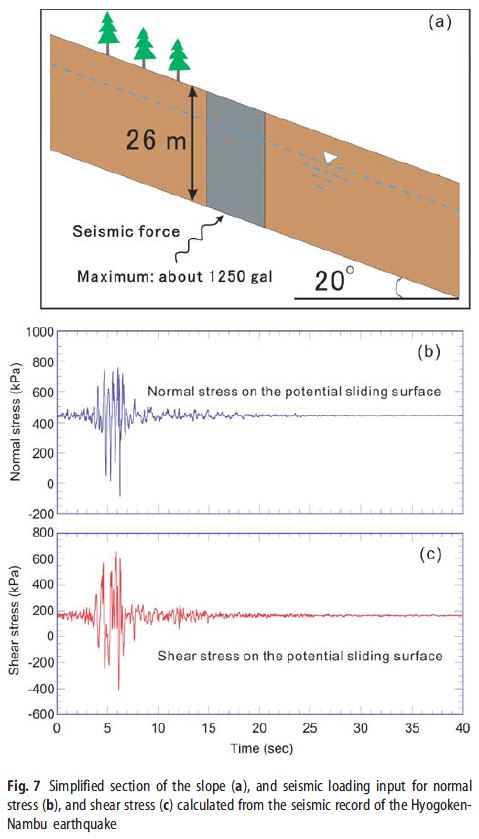
The Nikawa landslide (34 fatalities) was triggered by the 1995 Hyogoken-Nambu earthquake in Nishinomiya city between Osaka and Kobe. Drilling investigations (including boreholes drilled immediately after the earthquake and new ones drilled during this investigation) revealed that the bedrock is granite, which is overlain by Quaternary marine and lacustrine deposits (the Osaka group formation). The Osaka group formation consists of a silty gravel layer, a sandy layer interbedded with some clayey layers above it, overlain by fills. Note that the matrix of the silty gravel layer is mainly composed of fine sand and silt characterized by a very low permeability. The overall permeability of the silty gravel layer obtained through in-situ tests is about 10-7 m/s, while that of the sandy layer above it is 10-6 m/s. During an earthquake, a potential sliding surface is inferred to develop through the interface be-tween the sandy layer and the silty gravel layer where its shape, scale and inclination is very similar to the rupture surface of the Nikawa landslide. The maximum depth of the potential sliding surface is 26 m, and it has an average angle of about 20 degrees. The groundwater level in the section where the slip surface is 26 m deep is 16 m above the slip surface. Source: Sassa, K., Wang, G., Fukuoka, H. et al. Landslide risk evaluation and hazard zoning for rapid and long-travel landslides in urban development areas. Landslides (2004) 1: 221. doi:10.1007/s10346-004-0028-y |
|
Qianjiangping landslide
LCI : CHN1607131433| Main Information | |
| Landslide Name | : Qianjiangping landslide |
| Latitude | : 30:57:25 N |
| Longitude | : 110:36:56 E |
| Location | |
| City / District | : Shazhenxi |
| Province | : Hubei |
| Country | : China |
| Reporter | |
| Reporter 1 | : Khang Dang |
| Reporter 2 | : Fa-Wu Wang |
| Landslide Type | |
| Material | : Complex |
| Movement | : Slide |
| Velocity (mm/sec) | : Rapid |
| Depth (m) | : Deep-Moderate |
| Slope (degree) | : Steep |
| Volume (m³) | : Very Large |
| Date of Occurence | |
| Date of Occurence | : Jul 14, 2003 |
| Other Information | |
| Land Use |
Source area : Wildland, Road Run-out/deposition area : River |
| Other Activity | : Active in the past |
| Triggering Factor | : Others |
| Death(s) & Missing | : 24 |
| Houses and other structural damage | : 346 houses and 70 ha of fields and rice paddy |
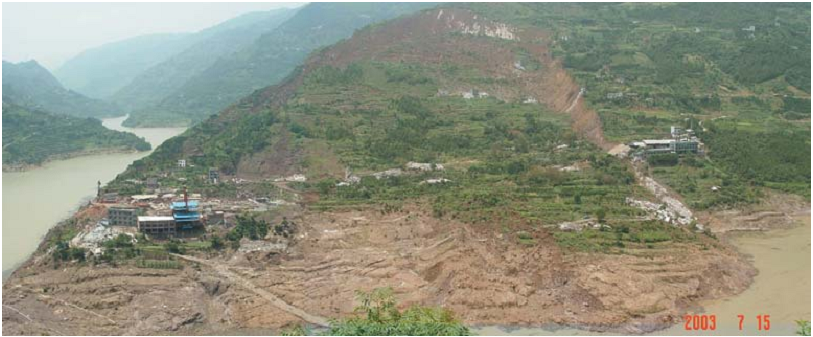
| Photo of landslide | : ![]() |
| Google earth kmz file | : Qianjiangping landslide.kmz |
| Plan of landslide | : - |
| Cross section of landslide | : ![]() |
| Reference (paper/report) | : http://link.springer.com/article/10.1007/s10346-004-0020-6 |
| Testing graph | : - |
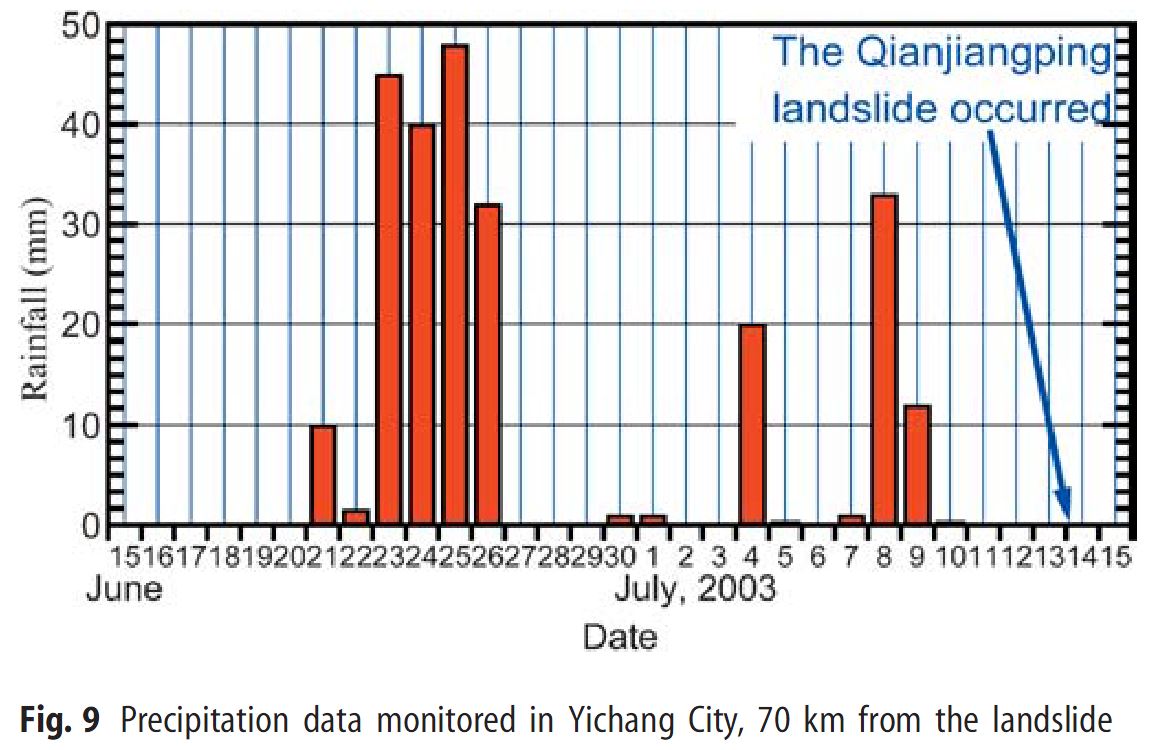
| Monitoring graph | : Monitored Precipitation Data.JPG |
| Video of moving landslides including 3D simulation | : - |
| Description | : |
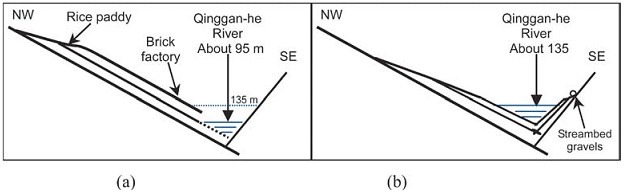
The Three Gorges Dam construction on the Yangtze River in China is the largest hydro-electricity project in the World. The first impoundment started from 95 m on June 1st, 2003, and reached 135 m on June 15th, 2003. Shortly after the water reached 135 m, many slopes began to de-form and some landslides occurred. In the early morning, at 00:20 July 14, 2003, the Qianjiangping landslide occurred at Shazhenxi Town beside Qinggan-he River, a tributary of the Yangtze. The Qianjiangping landslide was located on the western side of Qinggan-he River. On the opposite side of the river is the main street of Shazhenxi. The distance from the landslide to the junction of the Qinggan-he River with the Yangtze is about 3 km, and the distance along the Yangtze River from the junction to the Three Gorges Dam is about 50 km (the direct distance is about 40 km). The landslide had a tongue-shaped plan, with a length of 1,200 m, and a width of 1,000 m. It moved about 250 m in the main sliding direction of S450E. The average thickness of the sliding mass was about 20 m, thinner in the upper part and thicker at the lower part. The total volume was estimated to be more than 20 million cubic meters. The elevation of the main scarp was 450 m, and the elevation of the Qinggan-he River water level was 135 m when the landslide occurred. The landslide release surface was along a bedding plane in the bedrock. Standing trees on the sliding mass in the middle of the landslide indicate that the angle of the sliding surface remained constant and no rotation occurred. The exposed sliding surface at the upper part was very planar, and sub-parallel to the sandstone bedrock strata. All of these phenomena show that the sliding mass slid along a planar sliding surface. When the sliding mass entered Qinggan-he River, the dip direction of the strata was changed to N450W, which is opposite to the original dip direction of S450E. The dip angle is about 50 in the bed of Qinggan-he River. The deposits at the distal landslide margin contain white gravel with clasts up to 100mm-or-so in diameter. The dip angle of the sandstone bedding at the distal margin is steeper than 300. There was some loss of life and serious economic damage caused by the Qianjiangping landslide. It destroyed 346 houses and 70 ha of fields and rice paddy. Four factories on the lower part of the slope near Qinggan-he River were seriously damaged. Direct economic losses were about 7 million USD, and it reduced the asset value at Qianjiangping by 40%. In addition, 3 km of provincial roads and 20.5 km of electricity lines were cut. Twenty-two boats and ships were damaged and sunk in Qinggan-he River and the Yangtze River. Although a warning was given by the local government based on precursory deformation of the slope two hours before the final failure, 13 people on the slope, and 11 fishermen on boats in the nearby area were killed. The main reason for the deaths on the slope was that the people did not imagine that the landslide area would be so large, and believed their houses would be safe, because there was no ground defor-mation around them before the final failure of the slope. For the deaths on the river, the reason was just that it was not predicted that the landslide could move so rapidly. It was the wave caused by the rapid sliding that killed the fishermen on their boats. A water trace left on the red bridge detected after the landslide, indicated that the highest level of the wave was about 30 m above the water level of 135 m. This report referred the research in the paper: Fa-Wu Wang · Ye-Ming Zhang · Zhi-Tao Huo · Tatsunori Matsumoto · Bo-Lin Huang (2004) The July 14, 2003 Qianjiangping landslide, Three Gorges Reservoir, China. Landslides Vol. 1:157–162 |
|
Tsukidate landslide
LCI : jpn1607131407| Main Information | |
| Landslide Name | : Tsukidate landslide |
| Latitude | : 38:44:59 N |
| Longitude | : 141:00:51 E |
| Location | |
| City / District | : Tsukidate |
| Province | : Miyagi |
| Country | : Japan |
| Reporter | |
| Reporter 1 | : Khang Dang |
| Reporter 2 | : Hiroshi Fukuoka |
| Landslide Type | |
| Material | : Earth |
| Movement | : Slide |
| Velocity (mm/sec) | : Rapid |
| Depth (m) | : Moderate-Shallow |
| Slope (degree) | : Gentle |
| Volume (m³) | : Unknown |
| Date of Occurence | |
| Date of Occurence | : May 26, 2003 |
| Other Information | |
| Land Use |
Source area : Forest Run-out/deposition area : Farming, Human settlement |
| Other Activity | : Active in the past |
| Triggering Factor | : Earthquake |
| Death(s) & Missing | : - |
| Houses and other structural damage | : 2 houses |
| Photo of landslide | : ![]() |
| Google earth kmz file | : - |
| Plan of landslide | : - |
| Cross section of landslide | : ![]() |
| Reference (paper/report) | : - |
| Testing graph | : - |
| Monitoring graph | : Landslides (2004) 1 151–155-2004-6Hiroshi Fukuoka-Earthquake-induced rapid long-traveling(Recent Landslides).pdf |
| Video of moving landslides including 3D simulation | : - |
| Description | : |
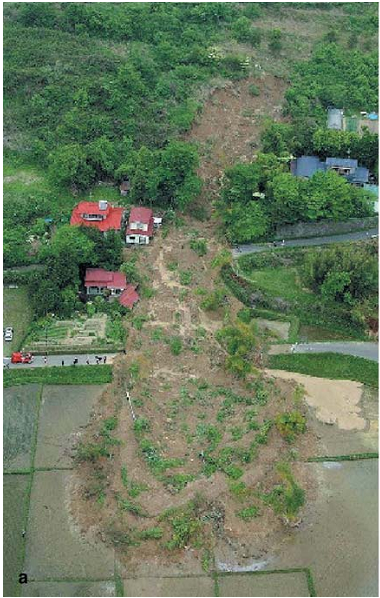
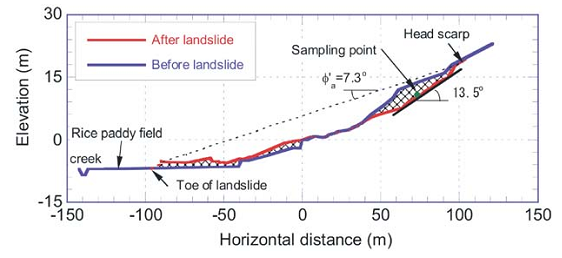
An earthquake with a moment magnitude of 7.0 occurred in northern Japan on May 26, 2003. Landslides were triggered by the earthquake, and among which a massive landslide occurred in the Tsukidate area, northwest of Sendai, the capital city of Miyagi Prefecture. The Tsukidate landslide partially destroyed two houses. Although two people were partially buried by the displaced landslide mass, both were subsequently rescued. The landslide was triggered on a gentle slope with the sliding surface inclination of approximately 13.5 degrees. The displaced landslide mass traveled a long distance of about 130 m, and finally spread and deposited on a horizontal rice paddy, thus showing some typical characteristics of rapid long traveling flow phenomenon. Because this landslide was triggered by an earthquake without rainfall, the fluidization behavior of the landslide attracted the attention of researchers in various fields. |
|
Spis Castle landslide
LCI : SVK1607131242| Main Information | |
| Landslide Name | : Spis Castle landslide |
| Latitude | : 49:0:2 N |
| Longitude | : 20:46:6 E |
| Location | |
| City / District | : Spisska Nova Ves |
| Province | : Kosice |
| Country | : Slovakia |
| Reporter | |
| Reporter 1 | : Khang Dang |
| Reporter 2 | : Jan Vlcko |
| Landslide Type | |
| Material | : Rock |
| Movement | : Complex |
| Velocity (mm/sec) | : Extremely Slow |
| Depth (m) | : Moderate-Shallow |
| Slope (degree) | : Extremely Steep |
| Volume (m³) | : Unknown |
| Date of Occurence | |
| Date of Occurence | : Jan 01, 1970 |
| Other Information | |
| Land Use |
Source area : Cultural heritage site Run-out/deposition area : Cultural heritage site |
| Other Activity | : Currently active |
| Triggering Factor | : Human activity |
| Death(s) & Missing | : - |
| Houses and other structural damage | : - |
| Photo of landslide | : |
| Google earth kmz file | : Spis Castle landslide.kmz |
| Plan of landslide | : - |
| Cross section of landslide | : |
| Reference (paper/report) | : http://link.springer.com/article/10.1007/s10346-003-0007-8 |
| Testing graph | : - |
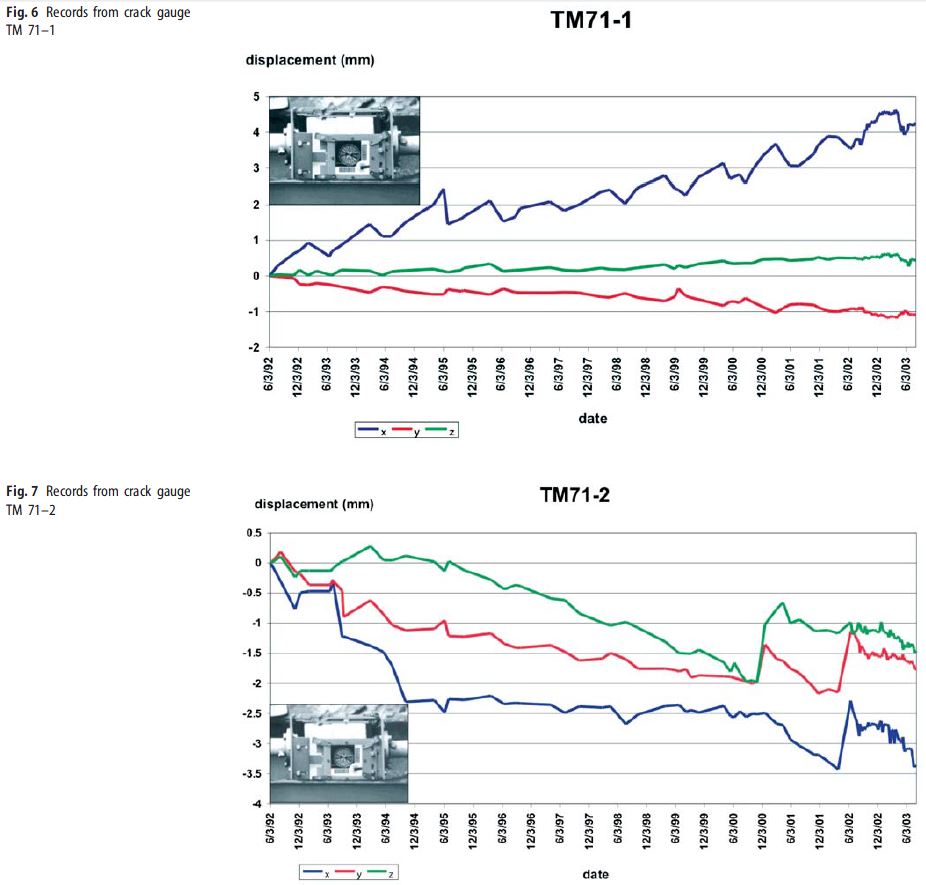
| Monitoring graph | : Monitoring Graphs-Spis Castle.JPG |
| Video of moving landslides including 3D simulation | : - |
| Description | : |
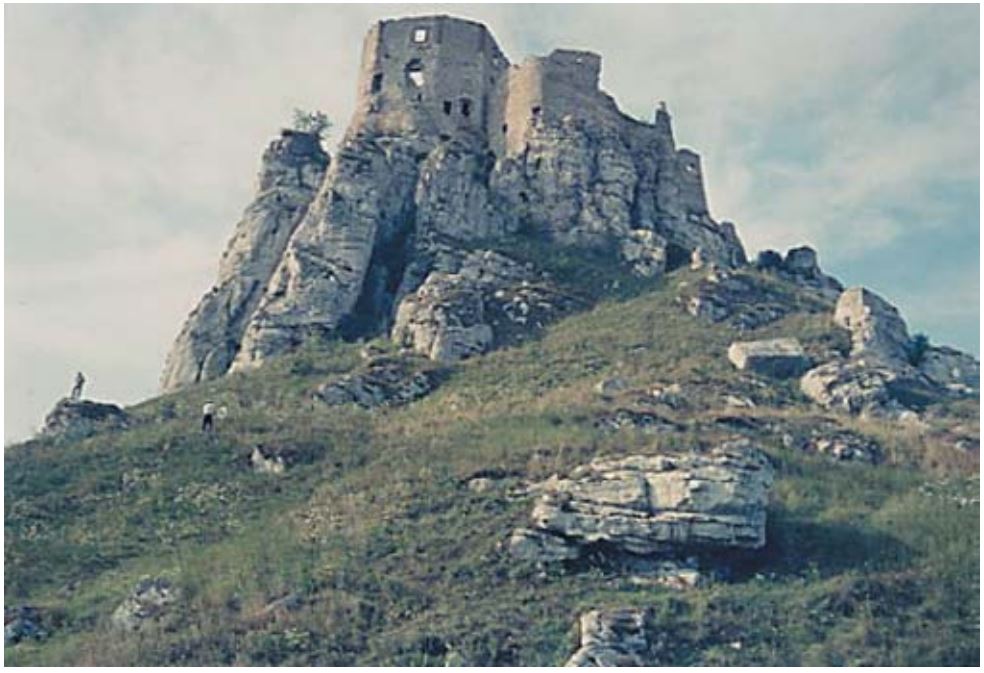
Spis Castle, a monument included in the UNESCO World Heritage Site list (Eastern Slovakia) is built on a travertine mound overlying soft Paleogene rocks. Lateral spreading resulting from the subsidence of strong upper travertine into soft claystone strata has fractured and separated the castle rock into several cliffs. The differential movement of individual cliff faces is the primary influence on the stability of the monument. In 1985 minor repair and reconstruction including some stabilization efforts (removal of vegetation from the natural rockface, removal of rock debris, grouting, etc.) was stated without an engineering geological investigation. In 1991 cracks in the Palace were reported and were believed to be attributable to slope movements. Consequently, the Institute for Monuments Preservation together with the Ministry of the Environment approached the Department of Engineering Geology (Comenius University Bratislava) and the Department of Geotechnics (Slovak Technical University Bratislava) to make a reconnaissance study of the castle. Subsequently it was confirmed that slope failures present a danger not only to the palace but also to the defense walls at the lower courtyard and near the entrance. This report referred the research in the paper : Jan Vlcko (2004) Extremely slow slope movements influencing the stability of Spis Castle, UNESCO site. Landslides (2004) 1:67–71 |
|
Minamata debris flow
LCI : JPN1607131159| Main Information | |
| Landslide Name | : Minamata debris flow |
| Latitude | : 32:12:40 N |
| Longitude | : 130:25:33 E |
| Location | |
| City / District | : Minamata |
| Province | : Kumamoto |
| Country | : Japan |
| Reporter | |
| Reporter 1 | : Khang Dang |
| Reporter 2 | : Kyoji Sassa |
| Landslide Type | |
| Material | : Debris |
| Movement | : Flow |
| Velocity (mm/sec) | : Extremely Rapid |
| Depth (m) | : Moderate-Shallow |
| Slope (degree) | : Moderate |
| Volume (m³) | : Unknown |
| Date of Occurence | |
| Date of Occurence | : Jul 20, 2003 |
| Other Information | |
| Land Use |
Source area : Forest Run-out/deposition area : Farming, Road |
| Other Activity | : Active in the past |
| Triggering Factor | : Rainfall |
| Death(s) & Missing | : 15 |
| Houses and other structural damage | : 15 |
| Photo of landslide | : ![]() |
| Google earth kmz file | : Minamata debris flow.kmz |
| Plan of landslide | : - |
| Cross section of landslide | : ![]() |
| Reference (paper/report) | : http://link.springer.com/article/10.1007/s10346-003-0004-y |
| Testing graph | : |
| Monitoring graph | : - |
| Video of moving landslides including 3D simulation | : - |
| Description | : |
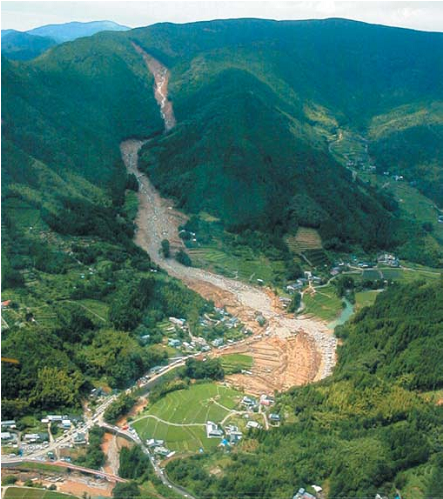
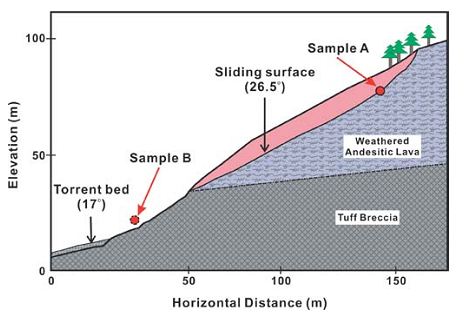
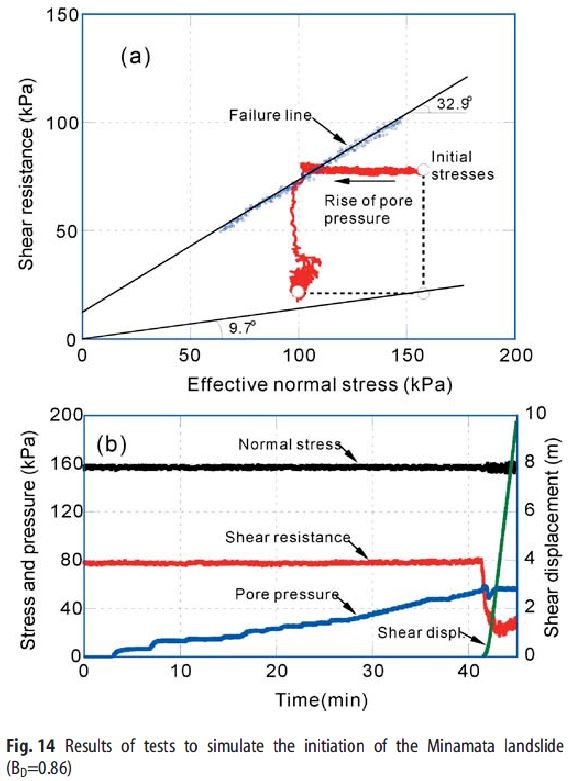
On 20 July 2003, a landslide occurred in an andesitic weathered lava layer on a mountain slope of 3132 degrees in Minamata City, Kumamoto Prefecture, Kyushu Island, Japan. It was triggered by a heavy rainstorm with 314 mm total rainfall and a maximum rate of rainfall of 91 mm/h. The slide mass entered a torrent, where it was transformed into a debris flow that struck a village along the torrent, destroying 15 houses, killing 15 people, and injuring an additional six people. This debris flow was triggered by the slide, and the landslide mass flowed downstream along the torrent, increasing its volume by entraining material from the channel and weathered surface soils of the mountain slopes on both sides of the channel. Based on a topographic survey made after the landslide occurred, the initial slide was estimated to have occurred along a failure surface with an inclination of 26.5 degrees and depth of approximately 1012 m. Source: Sassa, K., Fukuoka, H., Wang, G. et al. Undrained dynamic-loading ring-shear apparatus and its application to landslide dynamics. Landslides (2004) 1: 7. doi:10.1007/s10346-003-0004-y |
|
Unzen-Mayuyama megaslide
LCI : JPN1607121655| Main Information | |
| Landslide Name | : Unzen-Mayuyama megaslide |
| Latitude | : 32:45:51.51 N |
| Longitude | : 130:20:54.16 E |
| Location | |
| City / District | : Shimabara |
| Province | : Nagasaki |
| Country | : Japan |
| Reporter | |
| Reporter 1 | : Khang Dang |
| Reporter 2 | : Kyoji Sassa |
| Landslide Type | |
| Material | : Complex |
| Movement | : Slide |
| Velocity (mm/sec) | : Extremely Rapid |
| Depth (m) | : Very Deep |
| Slope (degree) | : Moderate |
| Volume (m³) | : Extremely Large |
| Date of Occurence | |
| Date of Occurence | : May 21, 1792 |
| Other Information | |
| Land Use |
Source area : Forest Run-out/deposition area : Farming, Urban area, Industrial use, Road, Railways, Sea/lake |
| Other Activity | : Active in the past |
| Triggering Factor | : Earthquake |
| Death(s) & Missing | : 15153 |
| Houses and other structural damage | : - |
| Photo of landslide | : |
| Google earth kmz file | : 11478764606.kmz |
| Plan of landslide | : |
| Cross section of landslide | : |
| Reference (paper/report) | : http://link.springer.com/article/10.1007/s10346-003-0004-y |
| Testing graph | : Fig1478764606.xlsx |
| Monitoring graph | : Iwate-Miyagi Earthquake CS1478764606.xlsx |
| Video of moving landslides including 3D simulation | : https://www.youtube.com/watch?v=GwAWjdXXNbk |
| Description | : |
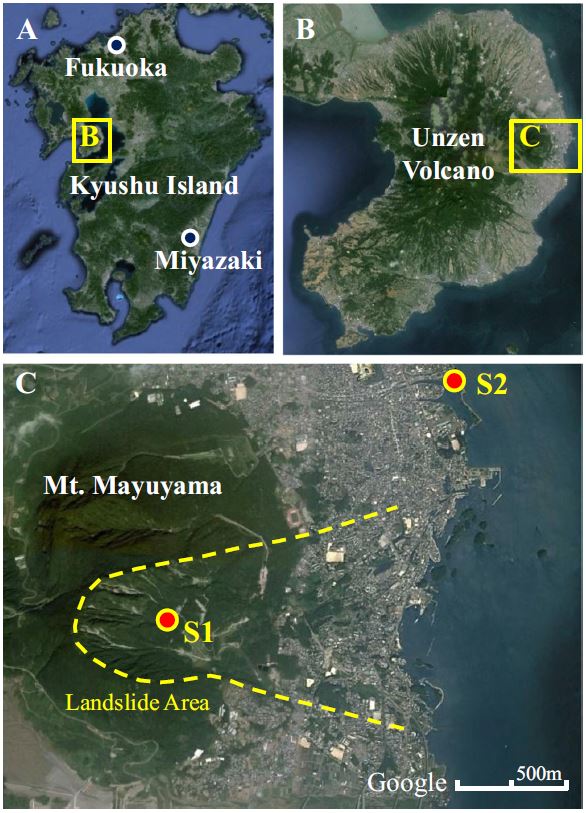
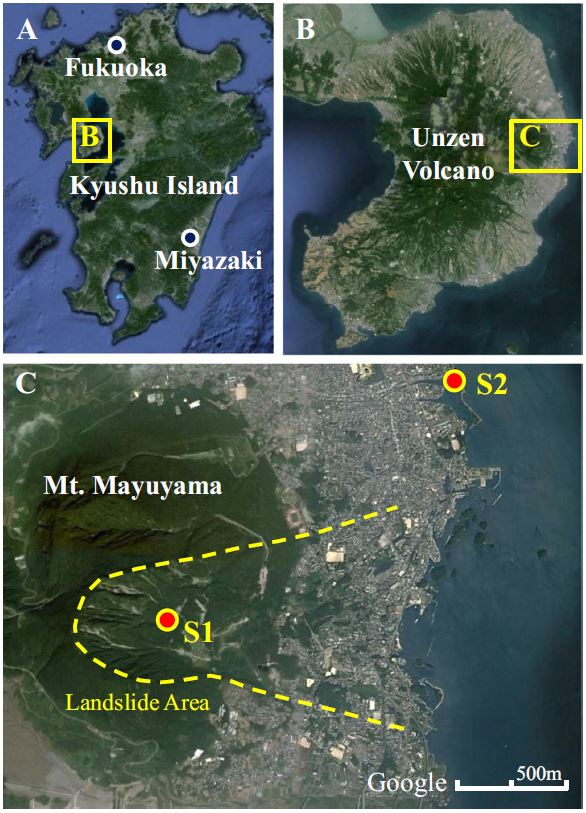
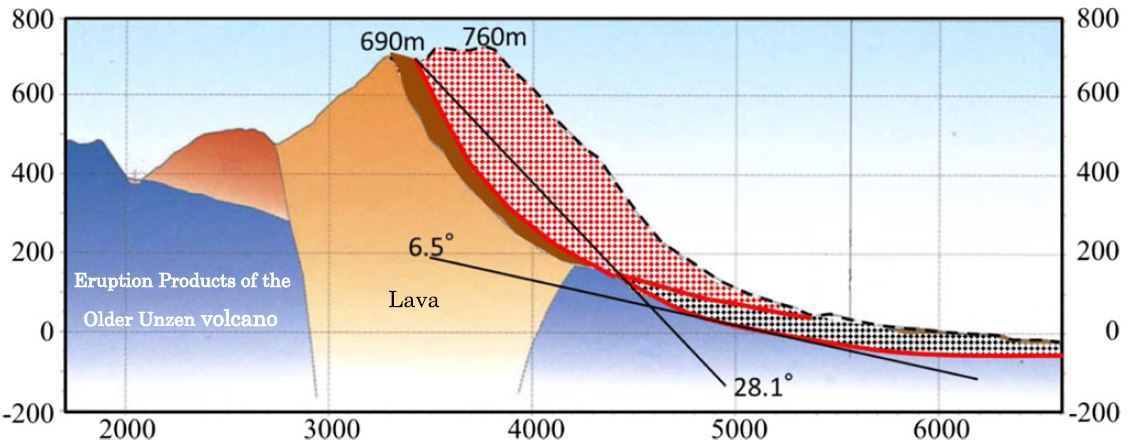
The greatest landslide disaster in the history of Japan is the 1792 Unzen–Mayuyama megaslide (Nakada et al. 1992, 1999). Its volume was 3.4×10⁸ m3 and the maximum depth was 400 m; around 15,000 people were killed by the landslide and its resulting tsunami (Unzen Restoration Office of the Ministry of Land, Infrastructure and Transport of Japan 2002; 2003). This report was made based on the paper of Sassa et al. 2014 published in Landslides Journal. This report referred the research in the paper `Kyoji Sassa I Khang Dang I Bin He I Kaoru Takara I Kimio Inoue I Osamu Nagai (2014) A new high-stress undrained ring-shear apparatus and its application to the 1792 Unzen–Mayuyama megaslide in Japan. Landslides Vol. 11:827–842` |
|
Aratozawa landslide
LCI : JPN1607070918| Main Information | |
| Landslide Name | : Aratozawa landslide |
| Latitude | : 38:53:40 N |
| Longitude | : 140:51:43 E |
| Location | |
| City / District | : Kurihara |
| Province | : Miyagi |
| Country | : Japan |
| Reporter | |
| Reporter 1 | : Ha Nguyen Duc |
| Reporter 2 | : Hendy Setiawan |
| Landslide Type | |
| Material | : Complex |
| Movement | : Slide |
| Velocity (mm/sec) | : - |
| Depth (m) | : Very Deep |
| Slope (degree) | : Almost Flat |
| Volume (m³) | : Very Large |
| Date of Occurence | |
| Date of Occurence | : Jun 14, 2008 |
| Other Information | |
| Land Use |
Source area : Forest Run-out/deposition area : Forest, Sea/lake |
| Other Activity | : - |
| Triggering Factor | : Earthquake |
| Death(s) & Missing | : - |
| Houses and other structural damage | : - |
| Photo of landslide | : |
| Google earth kmz file | : Aratozawa.kmz |
| Plan of landslide | : - |
| Cross section of landslide | : - |
| Reference (paper/report) | : http://link.springer.com/chapter/10.1007978-3-319-04999-1_64 |
| Testing graph | : |
| Monitoring graph | : - |
| Video of moving landslides including 3D simulation | : - |
| Description | : |
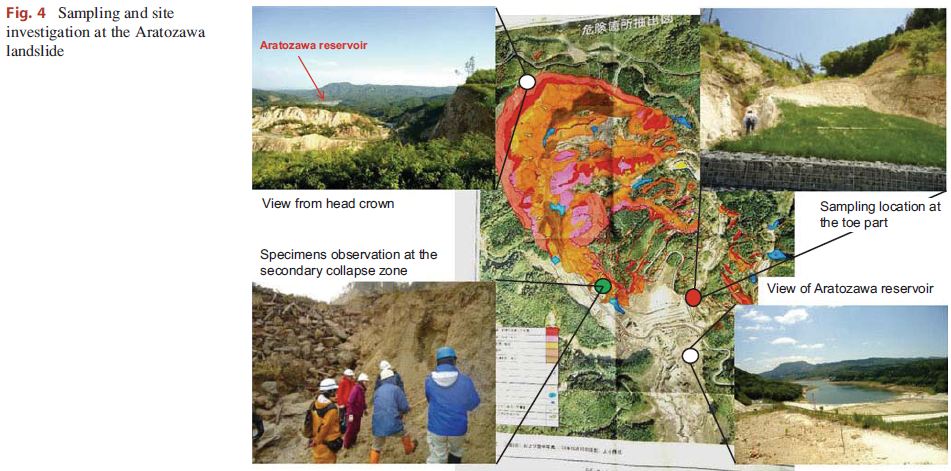
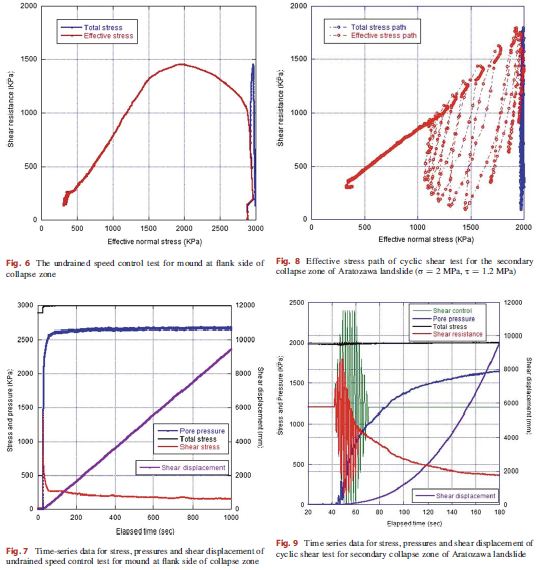
A huge landslide, namely Aratozawa, was triggered by the Miyagi-Iwate inland earthquake with magnitude 7.2 on 14 June 2008. This translational block glide of deep and large-scale landslide occurred at an upstream section of Aratozawa Dam in Kurihara city, Miyagi Prefecture, Japan. The catchment area of the Aratozawa is around 20.4 km2 and the designed water storage capacity is approximately 14,130 thousand m3.The size of the Aratozawa landslide is around 1300 meters long and 900 meters wide. The thickness of the landslide ranges from 70 meters to 150 meters and the gradient is about 3°. This landslide seems to be the biggest landslide occurring in Japan in the last 100 years. The total volume of the landslide was assessed to be around 67 million cubic meters. By using 3.0 MPa undrained dynamic loading ring shear apparatus ICL2 to analyze the mechanism of the landslide, the effect of groundwater fluctuation and the inter-linkage with the reservoir in the Aratozawa dam was found to be the main causes in addition to the peak ground acceleration of more than 1,000 gal. This report referred the research in the paper: Hendy Setiawan, Kyoji Sassa, Kaoru Takara, Toyohiko Miyagi, Hiroshi Fukuoka, and Bin He (2014). The simulation of a deep large-scale landslide near Aratozawa dam using a 3.0 MPa undrained dynamic loading ring shear apparatus. World Landslide Forum 3, at Beijing, China |
|
Leyte Landslide
LCI : PHL169151720| Main Information | |
| Landslide Name | : Leyte Landslide |
| Latitude | : 10:20:0 N |
| Longitude | : 125:5:50 E |
| Location | |
| City / District | : Guinsaugon |
| Province | : Leyte |
| Country | : Philippines |
| Reporter | |
| Reporter 1 | : Pham Tien |
| Reporter 2 | : Kyoji Sassa |
| Landslide Type | |
| Material | : Complex |
| Movement | : Slide |
| Velocity (mm/sec) | : Very Rapid |
| Depth (m) | : Very Deep |
| Slope (degree) | : Moderate |
| Volume (m³) | : Very Large |
| Date of Occurence | |
| Date of Occurence | : Feb 17, 2006 |
| Other Information | |
| Land Use |
Source area : Forest Run-out/deposition area : River |
| Other Activity | : - |
| Triggering Factor | : - |
| Death(s) & Missing | : - |
| Houses and other structural damage | : - |
| Photo of landslide | : |
| Google earth kmz file | : - |
| Plan of landslide | : - |
| Cross section of landslide | : |
| Reference (paper/report) | : - |
| Testing graph | : - |
| Monitoring graph | : Paper1467344385.pdf |
| Video of moving landslides including 3D simulation | : - |
| Description | : |
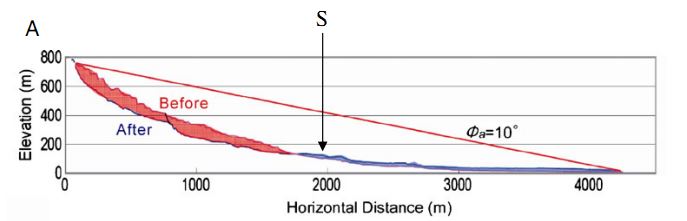
At 10:30 on February 17, 2006, a massive rock slide-debris avalanche was triggered by combined earthquakes-rainfalls impacts in the Southern Leyte Province, Philippine. The landslide with its volume about 20 million cubic meters occurred after 10-day period of heavy rainfalls and a minor earthquake (M 2.6). The rapid and long travelling movement mass buried Guinsaugon village in the town of Saint Bernard. As a result, the catastrophic disaster caused widespread damages to socio-economic infrastructures and claimed 1,126 people. This is the worst disaster hit Guinsaugon community. The collapsed slope has geologic features of weathered volcano-clastic rocks. The landslide mass moved from the slope and deposited on the flat area with a length about 4 km. Source: Kyoji Sassa, Osamu Nagai, Renato Solidum, Yoichi Yamazaki, Hidemasa Ohta (2010) “An integrated model simulating the initiation and motion of earthquake and rain induced rapid landslides and its application to the 2006 Leyte landslide”, Landslides Vol.7, pp:219-236. |
|
Kuridaira Landslide Dam
LCI : JPN169151630| Main Information | |
| Landslide Name | : Kuridaira Landslide Dam |
| Latitude | : 34:4:33.51 N |
| Longitude | : 135:50:7.92 E |
| Location | |
| City / District | : Nara |
| Province | : Nara |
| Country | : Japan |
| Reporter | |
| Reporter 1 | : Pham Tien |
| Reporter 2 | : |
| Landslide Type | |
| Material | : Rock, Debris, Earth |
| Movement | : Slide |
| Velocity (mm/sec) | : Extremely Rapid |
| Depth (m) | : Very Deep |
| Slope (degree) | : Steep |
| Volume (m³) | : Very Large |
| Date of Occurence | |
| Date of Occurence | : Sep 03, 2011 |
| Other Information | |
| Land Use |
Source area : Forest Run-out/deposition area : River |
| Other Activity | : Active in the past |
| Triggering Factor | : Rainfall |
| Death(s) & Missing | : - |
| Houses and other structural damage | : - |
| Photo of landslide | : |
| Google earth kmz file | : Kuridaira landslide.kmz |
| Plan of landslide | : |
| Cross section of landslide | : |
| Reference (paper/report) | : SABO (2013) A Pamphlet released in October, 2013 on overview of the 2011 disaster induced by Typhoon No. 12, Implementation of an urgent investigation and countermeasures to disaster areas. Kii Mountain District SABO Office, Kinki Regional Development Bureau. The Ministry of Land, Infrastructure, Transport and Tourism (MLIT). Available at http://www.kkr.mlit.go.jp/kiisanchi/outline/, 24 pages (in Japanese). |
| Testing graph | : |
| Monitoring graph | : - |
| Video of moving landslides including 3D simulation | : - |
| Description | : |
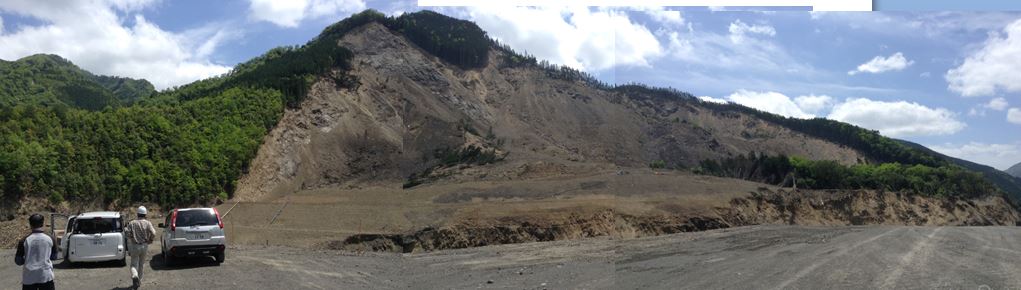
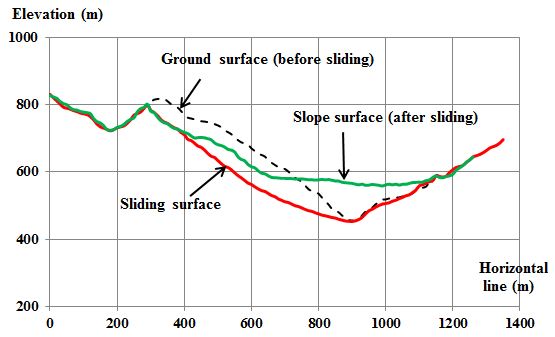
On 3 September 2011, a large-scale deep-seated landslide was triggered by heavy rainfall produced by Typhoon Talas in the Kuridaira valley, Totsukawa village, Nara Prefecture, Japan. The landslide with 850 m in length, 600 m in width and a maximum depth of 120 m became the largest biggest landslide in the 2011 disaster. The collapsed sediment estimated to be 25 million m3. The sliding soil mass moved down and then blocked a river to form a natural landslide dam in a large basin area approximately 8.7 km2. The dam had a water storage capacity of 7.5 million cubic meters. |
|