

MAIERATO LANDSLIDE

LCI : ITA1801121525
Main Information
Landslide Name : MAIERATO LANDSLIDE
Latitude : 38:41:04 N
Longitude : 16:11:07 E
Location
City / District : MAIERATO
Province : VIBO VALENTIA
Country : Italy
Reporter
Reporter 1 : GIOVANNA CAPPARELLI
Reporter 2 : PASQUALE VERSACE
Landslide Type
Material : Rock, Debris
Movement : Flow
Velocity (mm/sec) : Very Rapid
Depth (m) : Deep-Moderate
Slope (degree) : Gentle
Volume (m³) : Large
Date of Occurence
Date of Occurence : Feb 15, 2010
Other Information
Land Use Source area : Farming, Pasture, Urban area, Human settlement, Road
Run-out/deposition area : Farming, Pasture, Urban area, Human settlement, Road
Other Activity : Active in the past
Triggering Factor : Human activity and rainfall
Death(s) & Missing : NO
Houses and other structural damage : YES
Photo of landslide :
Google earth kmz file : Frana_Maierato_2010.kmz
Plan of landslide :
Cross section of landslide :
Reference (paper/report) : https://www.researchgate.net/publication/308015414_Kinematics_of_the_Maierato_Landslide_Calabria_Southern_Italy https://www.researchgate.net/publication/285948650_Geomatics_activities_for_monitoring_the_large_landslide_of_Maierato_Italy https://www.researchgate.net/publication/308792641_Esperienze_di_monitoraggio_topografico_di_grandi_frane_i_casi_di_Gimigliano_e_Maierato https://www.researchgate.net/publication/281111519_Analysis_of_the_rainfall_preceding_the_activation_of_the_large_Maierato_landslide_in_2010 http://www.cnr.it/istituti/Allegato_95848.pdf?LO=01000000d9c8b7a6090000000c0000002caf00006e679c53000000000100000000000000000000000000000000000000000000000000000000000000000000000000000000000000&type=application/pdf
Testing graph : TESTING GRAPH.pdf
Monitoring graph : -
Video of moving landslides including 3D simulation : https://www.youtube.com/watch?v=mL4XBpEg97I
Description :

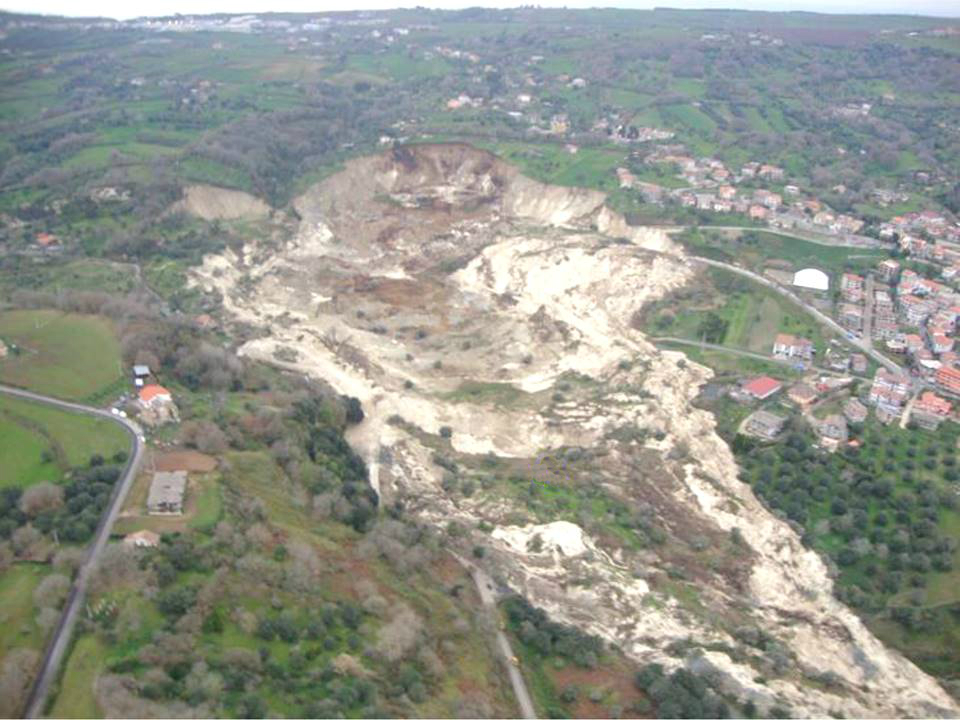
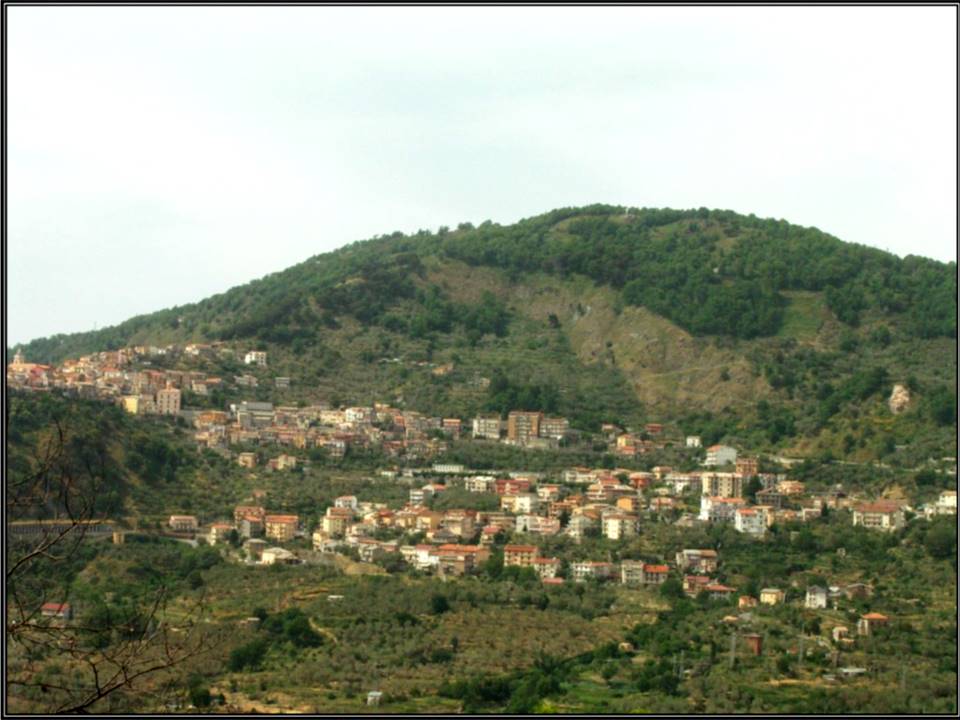
Maierato is located in Vibo Valentia’s territory, few kilometers from the Mar Tirreno in central Calabria. The Maierato’s town rises on a slope without particularly accentuated inclinations, but it is deeply disturbed by an enormous and ancient gravitational deformation (Guerricchio et Al., 2010). Moreover, the territory is characterized by ancient and “Great Lands”, these probably born as a result of marine regressions during glacial periods. In addition, the predisposition to landslide events was strongly characterized by the disastrous earthquake occurred in 1973, which generated fractures and considerable masses dislocated over the whole slope. As a consequence, the seep rains feed a powerful aquifer localized in the permeable layers of deposits. Due to the almost verticality of the cracks, the outflow occurs with a high gradient (about 10%) which, in case of abundant infiltrations, can generate a real “underground torrent”. The landslide of February 15th 2010 was preceded by a long phase of deformation that later produced the collapsed of slope. The elevation speed of the phenomenon seems to suggest that the movement has developed on a completely fluidized substrate, allowing to the ancient landslide debris to mobilize with great energy. The water level has generated pressures in order to cancel the effective stress, inducing a real liquefaction. The conditions favored a collapse in according to a mechanism of multiple rotational sliding, followed by a deep “disarticulation” of the landslide. It could be considered as a “debris flow with rock blocks”. The landslide movement has a main scarp with a development of approximately 1.1 km and with a maximum depth about 50 m. The average depth of the landslide body was estimated at 25-30 m, with a volume that exceeds 8 million m3.

GIMIGLIANO LANDSLIDE

LCI : ITA1801111055
Main Information
Landslide Name : GIMIGLIANO LANDSLIDE
Latitude : 38:58:23.69 N
Longitude : 16:31:47.76 E
Location
City / District : GIMIGLIANO
Province : CATANZARO
Country : Italy
Reporter
Reporter 1 : GIOVANNA CAPPARELLI
Reporter 2 : PASQUALE VERSACE
Landslide Type
Material : Complex
Movement : Complex
Velocity (mm/sec) : Slow
Depth (m) : Deep-Moderate
Slope (degree) : Gentle
Volume (m³) : Very Large
Date of Occurence
Date of Occurence : Jan 12, 2018
Other Information
Land Use Source area : Forest, Farming, Road
Run-out/deposition area : Forest, Farming, Urban area, Road
Other Activity : Active in the past
Triggering Factor : Rainfall
Death(s) & Missing : NO
Houses and other structural damage : YES
Photo of landslide :
Google earth kmz file : FraneGimigliano.kmz
Plan of landslide :
Cross section of landslide :
Reference (paper/report) : https://www.researchgate.net/publication/308792641_Esperienze_di_monitoraggio_topografico_di_grandi_frane_i_casi_di_Gimigliano_e_Maierato
Testing graph : -
Monitoring graph : -
Video of moving landslides including 3D simulation : -
Description :

The area affected by instability is located in Gimigliano, in the “Sila Piccola’s” southern sector, located to 8,5 km from Catanzaro town, Calabria, Italy. The area’s geomorphological context is strongly influenced by the geological structure. Therefore, in the analysis is appropriate to consider the topographic, geologic-structural and hydrogeological influence due to the presence of fractured rocks and the underground water circulation. The stratigraphic reconstruction is very complex, regarding these units as have undergone multiple deformation phases. The presence of fault systems generates many areas covered by strongly fractured and altered rocks that often are the expression of real shear zone. Surveys and superficial and deep (inclinometers) monitoring data gave information on the deformation evolution. The phenomena occurred are characterized not only by different types of mechanisms but also by different states, distributions and activity styles (WP / WLI, 1995), as a consequence of an extremely complex geological context. In the area considered there are three main landslides, on which innumerable superficial phenomena develop. One of these is located at north-west of Gimigliano Superiore, one at South and other at East of the town (characterized by major cracks and fissures). Some of these landslides show translational sliding mechanisms and in some situations a rotational component. The multiplicity of landslides classifies the instability as a complex mechanism. Moreover, the results define the landslide of Gimigliano as a deep landslide with a well identified sliding surface around the depth of 50 meters in the central area of the landslide body. The landslide is active and the movements have a moderated speed, therefore the phenomenon is classified as a slow mechanism. Due to the presence of an active landslide body, of considerable size, joined with various degradation phenomena of the slope, this area is considered with a very high landslide risk.

Xinmo rock avalanche

LCI : CHN1712151115
Main Information
Landslide Name : Xinmo rock avalanche
Latitude : 32:04:47 N
Longitude : 103:39:46 E
Location
City / District : Maoxian
Province : Sichuan
Country : China
Reporter
Reporter 1 : Qiang Xu
Reporter 2 : Xuanmei Fan
Landslide Type
Material : Rock
Movement : Slide, Complex
Velocity (mm/sec) : Extremely Rapid
Depth (m) : Moderate-Shallow
Slope (degree) : Steep
Volume (m³) : Very Large
Date of Occurence
Date of Occurence : Jun 24, 2017
Other Information
Land Use Source area : Forest
Run-out/deposition area : Forest, Road, River
Other Activity : Active in the past
Triggering Factor : Rainfall and earthquake
Death(s) & Missing : 83
Houses and other structural damage : 64
Photo of landslide :
Google earth kmz file : Xinmo Landslide1513568762.kmz
Plan of landslide :
Cross section of landslide :
Reference (paper/report) : https://link.springer.com/article/10.1007/s10346-017-0907-7
Testing graph : -
Monitoring graph : Fig.16.jpg
Video of moving landslides including 3D simulation : -
Description :

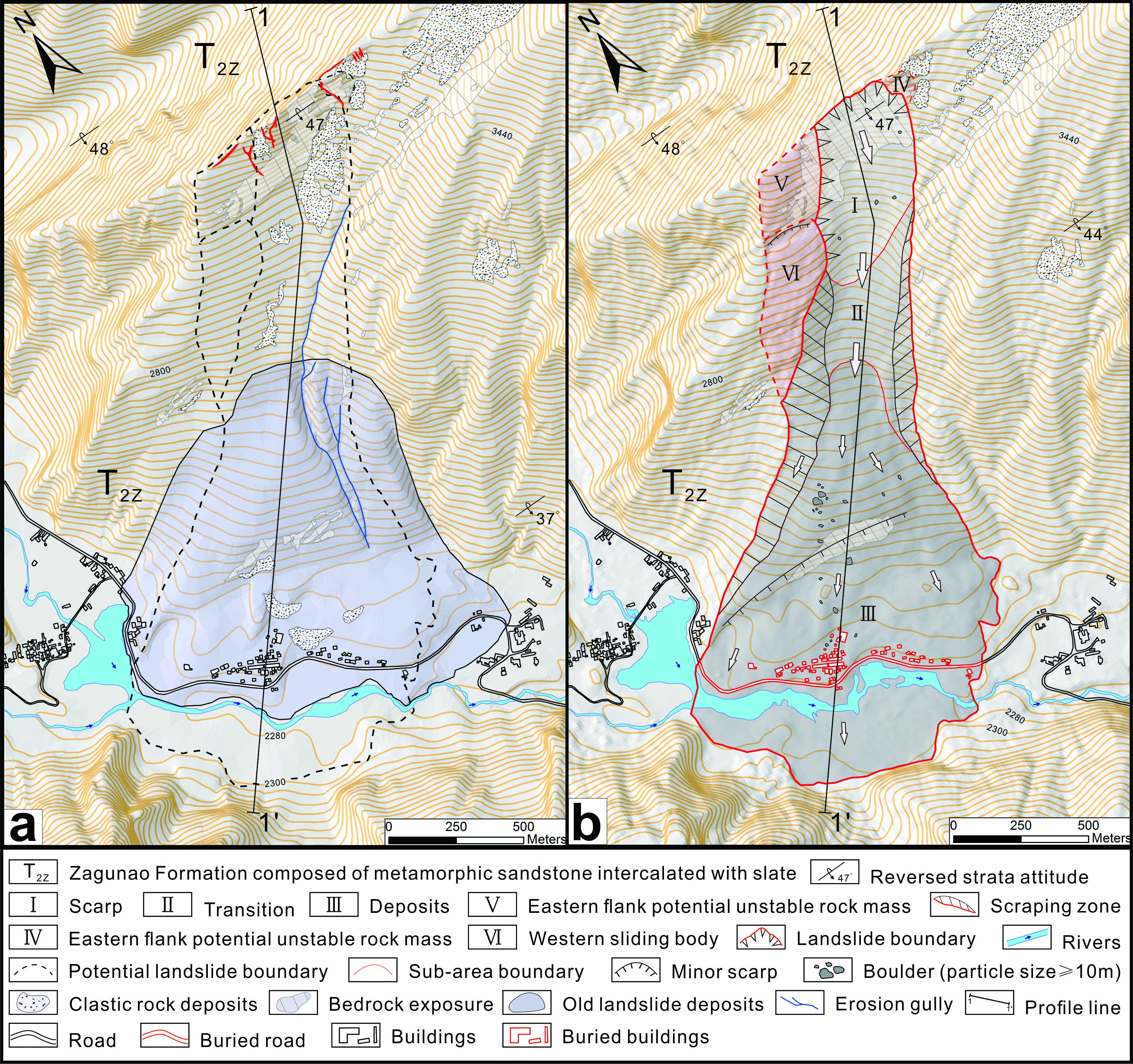
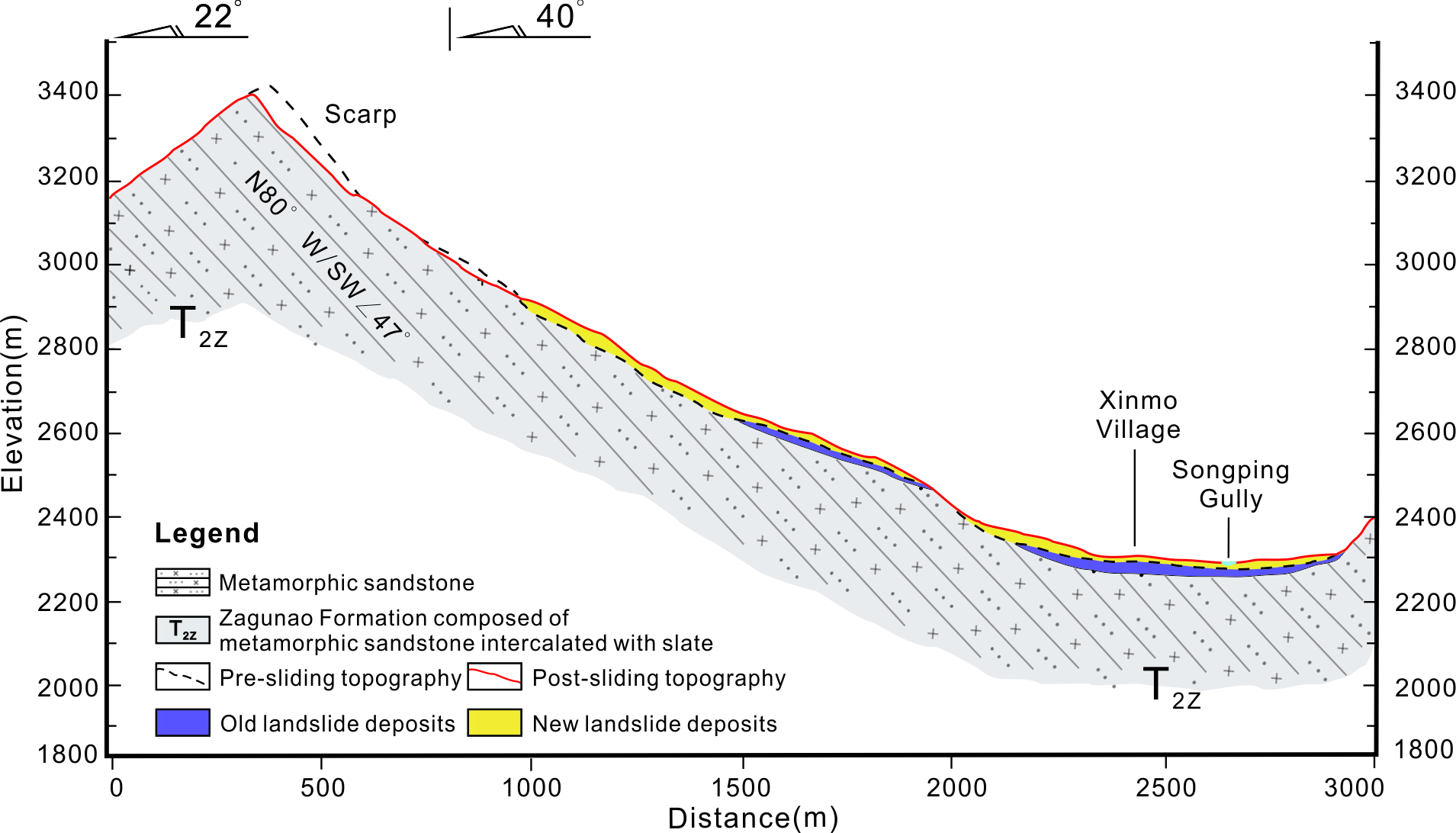
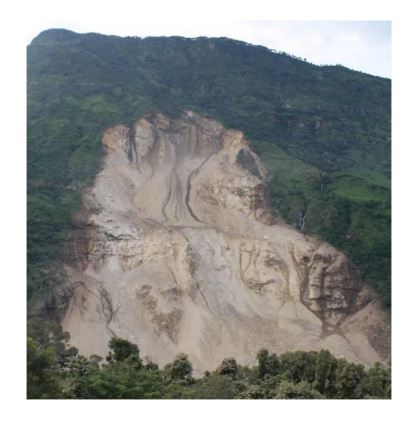
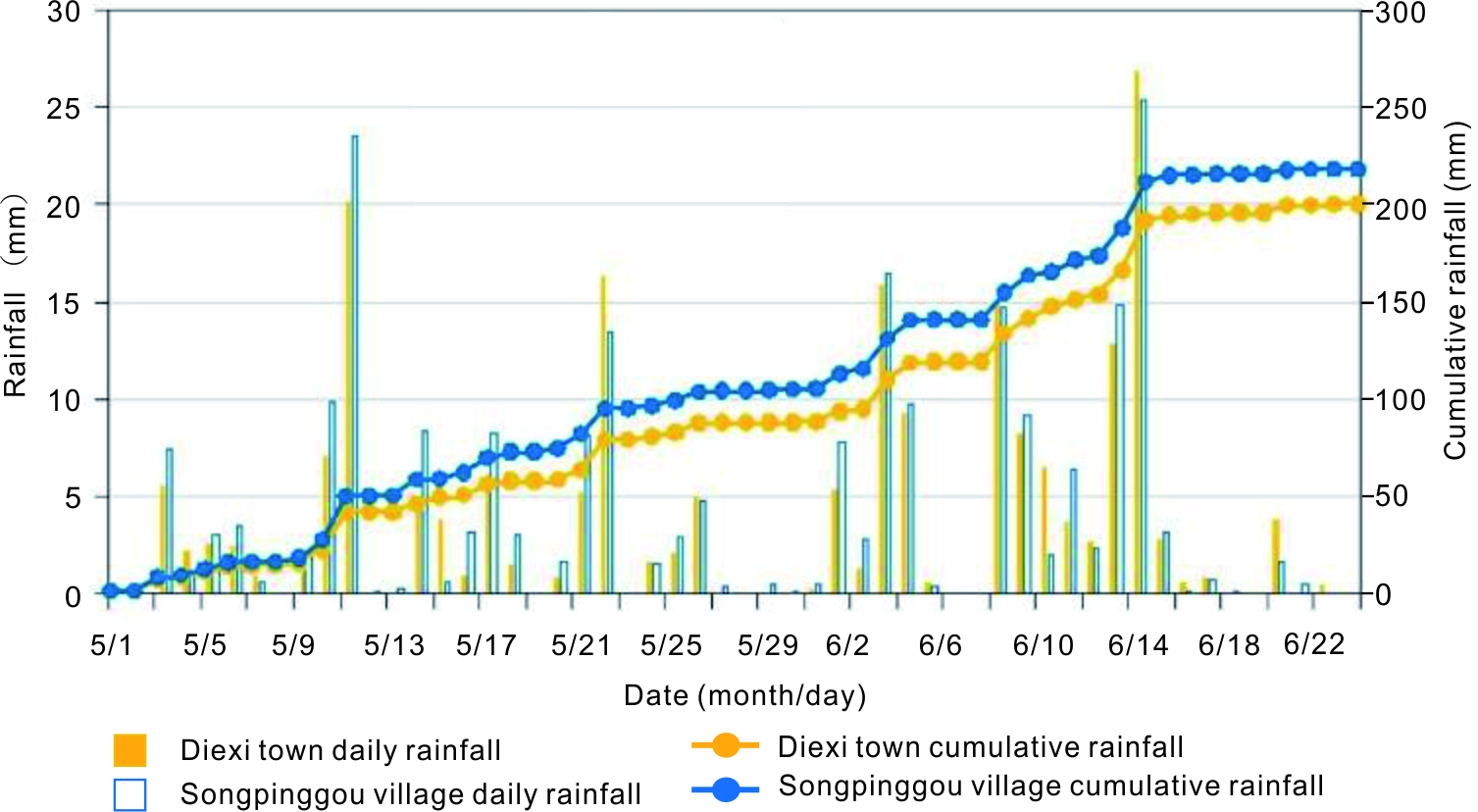
The Xinmo rock avalanche occurred at 5:38 AM on the 24th June, 2017, destroyed the whole village of Xinmo, in Maoxian County, Sichuan Province, China. About 4.3 million m3 of rock detached from the crest of the mountain, gained momentum along a steep hillslope, entrained a large amount of pre-existing deposits, and hit the village at a velocity of 250 km/h. The impact produced a seismic shaking of ML = 2.3 magnitude. The sliding mass dammed the Songping gully with an accumulation body of 13 million m3. The avalanche buried 64 houses; 10 people were killed and 73 were reported missing. Source: Fan, X., Xu, Q., Scaringi, G. et al. Landslides (2017) 14: 2129. https://doi.org/10.1007/s10346-017-0907-7

Toro Village

LCI : NGA1711131326
Main Information
Landslide Name : Toro Village
Latitude : 1:44:25 N
Longitude : 30:46:2 E
Location
City / District : Toro
Province : Orientale
Country : Congo, the Democratic Republic of the
Reporter
Reporter 1 : Ogbonnaya Igwe
Reporter 2 :
Landslide Type
Material : Earth
Movement : Flow
Velocity (mm/sec) : Rapid
Depth (m) : Deep-Moderate
Slope (degree) : Moderate
Volume (m³) : Large
Date of Occurence
Date of Occurence : Aug 17, 2017
Other Information
Land Use Source area : Forest, Farming
Run-out/deposition area : Farming, Sea/lake
Other Activity : -
Triggering Factor : Rainfall
Death(s) & Missing : 50
Houses and other structural damage : -
Photo of landslide : -
Google earth kmz file : -
Plan of landslide : -
Cross section of landslide : -
Reference (paper/report) : -
Testing graph : -
Monitoring graph : -
Video of moving landslides including 3D simulation : -
Description :

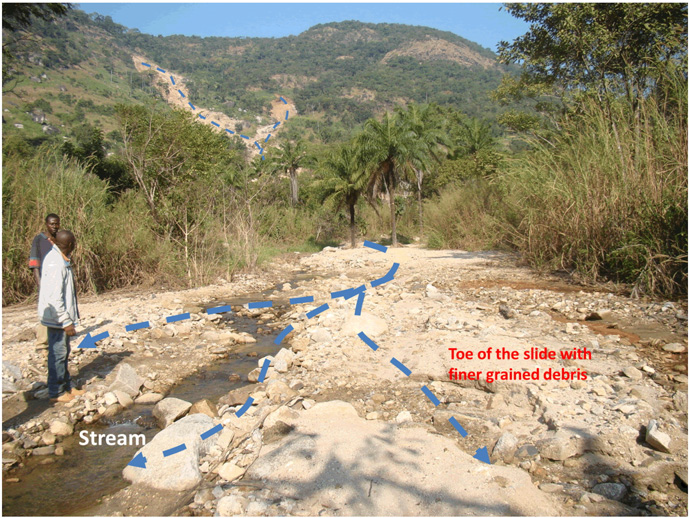
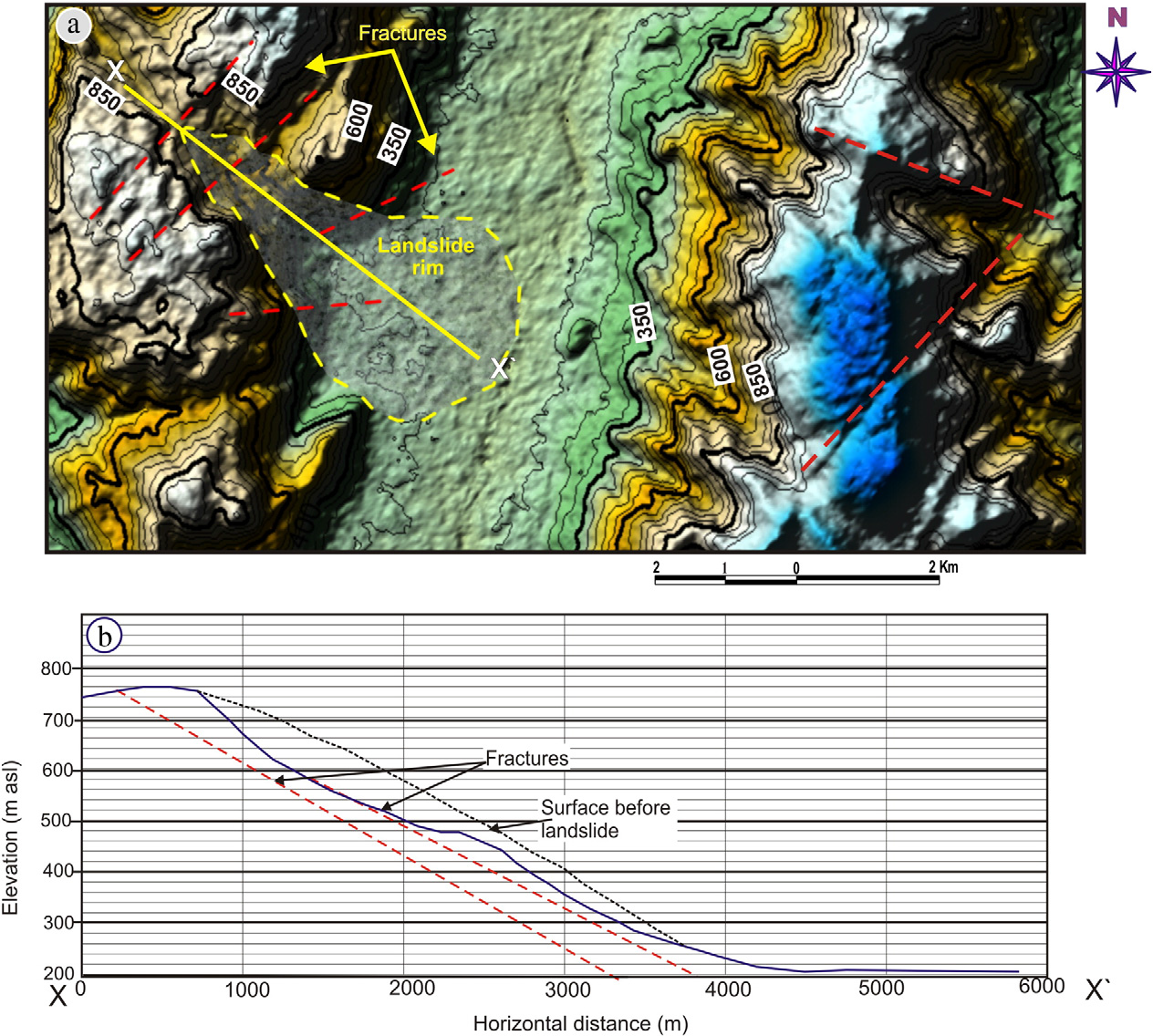
The Congo DR landslide of August 16, 2017, occurred at the Toro Village on the Western Bank of Lake Albert. Lake Albert is an elongated lake formed within the rift structures of the Western or Albertine branch of the East African Rift Valley System. The rift valley which is filled by Lake Albert is an asymmetric half-graben with the main fault on the western side of the Lake dipping to the east (Chorowicz, 2005). This fault is manifested as a 2200m high scrap which slopes down directly to the lake. The rifted rocks are Precambrian Basement Rocks of the Tanzanian Craton overlain by Neogene to recent volcanic rocks .

Regent Hill Landslide

LCI : NGA1711131322
Main Information
Landslide Name : Regent Hill Landslide
Latitude : 8:26:0 N
Longitude : 13:13:18 W
Location
City / District : Freetown
Province : Western Area
Country : Sierra Leone
Reporter
Reporter 1 : Ogbonnaya Igwe
Reporter 2 :
Landslide Type
Material : Earth
Movement : Flow
Velocity (mm/sec) : Rapid
Depth (m) : Moderate-Shallow
Slope (degree) : Steep
Volume (m³) : Large
Date of Occurence
Date of Occurence : Aug 14, 2017
Other Information
Land Use Source area : Forest, River
Run-out/deposition area : Urban area
Other Activity : -
Triggering Factor : Rainfall
Death(s) & Missing : 1000
Houses and other structural damage : Extensive
Photo of landslide : -
Google earth kmz file : 2017 Sierra Leone mudslides.kmz
Plan of landslide : -
Cross section of landslide : -
Reference (paper/report) : -
Testing graph : -
Monitoring graph : -
Video of moving landslides including 3D simulation : -
Description :

The Sierra Leone mudslide of August 14, 2017, took place in the Regent area of Freetown on the steep slopes of Mount Sugar Loaf. Sugar Loaf forms a part of extensive and forested highlands south of the the city. The city of Freetown and its suburbs have grown in recent times to almost encircle this roughly elliptical highland region. Intruding these rocks are isolated basic intrusives of Triassic to Early Jurassic age. The most prominent of this is the Freetown Layered complex which forms the extensive highlands which Freetown surrounds and which Mount Sugar Loaf is a part of. The Freetown layered complex consists of troctolitic gabbro and anorthositic rocks dated 193 Ma. This intrusion formed part of the basic volcanism associated with the initial rifting stage of the opening of the Atlantic Ocean. The hills of the Freetown Layered Complex show major NE-SW and minor NW-SE trending lineaments. These lineaments are most likes fracture zones within the rocks of the Freetown complex. The lineaments clearly control the drainage and the erosion of the hills in the region. One of these structurally controlled NE-SW streams cuts through the Regent area where the mudslide occurred.

Kwande Landslide

LCI : NGA1711131256
Main Information
Landslide Name : Kwande Landslide
Latitude : 6:37:57 N
Longitude : 9:37:20 E
Location
City / District : Kwande
Province : Benue
Country : Nigeria
Reporter
Reporter 1 : Ogbonnaya Igwe
Reporter 2 :
Landslide Type
Material : Debris
Movement : Slide
Velocity (mm/sec) : Extremely Rapid
Depth (m) : Moderate-Shallow
Slope (degree) : -
Volume (m³) : Large
Date of Occurence
Date of Occurence : Oct 27, 2010
Other Information
Land Use Source area : Forest, Farming, Pasture
Run-out/deposition area : Forest, Farming, Pasture
Other Activity : Unknown
Triggering Factor : Rainfall
Death(s) & Missing : 3
Houses and other structural damage : -
Photo of landslide :
Google earth kmz file : Kwande.kmz
Plan of landslide :
Cross section of landslide : -
Reference (paper/report) : http://dx.doi.org/10.1016/j.geomorph.2014.12.040
Testing graph : -
Monitoring graph : -
Video of moving landslides including 3D simulation : -
Description :

Rock-debris Avalanche that occurred on in the Bamenda massif area on the Nigeria-Cameroon Border. The slide occurred on steep hillslopes with a thin veneer of clay-rich soils weathered from Precambrian Basement migmatites, gneisses and granites, forming a complex of mud and rock boulder debris. The slide occurred after an extended period of heavy rainfall in the area. It led to the loss of 3 lives as well as substantial damage to surrounding farmland and pastureland.

Gírová landslide (Tentative)

LCI : CZE1612131317
Main Information
Landslide Name : Gírová landslide (Tentative)
Latitude : 49:31:51.69 N
Longitude : 18:47:30.43 E
Location
City / District : Outer West Carpathians
Province : Mosty u Jablunkova
Country : Czech Republic
Reporter
Reporter 1 : Ha Nguyen Duc (Under request)
Reporter 2 : Ivo Baroň
Landslide Type
Material : Debris, Earth
Movement : Slide
Velocity (mm/sec) : -
Depth (m) : Deep-Moderate
Slope (degree) : Steep
Volume (m³) : Large
Date of Occurence
Date of Occurence : May 19, 2010
Other Information
Land Use Source area : Forest
Run-out/deposition area : Forest
Other Activity : -
Triggering Factor : Rainfall
Death(s) & Missing : -
Houses and other structural damage : -
Photo of landslide :
Google earth kmz file : Girova landslide.kmz
Plan of landslide : -
Cross section of landslide :
Reference (paper/report) : http://link.springer.com/article/10.1007/s10346-011-0255-y
Testing graph : -
Monitoring graph : -
Video of moving landslides including 3D simulation : -
Description :

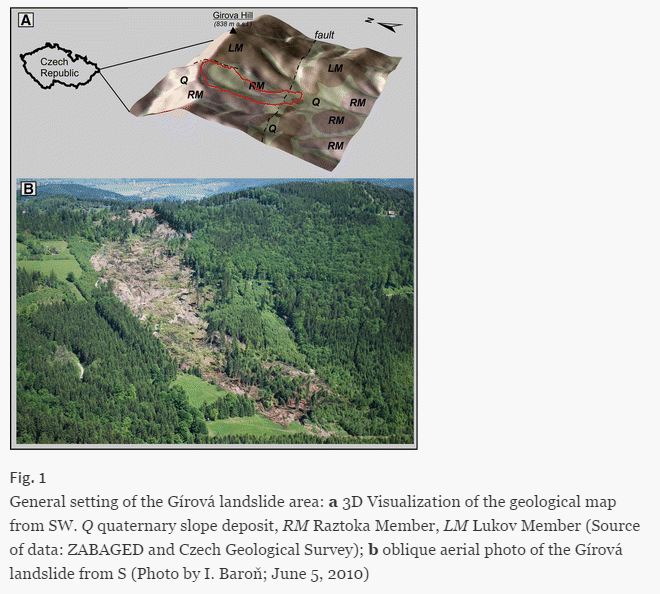
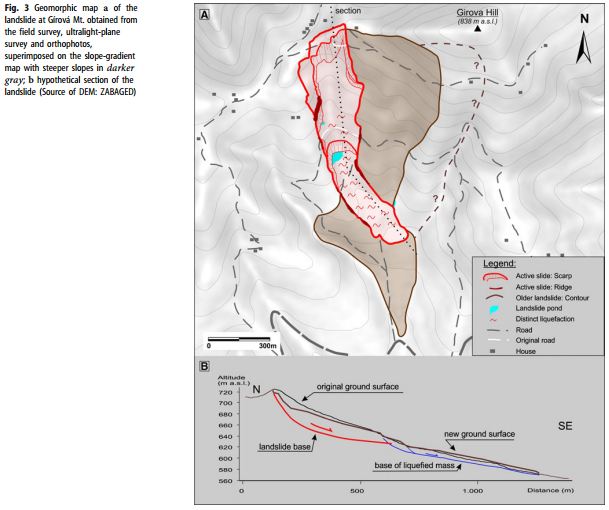
In the early morning on May 19, 2010, a large deep-seated landslide occurred at Gírová Mountain, Outer West Carpathians, Czech Republic. The area where this landslide happens is the region of pre-existing deep-seated gravitational deformation. The size of the landslide is approximately 1060 meters long and 200 meters wide. The thickness of the landslide ranges from around 10 meters in the lower part to around 30 meters in the upper area. The entire sliding mass has a volume of roughly 2.8 million cubic meters and the estimated displacement varies from about 75 meters to 253 meters. No-one was injured and no properties were damaged. The precipitation fell from May 15th to 18th (few hours before the initiation of the landslide) is considered as the main factor inducing the landslide. The total amount of the rainfall was 244.6 mm with the maximum daily precipitation was 115.1 mm and the minimum daily precipitation was 12.4 mm. The Gírová landslide is a good case study on inducing factors and process of liquefaction at mountain slopes. This case study also confirms the theory that large active landslide often progresses inside existing unstable regions. This report referred the research in the paper: Ivo Baroň,Tomáš Řehánek, Jiří Vošmik, Vítězslav Musel, Lucie Kondrová (2011) Report on a recent deep-seated landslide at Gírová Mt., Czech Republic, triggered by a heavy rainfall: The Gírová Mt., Outer West Carpathians; Czech Republic. Landslides 8:355–361

Juan Grijalva

LCI : MEX1612071200
Main Information
Landslide Name : Juan Grijalva
Latitude : 17:22:12.97 N
Longitude : 93:22:52.77 E
Location
City / District : Ostuacan
Province : Chiapas
Country : Mexico
Reporter
Reporter 1 : VICTOR MANUEL HERNANDEZ-MADRIGAL
Reporter 2 : Juan Carlos Mora-Chaparro
Landslide Type
Material : Rock
Movement : Slide, Complex
Velocity (mm/sec) : Very Rapid
Depth (m) : Deep-Moderate
Slope (degree) : Gentle
Volume (m³) : Very Large
Date of Occurence
Date of Occurence : Nov 04, 2007
Other Information
Land Use Source area : Forest, Pasture
Run-out/deposition area : Forest, Pasture, River
Other Activity : Unknown
Triggering Factor : Human activity and rainfall
Death(s) & Missing : 16
Houses and other structural damage : 12 houses
Photo of landslide :
Google earth kmz file : Juan Grijalva landslide.kmz
Plan of landslide :
Cross section of landslide :
Reference (paper/report) : http://rd.springer.com/article/10.1007/s10346-010-0212-1#enumeration
Testing graph : -
Monitoring graph : -
Video of moving landslides including 3D simulation : -
Description :

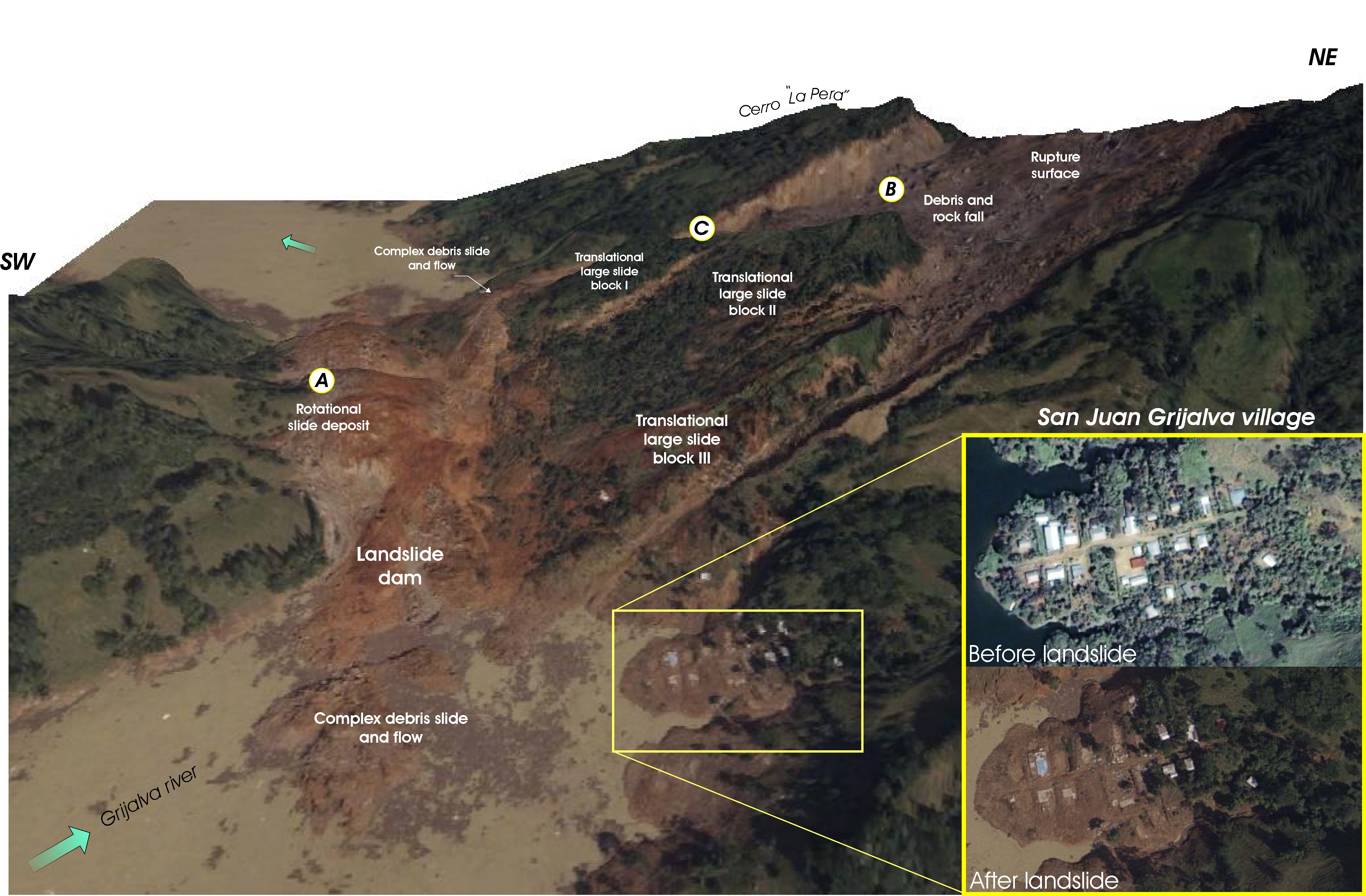
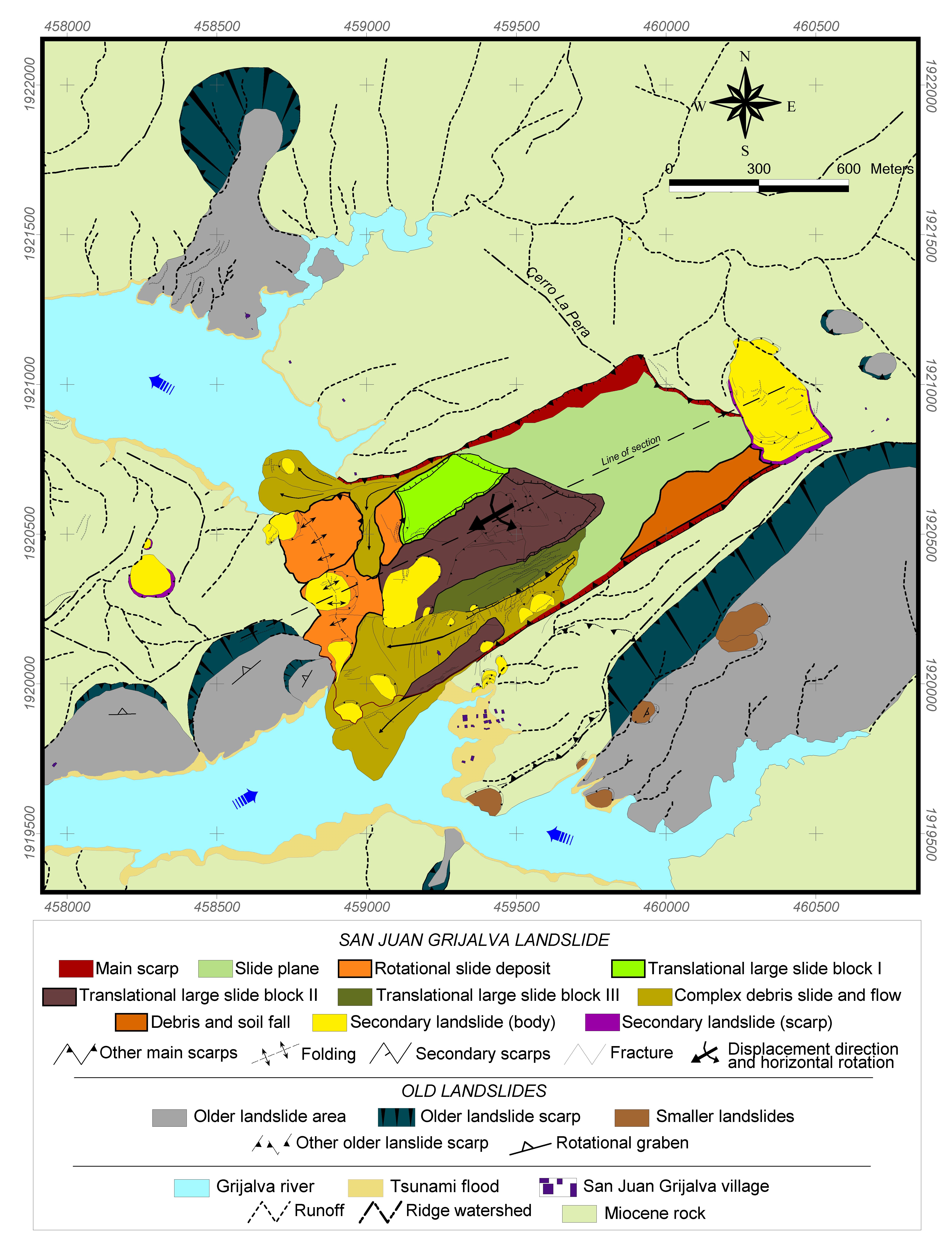
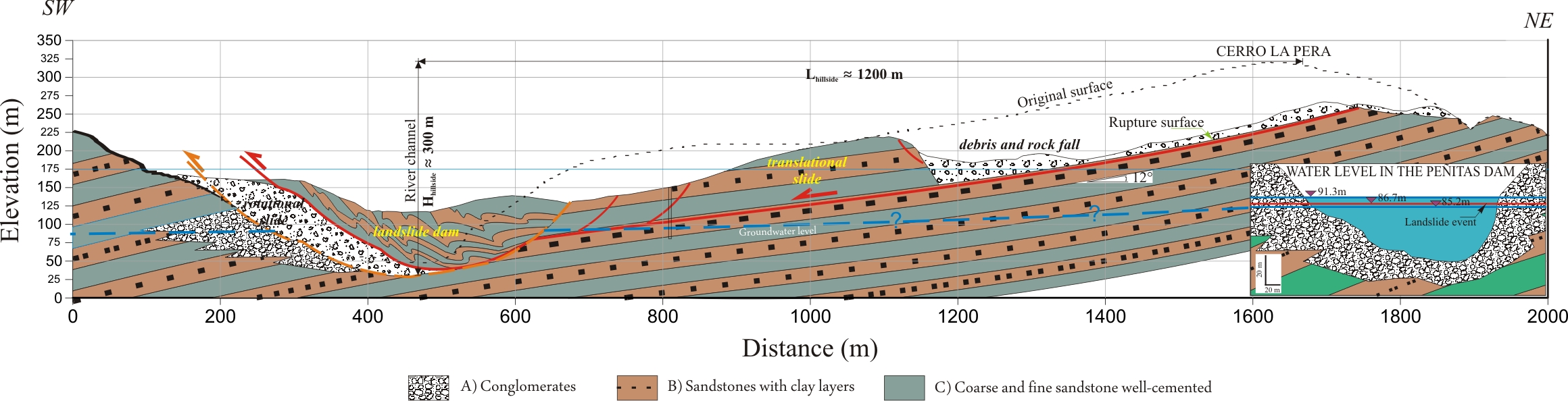
A large block slide occurred on the south face of the Cerro La Pera, in the locality of Juan Grijalva (JG), municipality of Ostuacan, northwest Chiapas (Mexico). The JG landslide (1.11 km2 / 50 Mm3) created a dam over 80 m high and 1,170 m wide across the Grijalva River (the second largest river in Mexico), backing up the water and forming a 49 km2 lake. Landslide-generated tsunamis up to 15 m high destroyed the village of JG and killed 16 people. The newly formed lake flooded 21 villages located upstream and around 3,600 people to be evacuated with incalculable economic losses. Further, the probable dam-landslide collapse put at risk the Peñitas dam and the city of Villa Hermosa (Tabasco) located downstream 14 km and 120 km, respectively. It was perhaps the most catastrophic landslide in the history of Mexico. The probable trigger of the landslide was cumulative precipitation of about 67% of the average annual rainfall over the preceding 30 days, and a water-level drawdown at the Grijalva River generated by the release of water from the Peñitas dam. After works carried out by the Comisión Federal de Electricidad to join the river and stabilize the slope, the landslide is motionless.

Sunkoshi landslide

LCI : NPL1612061032
Main Information
Landslide Name : Sunkoshi landslide
Latitude : 27:46:14.64 N
Longitude : 85:52:6.48 E
Location
City / District : Sindhupalchok
Province : Sindhupalchok
Country : Nepal
Reporter
Reporter 1 : Pham Tien
Reporter 2 :
Landslide Type
Material : Rock, Complex
Movement : Slide
Velocity (mm/sec) : Extremely Rapid
Depth (m) : Deep-Moderate
Slope (degree) : -
Volume (m³) : Large
Date of Occurence
Date of Occurence : Aug 02, 2014
Other Information
Land Use Source area : Forest, Human settlement
Run-out/deposition area : Road, River
Other Activity : Active in the past
Triggering Factor : Rainfall
Death(s) & Missing : 156
Houses and other structural damage : Sunkoshi hydropower dam , highway
Photo of landslide :
Google earth kmz file : Sunkoshi landslide.kmz
Plan of landslide :
Cross section of landslide : -
Reference (paper/report) : Report on Jure Landslide, Mankha VDC, Sindhupalchowk District, Nepal Government Ministry of Irrigation, August 24, 2014, 29 pages in English. Available at http://www.sabo-int.org/case/2014_aug_nepal.pdf and A report by DpNET. Available at http://dpnet.org.np/docs/reportManagement/c1177e6cb4970cf8b32f2a789a05d67c.pdf
Testing graph : -
Monitoring graph : -
Video of moving landslides including 3D simulation : -
Description :

The Jure landslide or the Sunkoshi landslide, a deep-seated catastrophic landslide was triggered by a heavy rainfall at 02:36 AM on Saturday morning, 2 August 2014 in Jure Village, Sindhupalchowk District, Nepal. The huge landslide claimed 156 people, caused a seriously damages to tens of house. The landslide created a rapidly massive wave of about 100 meter towards the opposite bank of the river, which destroyed the forest area on the left bank of Sunkoshi River with a height of 100 m. The landslide velocity was estimated from 60 to 70m per second and it completely dammed the river within about 2 – 3 minutes. The catastrophic landslide also resulted in a local quake of 3.3 magnitudes. In addition, the large volume of debris about 7.4 million cubic meters blocked the Sunkoshi River and created a dam that is about 3 km long, 300 to 350 m width and 46.7 m depth. The deposited materials damaged the two gates of the Sunkoshi hydropower dam by the pressurized surging of the mud and debris. The outburst discharge and the dam breach took place on 7 September 2014. Sources: – Report on Jure Landslide, Mankha VDC, Sindhupalchowk District, Nepal Government Ministry of Irrigation, August 24, 2014, 29 pages in English. Available at http://www.sabo-int.org/case/2014_aug_nepal.pdf . – A report by Disaster Preparedness Network Nepal (DPNet Nepal). Available at http://dpnet.org.np/docs/reportManagement/c1177e6cb4970cf8b32f2a789a05d67c.pdf

Slano Blato Landslide

LCI : SVN201612061910
Main Information
Landslide Name : Slano Blato Landslide
Latitude : 45:54:0 N
Longitude : 13:51:0 E
Location
City / District : Stomaz
Province : Ajdovscina
Country : Slovenia
Reporter
Reporter 1 : Khang Dang
Reporter 2 : Boštjan Pulko
Landslide Type
Material : Debris, Earth
Movement : Flow
Velocity (mm/sec) : Moderate
Depth (m) : Moderate-Shallow
Slope (degree) : -
Volume (m³) : Large-Moderate
Date of Occurence
Date of Occurence : May 01, 1887
Other Information
Land Use Source area : Forest
Run-out/deposition area : Road
Other Activity : Active in the past
Triggering Factor : Rainfall
Death(s) & Missing : -
Houses and other structural damage : main road
Photo of landslide :
Google earth kmz file : Slano Blato Landslide.kmz
Plan of landslide : -
Cross section of landslide :
Reference (paper/report) : http://link.springer.com/article/10.1007/s10346-012-0372-2
Testing graph : -
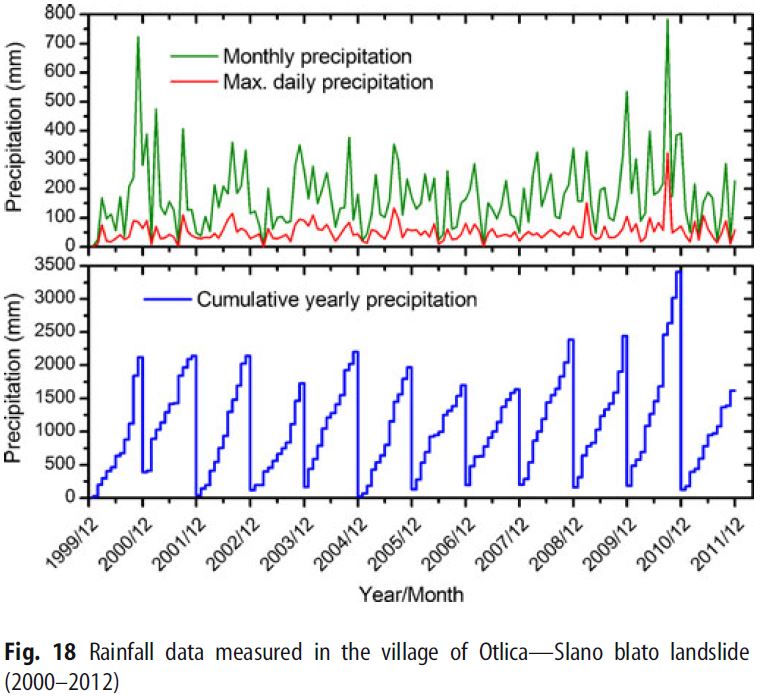
Monitoring graph : Rainfall Data-Otlica-Slano blato landslide 2002-2012.JPG
Video of moving landslides including 3D simulation : -
Description :

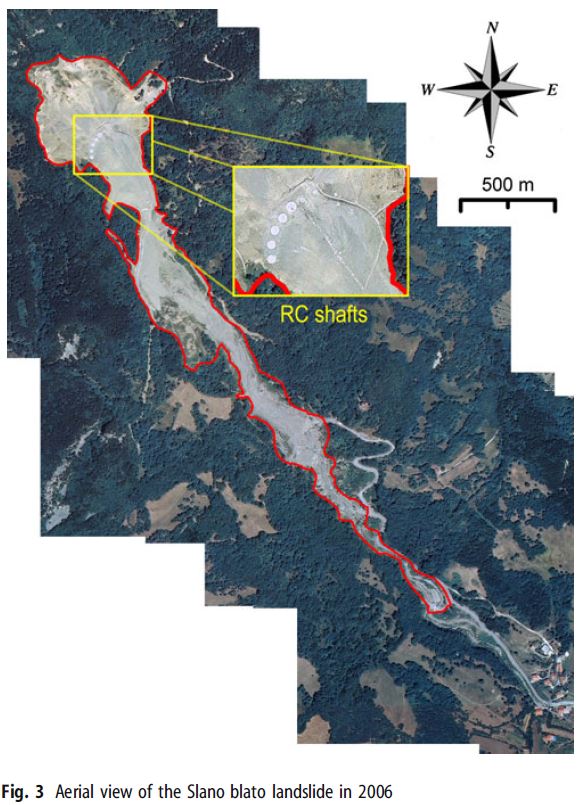
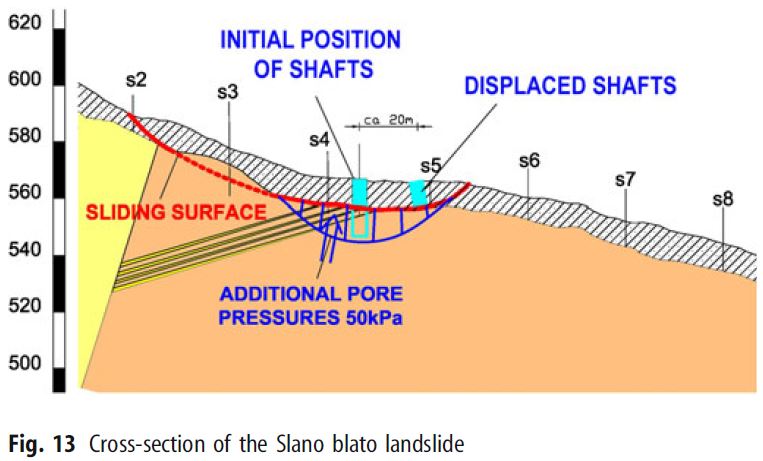
Slano blato landslide is located at 45°54? N 13°51? E in the Eocene flysch region of western Slovenia. The landslide was first mentioned in 1887 with the occurrence of an earth flow destroying the main road in the valley about 2 km away. The landslide was thereafter remediated with a series of torrential check dams along the Grajš?ek stream. The landslide remained stable till November 2000, when during heavy rainfall, a large landslide of mud and debris was triggered, moved along the Grajš?ek stream at a speed of up to 100 m/day and threatened the village of Lokavec situated in the valley below. The landslide is about 1,600 m long, 60 to 250 m wide, with a total sliding mass of about 900,000 m3 located between 270 and 650 m asl. In 2001 and 2002, approximately 230,000 m3 of accumulated debris material were removed from the area of a rockfill dam that was built about 300 m above the village as a part of protection measures, followed by surface and subsurface drainage works and a construction of three RC shafts/wells in 2004, with gradual construction of additional eight RC shafts that were completed in 2007. The landslides is long and relatively shallow with variable slope inclination. Source: Pulko, B., Majes, B. & Mikoš, M. Reinforced concrete shafts for the structural mitigation of large deep-seated landslides: an experience from the Macesnik and the Slano blato landslides (Slovenia). Landslides (2014) 11: 81. doi:10.1007/s10346-012-0372-2