

Bosmatto landslide

LCI : ITA2006221100
Main Information
Landslide Name : Bosmatto landslide
Latitude : 45:45:40.22 N
Longitude : 7:51:7.87 E
Location
City / District : Gressoney-Saint-Jean
Province : Aosta
Country : Italy
Reporter
Reporter 1 : Tommaso Carlà
Reporter 2 : Veronica Tofani
Landslide Type
Material : Rock
Movement : Slide
Velocity (mm/sec) : Very Slow
Depth (m) : Deep-Moderate
Slope (degree) : Steep
Volume (m³) : Large
Date of Occurence
Date of Occurence : Jan 01, 1970
Other Information
Land Use Source area : Forest, Wildland
Run-out/deposition area : Urban area, Road
Other Activity : Currently active
Triggering Factor : Rainfall
Death(s) & Missing : -
Houses and other structural damage : Widespread damage to buildings and infrastructures in October 2000 after a part of the landslide material was mobilized as a debris flow
Photo of landslide :
Google earth kmz file : Bosmatto landslide.kmz
Plan of landslide :
Cross section of landslide :
Reference (paper/report) : https://www.sciencedirect.com/science/article/pii/S0169555X19301084?viaihub
Testing graph : -
Monitoring graph : Sat_desc.png
Video of moving landslides including 3D simulation : -
Description :

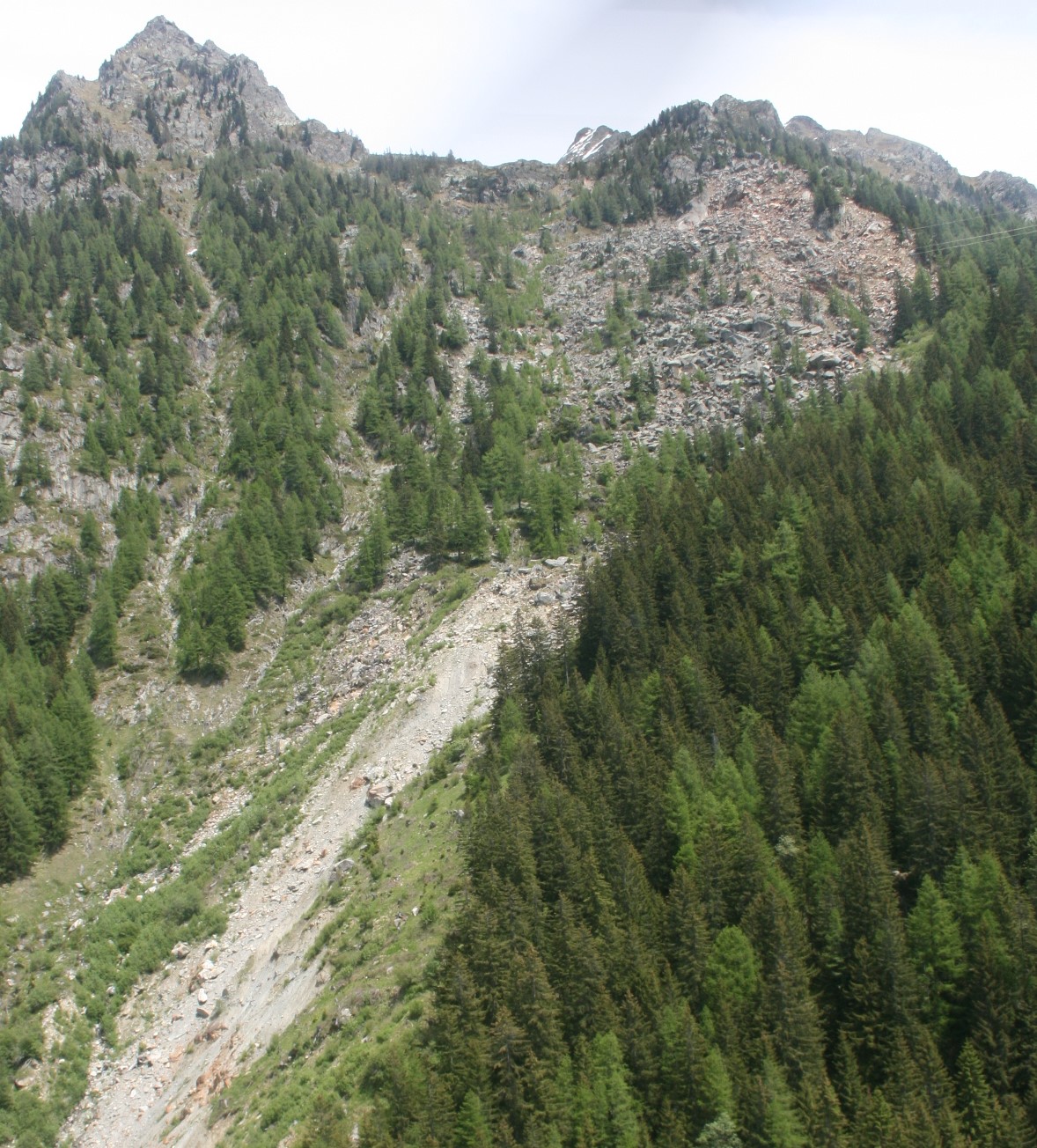
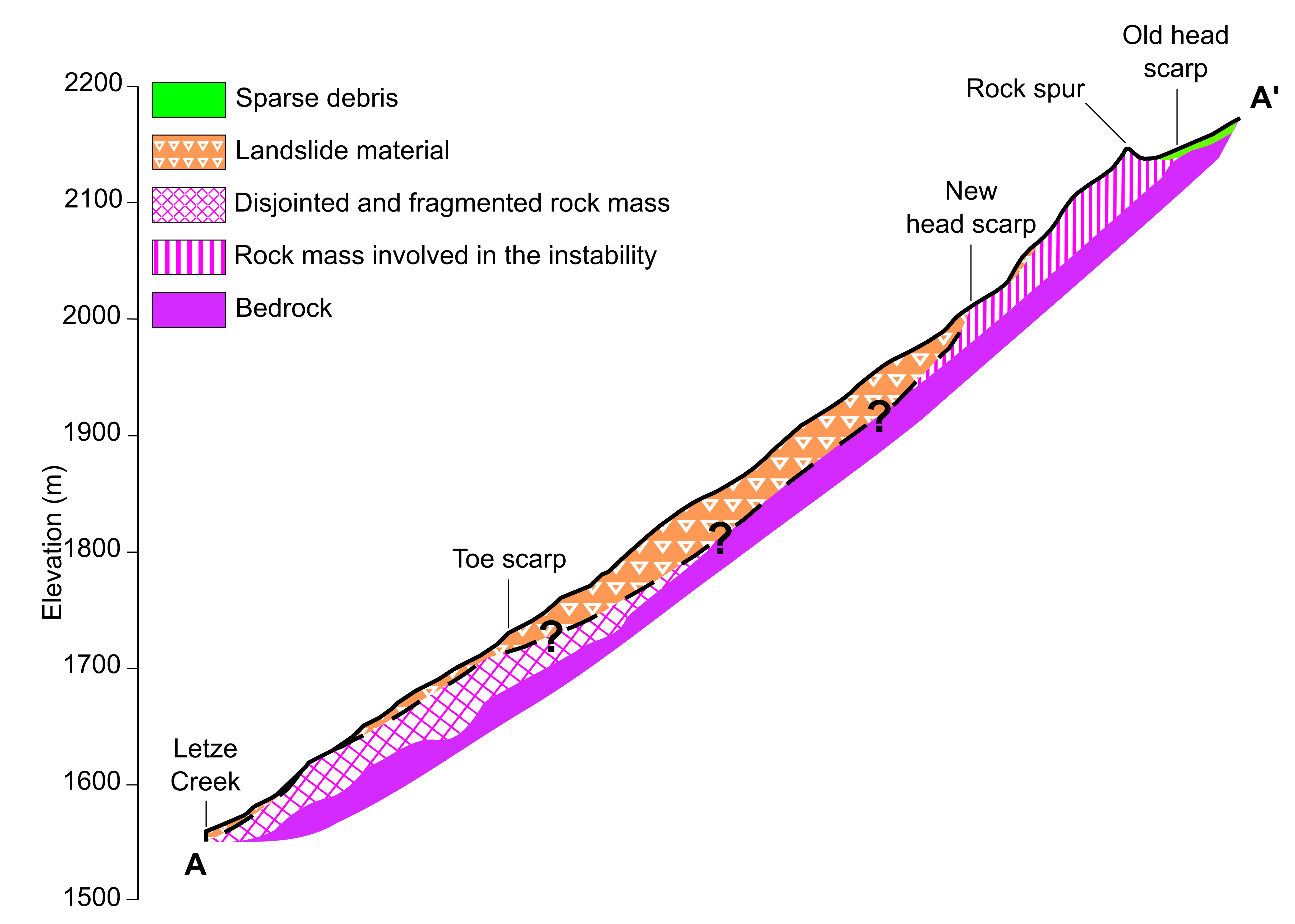
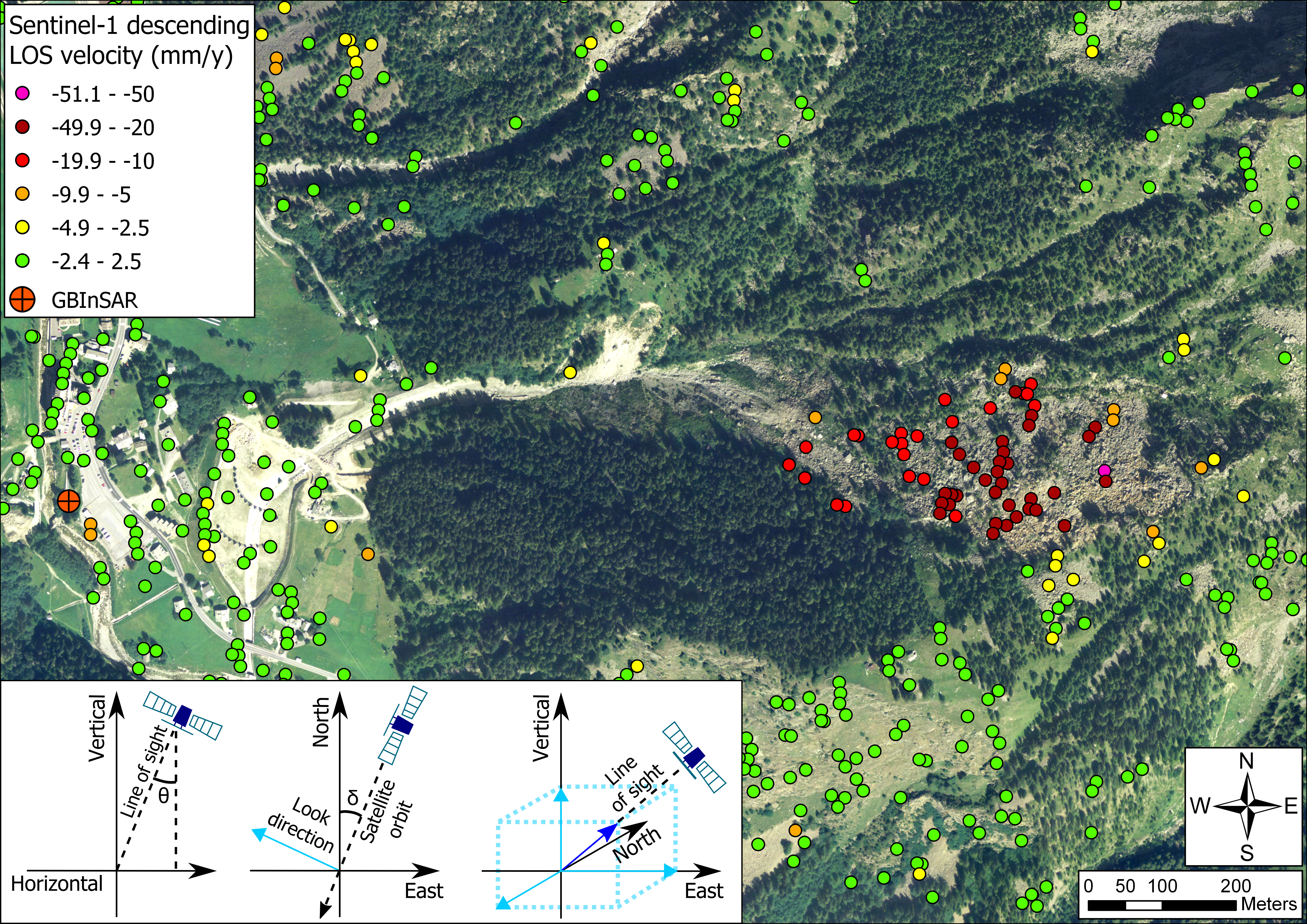
The Bosmatto landslide is an ancient, large instability in a steep (30° to 40°) West-facing slope in the Northwestern Alps, overhanging the roughly N-S trending glacial Lys Valley above the village of Gressoney Saint-Jean (Aosta Valley, Italy). The slope is split in two sectors with different state of activity: the southern inactive sector is completely vegetated by a dense high forest; the northern active sector (the one meant here as the “Bosmatto landslide”), extending longitudinally for at least 500 m and with a maximum width of approximately 300 m, lacks vegetation cover and appears as a highly chaotic mass of large disjointed blocks and fragments of metamorphic bedrock within a scarce sandy to gravelly matrix. Relatively coherent portions of rock mass are also present within the main body. The lower part of the slope is undercut by the deeply incised bed of the Letze Creek. In the head scarp area, and beyond the main landslide body up to an elevation of about 2300 m a.s.l., rocky outcrops are heavily fractured and show signs of possible deep-seated deformation. The transition from the toe of the landslide to the debris flow source area is outlined by a minor scarp at 1700 m a.s.l.. Below this point, five springs mark the point after which the Letze Creek has a perennial water flow, whereas water flow in the bed incisions upslope is intermittent or ephemeral. This hints at the presence of a complex water circulation system below the ground surface, possibly influencing the stability of the slope. A single borehole survey has been performed, in proximity of the minor scarp at 1700 m a.s.l. This indicated a 30-m thick layer of landslide material, separated from the bedrock by a roughly 10-m thick heavily deformed and brecciated zone with silty-sandy gauge layers that may act as a preferential plane of weakness.

Gallivaggio landslide

LCI : ITA2006221015
Main Information
Landslide Name : Gallivaggio landslide
Latitude : 46:21:46.40 N
Longitude : 9:22:7.75 E
Location
City / District : San Giacomo Filippo
Province : Sondrio
Country : Italy
Reporter
Reporter 1 : Tommaso Carlà
Reporter 2 : Veronica Tofani
Landslide Type
Material : Rock
Movement : Fall
Velocity (mm/sec) : Extremely Rapid
Depth (m) : Moderate-Shallow
Slope (degree) : -
Volume (m³) : Small
Date of Occurence
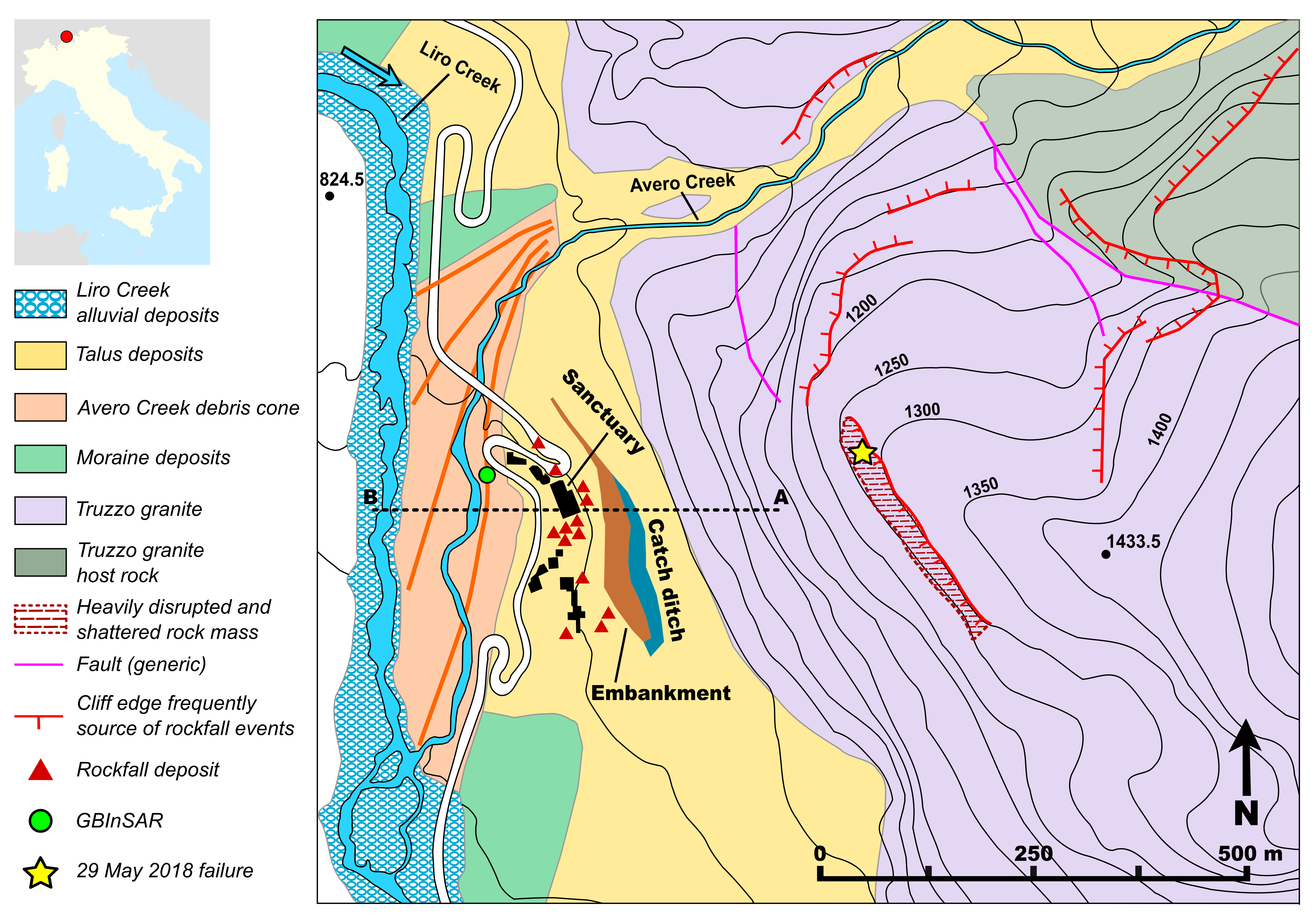
Date of Occurence : May 29, 2018
Other Information
Land Use Source area : Wildland
Run-out/deposition area : Road, Cultural heritage site
Other Activity : Active in the past
Triggering Factor : Others
Death(s) & Missing : None
Houses and other structural damage : Serious damages to several buildings and a road
Photo of landslide :
Google earth kmz file : Runout area.kmz
Plan of landslide :
Cross section of landslide :
Reference (paper/report) : https://link.springer.com/article/10.1007/s10346-019-01190-y
Testing graph : -
Monitoring graph : Spostamento (b).png
Video of moving landslides including 3D simulation : https://www.youtube.com/watch?v=orn-nhHDIkI
Description :

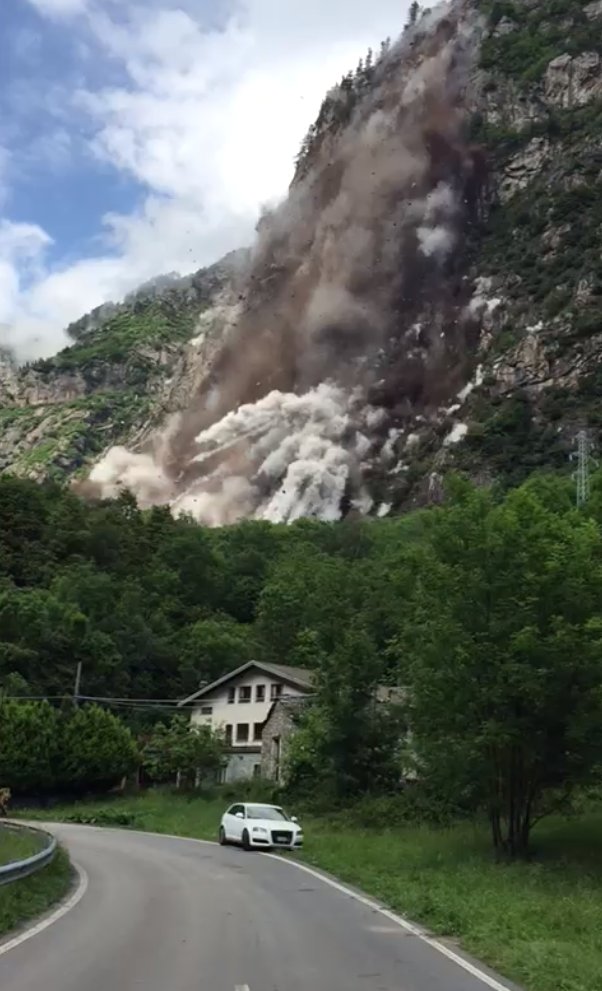
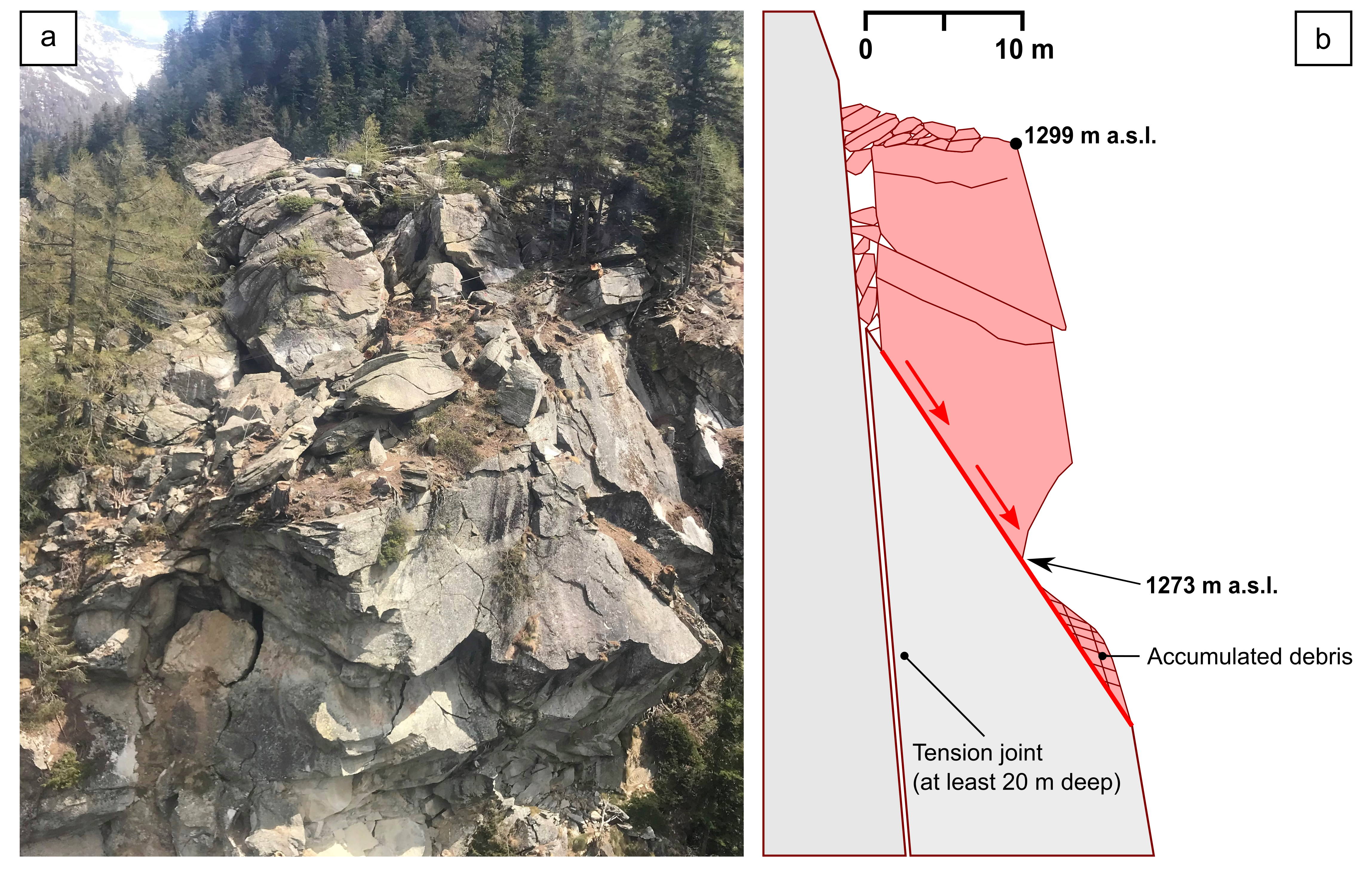
The failure originated at the top of the rock wall looming over the Gallivaggio sanctuary. Before the event, the instability appeared as a markedly disintegrated rock mass with very weak internal structure, lacking base support, and jutting out of the slope. Such an indentation could have derived from the previous detachment of other blocks, which left the overlying mass in precarious equilibrium. The size was 20–25 m in height, 21 m in width, and 8–11 m in thickness, yielding an estimated volume of ~ 5000 m^3. The geometry of the failure block was defined by a compound sliding plane. In particular, the main morphological features included the following: – a sub-vertical joint as rear release surface, penetrating at least 20 m into the slope and opening up to as much as 2 m in width; – a steeply dipping (55–60°) joint acting as basal release surface, over which the sliding movement predominantly occurred; – at the top of the mass, a chaotic pile of blocks and crushed debris indicating significant lowering of the ground surface. After final detachment and collapse, the falling mass crumbled in a myriad of smaller blocks and fragments, forming a huge cloud of dust and debris which ran over the valley floor.

Aranayaka Landslide

LCI : LKA201911261713
Main Information
Landslide Name : Aranayaka Landslide
Latitude : 7:9:19.22 N
Longitude : 80:25:50.06 E
Location
City / District : Kegalle
Province : Sabaragamuwa
Country : Sri Lanka
Reporter
Reporter 1 : Khang Dang
Reporter 2 :
Landslide Type
Material : Rock, Earth
Movement : Complex
Velocity (mm/sec) : Extremely Rapid
Depth (m) : Deep-Moderate
Slope (degree) : Steep
Volume (m³) : Large
Date of Occurence
Date of Occurence : May 17, 2016
Other Information
Land Use Source area : Forest, Farming
Run-out/deposition area : Human settlement, Road
Other Activity : Active in the past
Triggering Factor : Rainfall
Death(s) & Missing : 127
Houses and other structural damage : 75 houses
Photo of landslide :
Google earth kmz file : Aranayake Landslide.kmz
Plan of landslide :
Cross section of landslide :
Reference (paper/report) : https://link.springer.com/article/10.1007/s10346-018-1089-7
Testing graph :
Monitoring graph :
Video of moving landslides including 3D simulation : -
Description :

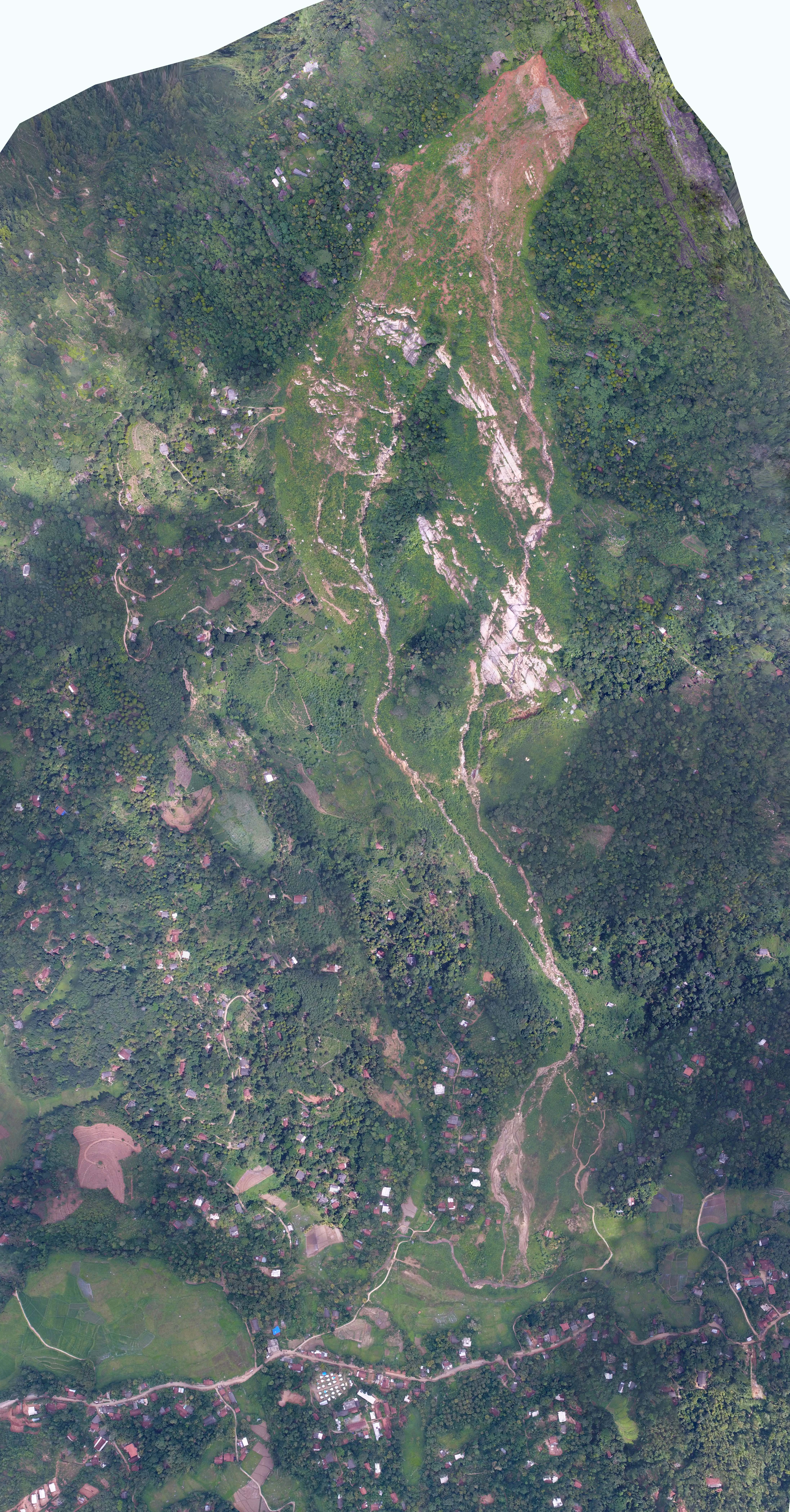
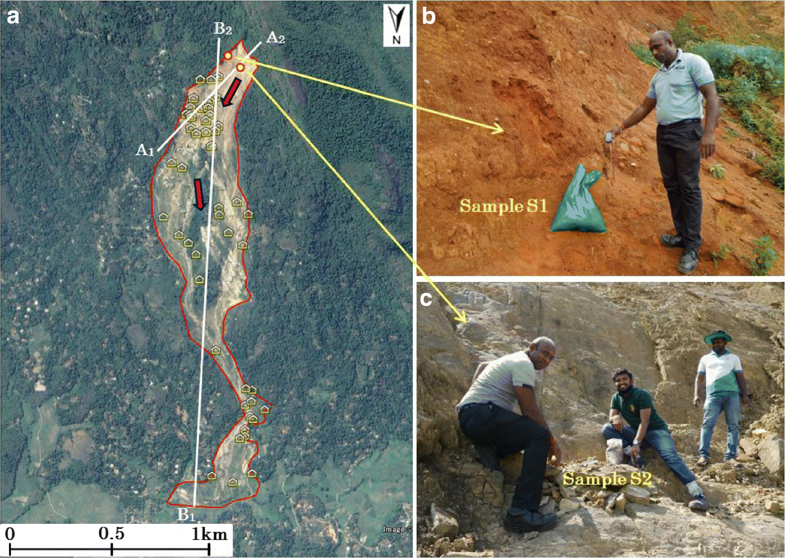
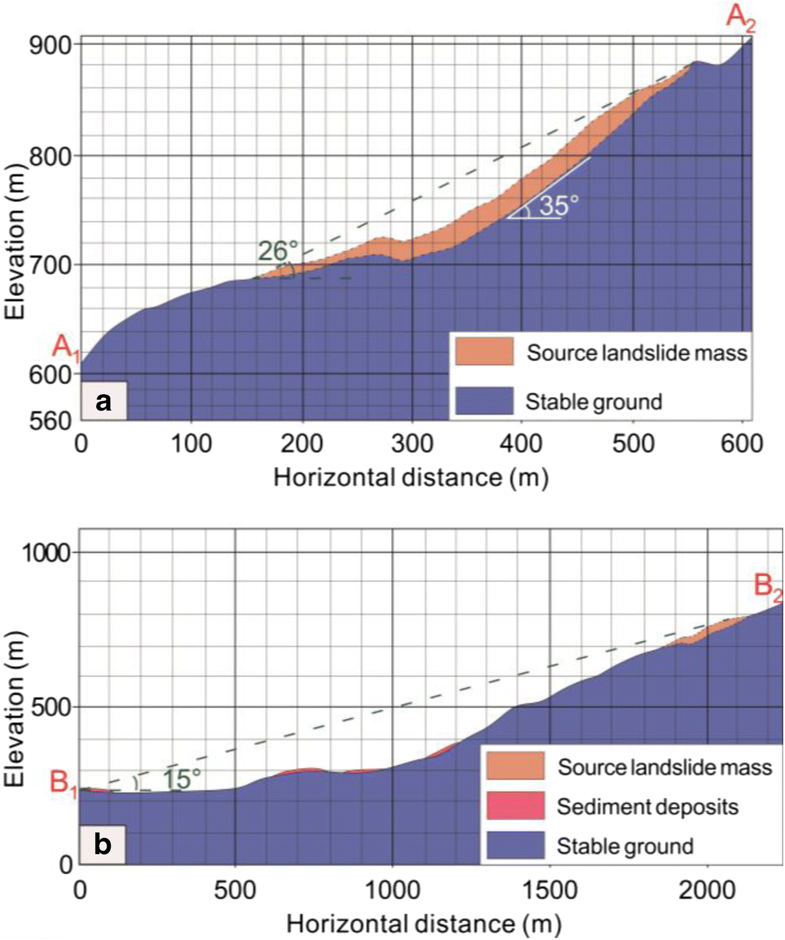
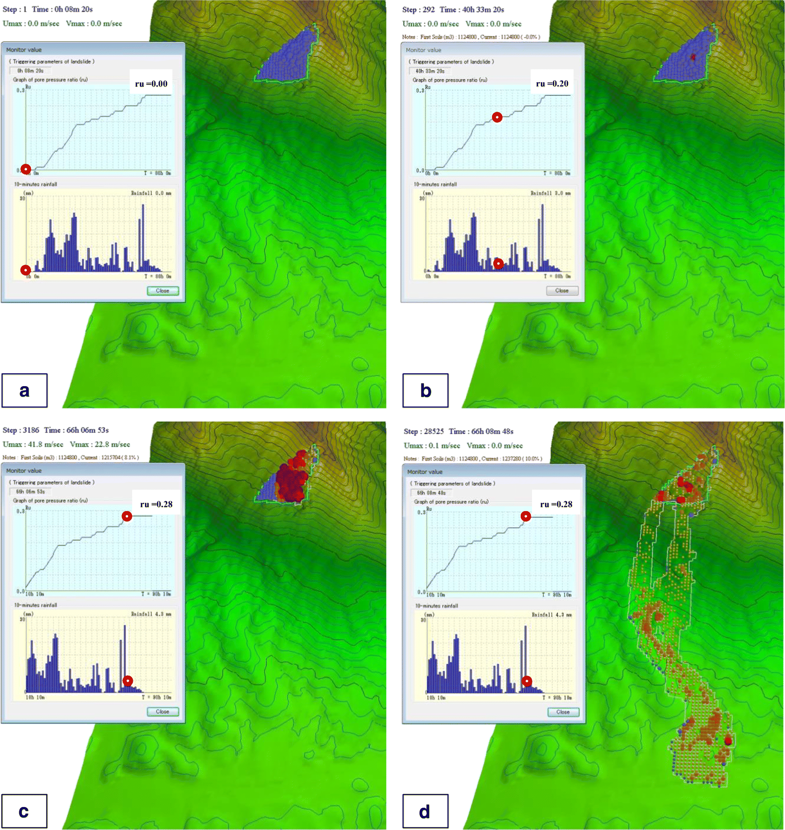
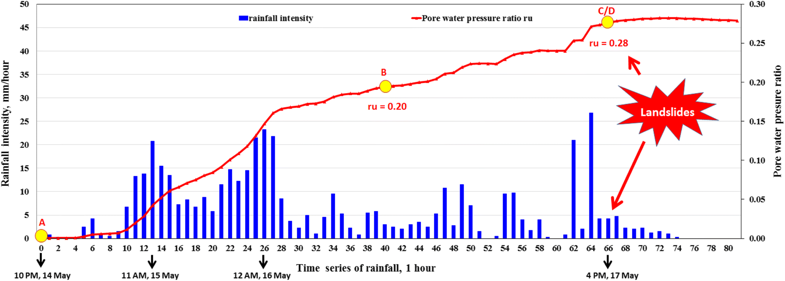
A rapid and long-traveling landslide was triggered at Aranayaka, Kegalle district, Sri Lanka on 17 May 2016 by exceptionally heavy rainfall associated with a slow-moving tropical cyclone. The precipitation that accumulated within the last 3 days from May 14 to 17 reached 446.5 mm. The landslide mass traveled over an approximately 2-km distance killing 127 people and destroying 75 houses. To deduce the failure mechanism of the Aranayaka landslide, shear behavior of two samples taken from the initial landslide area were examined through ring-shear tests. The first sample (S1) was taken from the weathered soil layer on the left scarp of the landslide. The second sample (S2) was taken from the weathered granitic gneiss at the bottom of the depression in the middle part of the landslide area. The layer was affected by intense tectonic crushing and subsequent deep weathering. A high value of shear resistance at steady state was measured on the sample S1 while the sample S2 obtained a much smaller steady state shear resistance. This indicated that the sliding surface of the landslide was located in the weathered granitic gneiss associated with the sample S2. A series of computer simulations of this landslide was then carried out given the soil parameters from the ring-shear tests and pore-water pressure ratio estimated from the rainfall records using the “SLIDE” model. In the simulation, the landslide initiated from the middle part of the source area, close to the location from where sample S2 was taken. Moreover, the time of occurrence from the simulation was similar to that observed in the real event. This is a very important information to assess further rapid landslides in areas with similar conditions. This study also indicates the importance of selecting soil samples and suggests that the ring-shear apparatus and computer simulations are effective tools to reproduce the process of landslides.

2012 Haida Gwaii landslides

LCI : CAN1911261446
Main Information
Landslide Name : 2012 Haida Gwaii landslides
Latitude : 52:34:56.03 N
Longitude : 131:47:36.67 W
Location
City / District : Haida Gwaii
Province : British Columbia
Country : Canada
Reporter
Reporter 1 : Khang Dang
Reporter 2 : Marten Geertsema
Landslide Type
Material : Debris
Movement : Slide, Flow
Velocity (mm/sec) : Unknown
Depth (m) : Unknown
Slope (degree) : Unknown
Volume (m³) : Unknown
Date of Occurence
Date of Occurence : Oct 27, 2012
Other Information
Land Use Source area : Forest, Wildland
Run-out/deposition area : Forest, Wildland, Sea/lake
Other Activity : Active in the past
Triggering Factor : Earthquake
Death(s) & Missing : -
Houses and other structural damage : -
Photo of landslide :
Google earth kmz file : 2012 Haida Gwaii landslides.kmz
Plan of landslide :
Cross section of landslide : -
Reference (paper/report) : https://link.springer.com/article/10.1007/s10346-019-01292-7
Testing graph : -
Monitoring graph : -
Video of moving landslides including 3D simulation : -
Description :

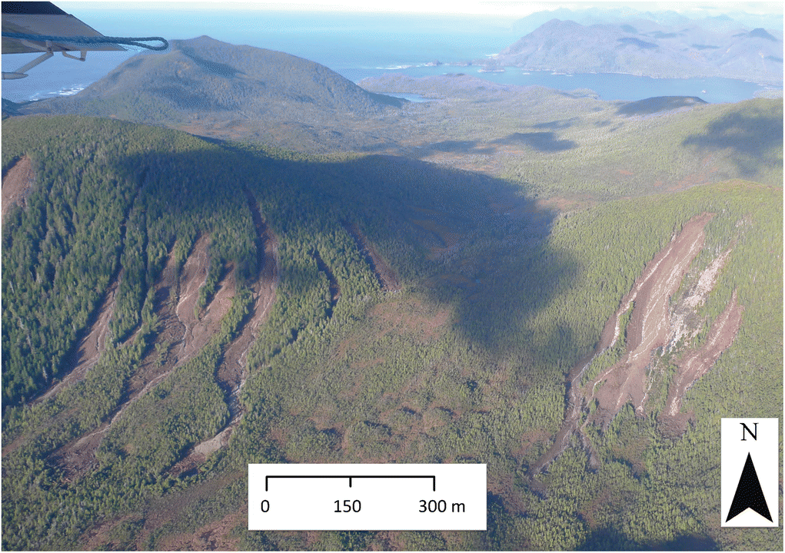
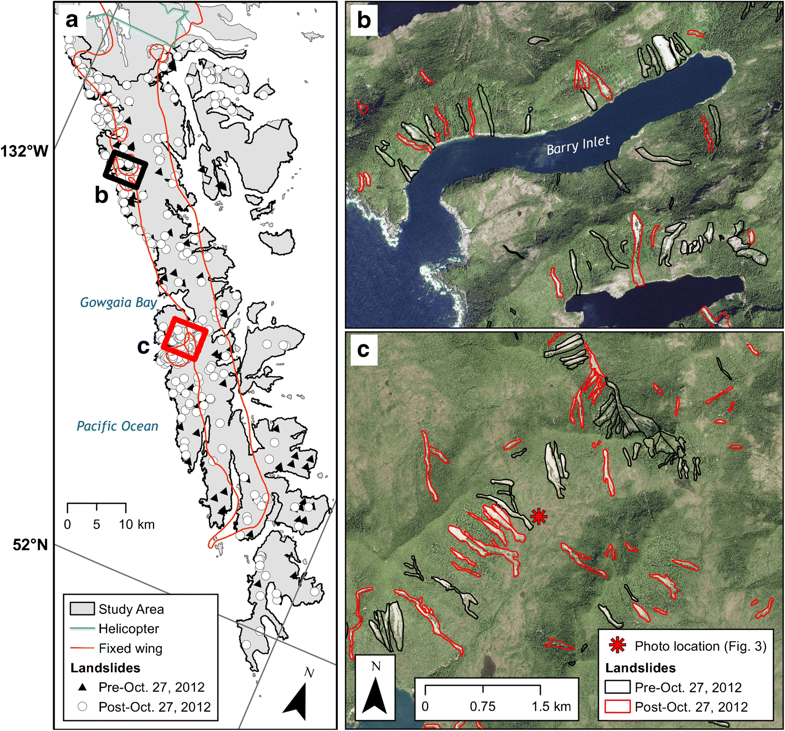
On 27 October 2012, an Mw 7.8 earthquake, the second largest instrumentally recorded earthquake in Canada, occurred approximately 20 km off the coast of Haida Gwaii at a depth of 23 km. 244 landslides were seismically induced and probably co-seismic. Barth S. et al. documented an order-of-magnitude increase in the number of debris slides and debris flows during and shortly after the Haida Gwaii earthquake of 27 October 2012. The number of landslides increased 12.9 times and the area of landslides increased 65.8 times immediately after the earthquake. Average landslide area increased from 0.07 km2 per year to 4.6 km2 per year, and the average size of landslides increased from 0.36 ha/y immediately before the earthquake to 1.88 ha/year afterwards. Landslide rates and sizes returned to near pre-2012 levels in the years after the earthquake, although they remained slightly elevated. Most non-seismically triggered landslides in study area occur on south- and southwest-facing slopes in the direction of the prevailing winds and storms. In contrast, some 32% of the seismically induced landslides occurred on north- and northwest-facing slopes, and 33% on south- and southeast facing in the direction of the earthquake epicentre. This contrasts with other studies that have shown a preference for landslides to face away from earthquake epicentres. This may relate to the earthquake’s rupture mechanism influencing directivity of ground motion.

La Pergalla landslide

LCI : ITA1901211313
Main Information
Landslide Name : La Pergalla landslide
Latitude : 44:45:59.09 N
Longitude : 9:36:21.62 E
Location
City / District : Bettola
Province : Piacenza
Country : Italy
Reporter
Reporter 1 : Marco Mulas
Reporter 2 : Alessandro Corsini
Landslide Type
Material : Earth
Movement : Complex
Velocity (mm/sec) : Moderate
Depth (m) : Deep-Moderate
Slope (degree) : Moderate
Volume (m³) : Small
Date of Occurence
Date of Occurence : Mar 26, 2016
Other Information
Land Use Source area : Forest, Farming, Pasture, Human settlement, Road
Run-out/deposition area : Forest, Farming, Pasture, Road, River
Other Activity : Active in the past
Triggering Factor : Rainfall
Death(s) & Missing : -
Houses and other structural damage : yes
Photo of landslide :
Google earth kmz file : Pergalla.kmz
Plan of landslide :
Cross section of landslide :
Reference (paper/report) : http://link.springer.com/10.1007/s10346-018-1039-4
Testing graph :
Monitoring graph :
Video of moving landslides including 3D simulation : -
Description :

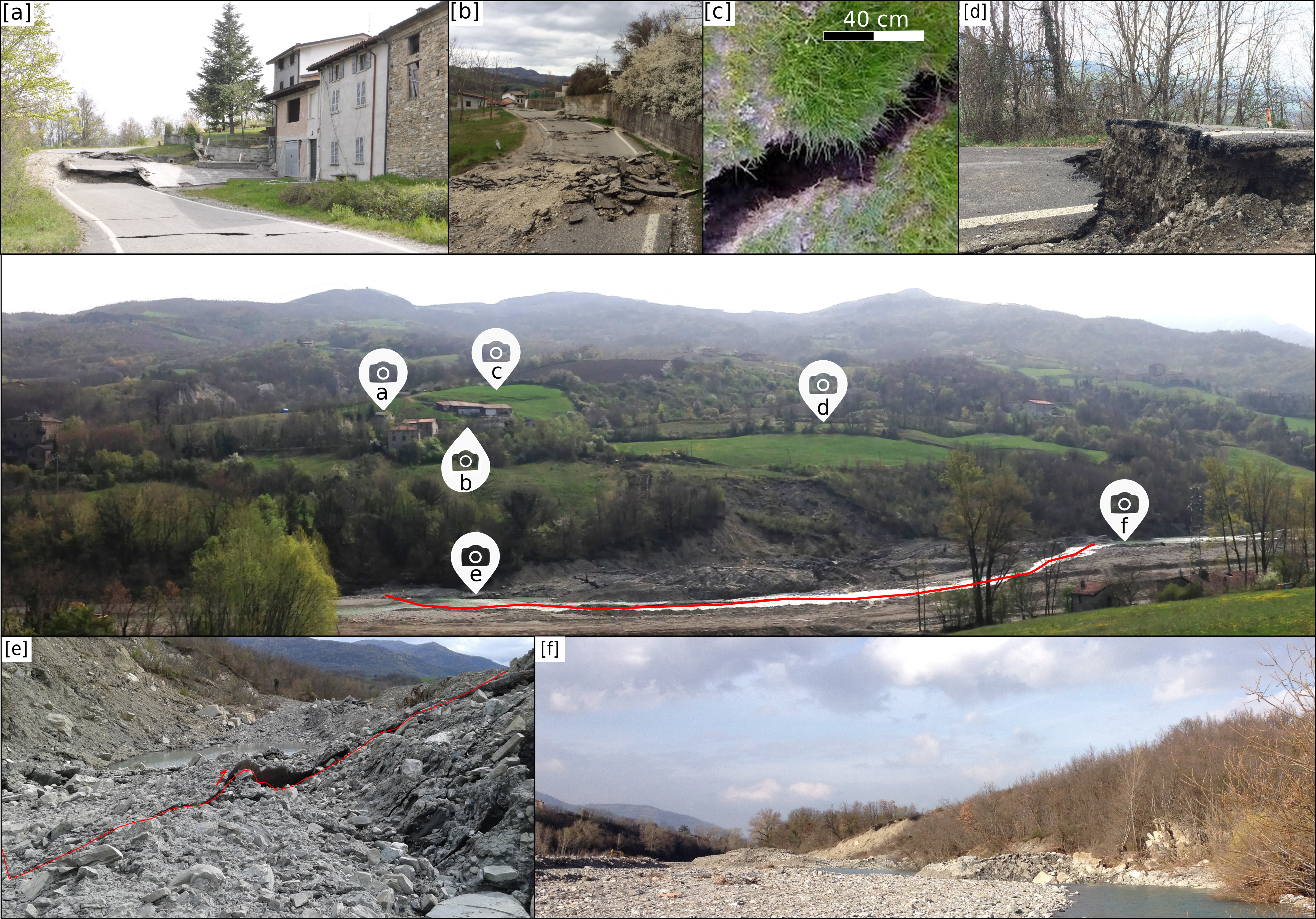
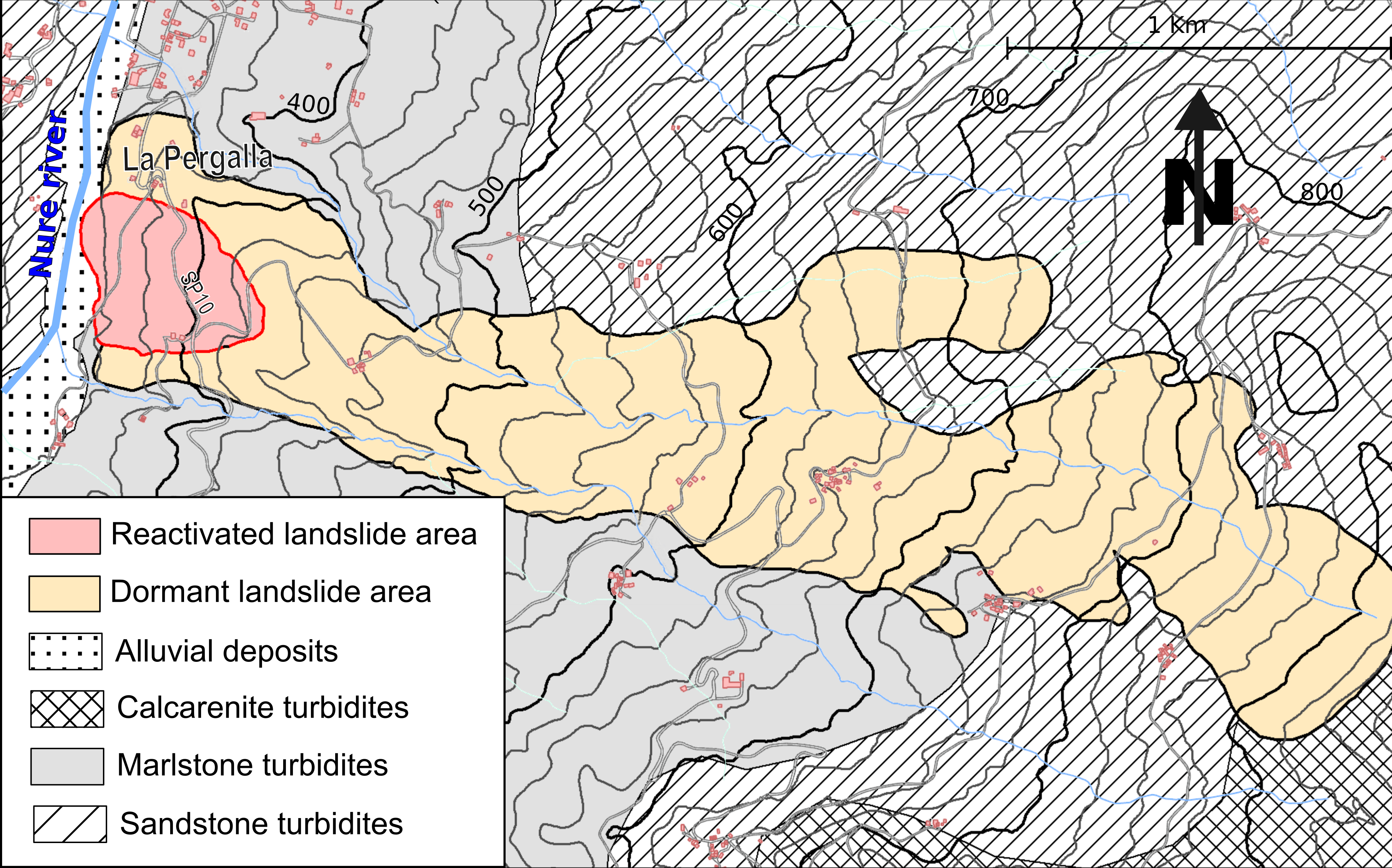
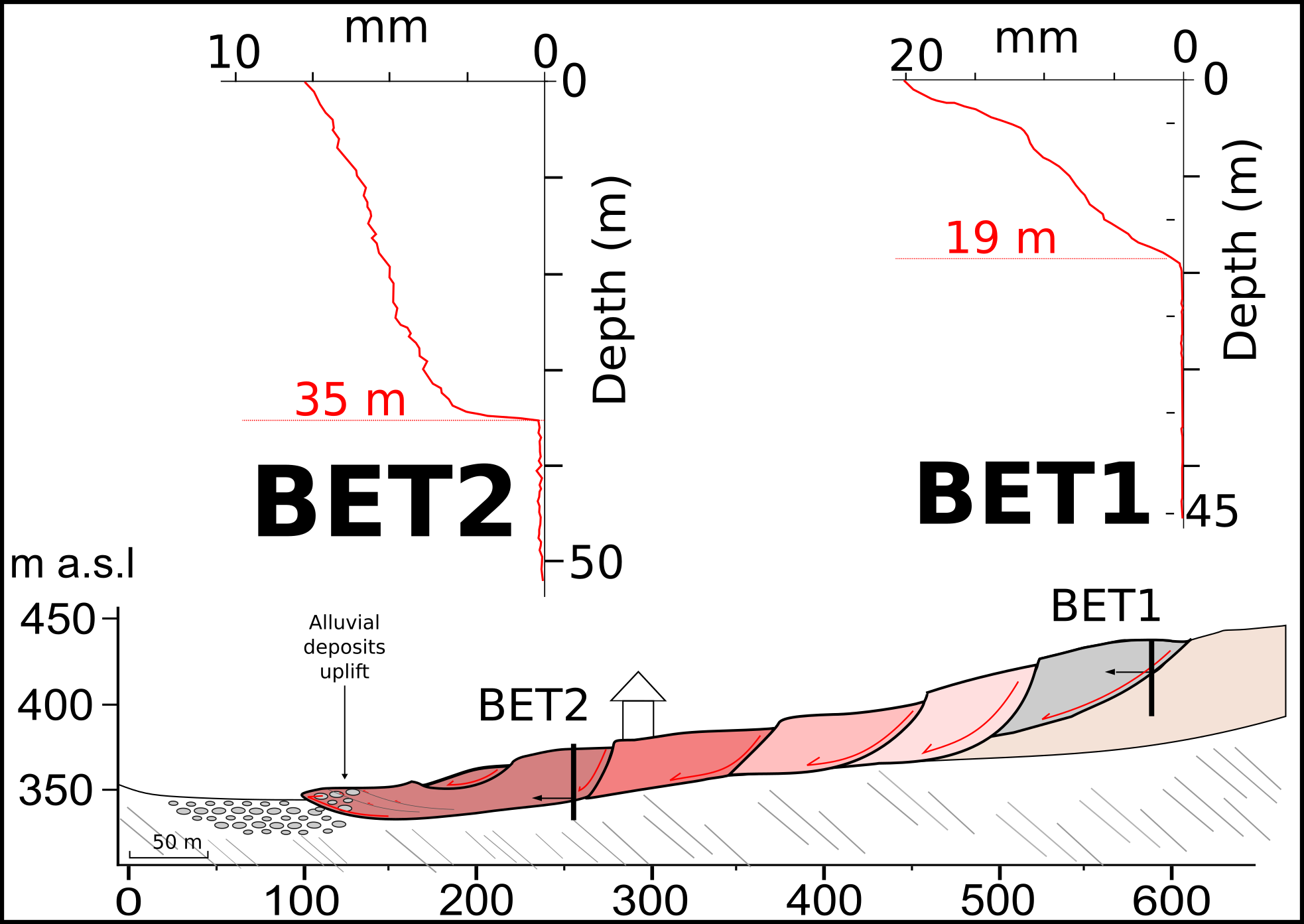
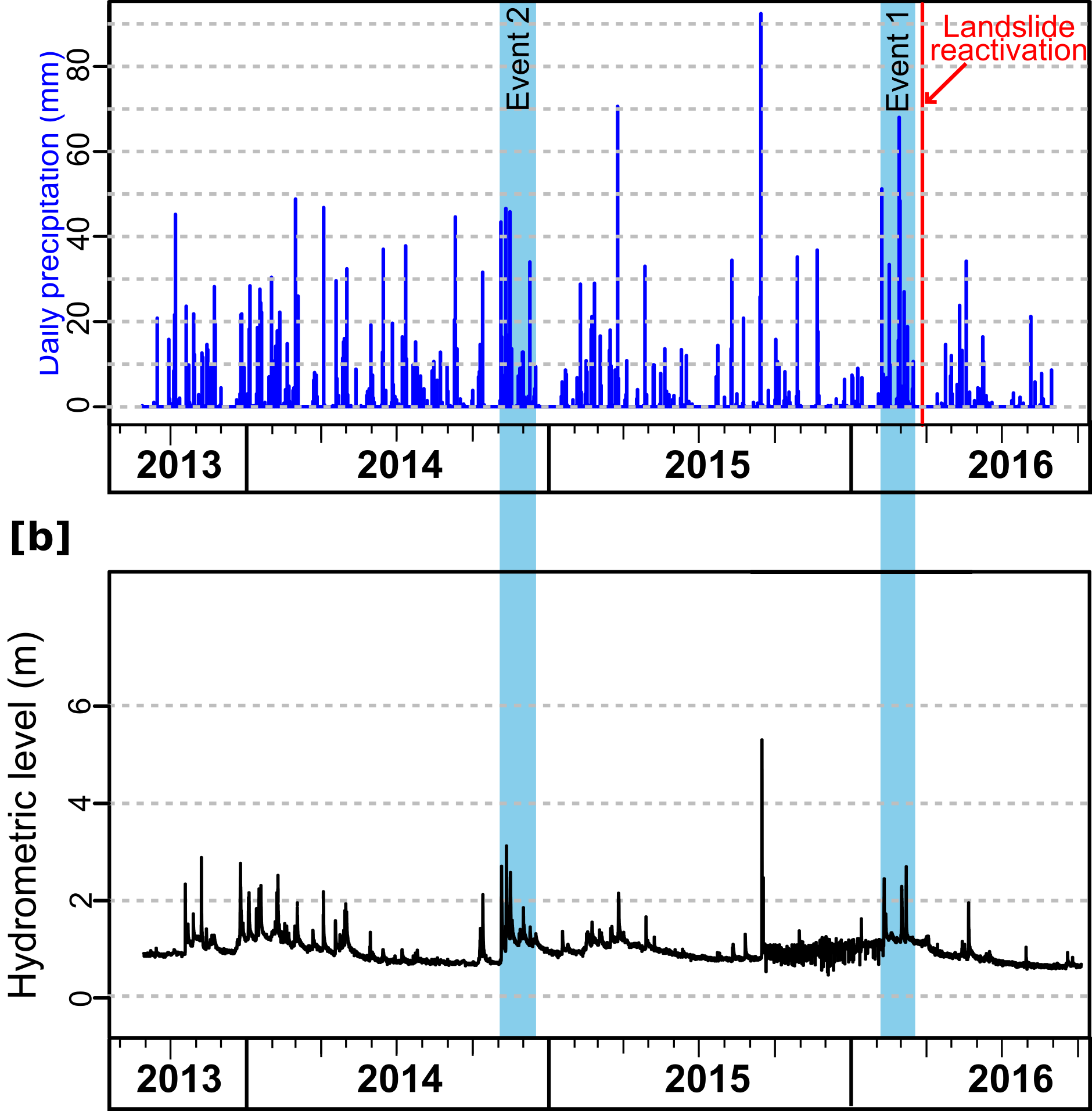
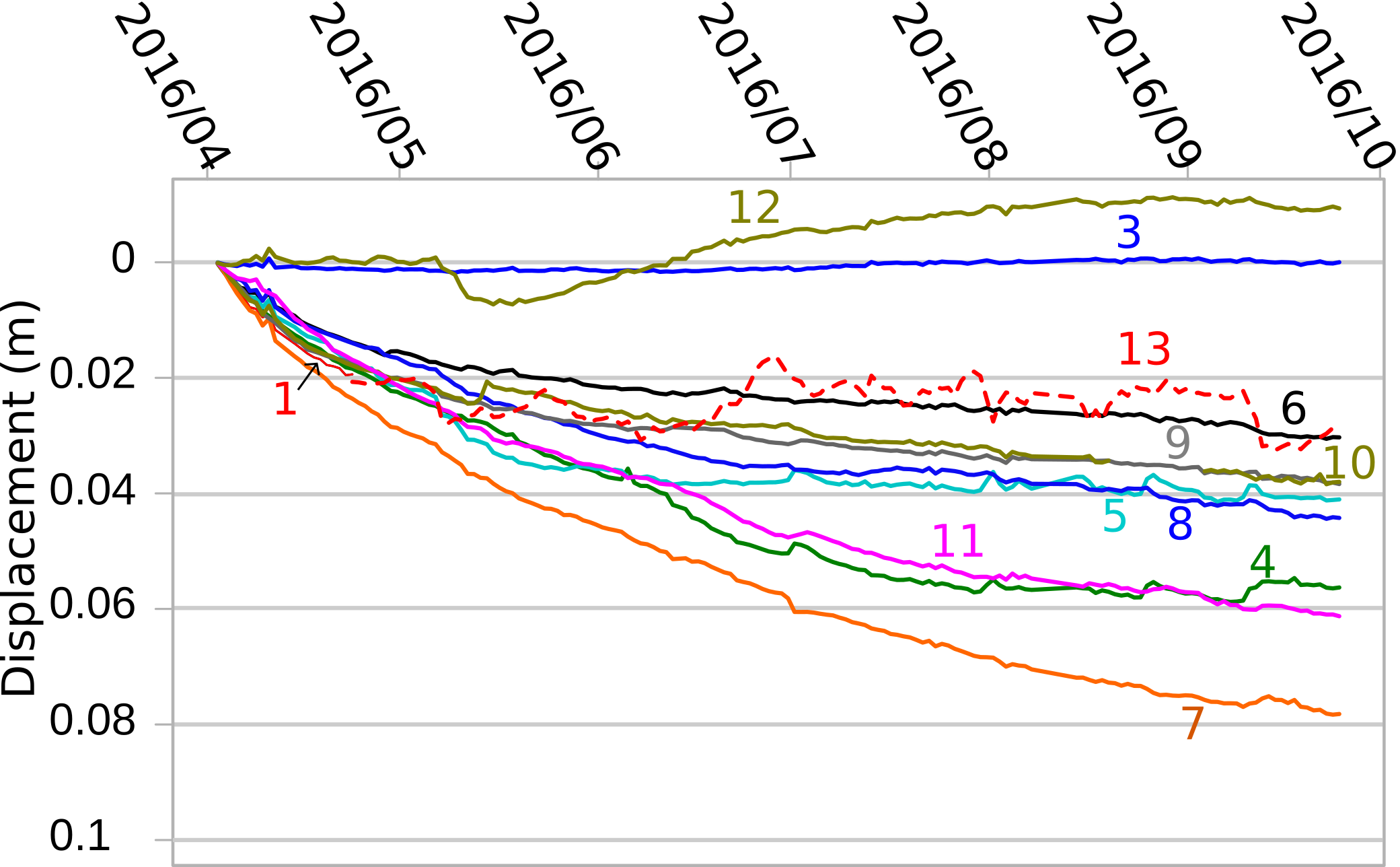
On March 28, 2016, the toe zone of the apparently dormant Pergalla earthslide-earthflow (Northern Apennines, Italy) had a paroxysmal reactivation. In the course of 2 days, displacements up to almost 8 m severely damaged several houses and roads. At the bottom of the slope, the emersion of rotational sliding surfaces determined the uplift of almost 3 m of the Nure river streambed that was consequently partially dammed. The landslide event was investigated by mean of field surveys and analysis of post-event aerial photos, as well as data from geophysical surveys and pre- to post-failure displacement monitoring. Antecedent rainfall, the migration of active streambed channels of Nure river toward the landslide toe in the previous year, and the existence of long-term pre-failure slow movements were identified as factors responsable for the landslide reactivation. It is concluded that these factors, together with the presence of sliding surfaces extending beneath the valley floor, should be primarily considered if a preventive assessment of river damming potential due to streambed uplift should be made for other similar landslides in the Apennines.

Karrat Fjord tsunamigenic landslide

LCI : GRL1810091655
Main Information
Landslide Name : Karrat Fjord tsunamigenic landslide
Latitude : 71:38:33.51 N
Longitude : 52:15:57.90 W
Location
City / District : Karrat Fjord
Province : Nuugaatsiaq
Country : Greenland
Reporter
Reporter 1 : Khang Dang
Reporter 2 : Dave Gauthier
Landslide Type
Material : Rock
Movement : Slide
Velocity (mm/sec) : Extremely Rapid
Depth (m) : Very Deep
Slope (degree) : -
Volume (m³) : Very Large
Date of Occurence
Date of Occurence : Jun 17, 2017
Other Information
Land Use Source area : Wildland
Run-out/deposition area : Sea/lake
Other Activity : Active in the past
Triggering Factor : Unknown
Death(s) & Missing : 4
Houses and other structural damage : -
Photo of landslide :
Google earth kmz file : Karrat Fjord tsunamigenic landslide.kmz
Plan of landslide :
Cross section of landslide :
Reference (paper/report) : https://doi.org/10.1007/s10346-017-0926-4
Testing graph :
Monitoring graph : -
Video of moving landslides including 3D simulation : -
Description :

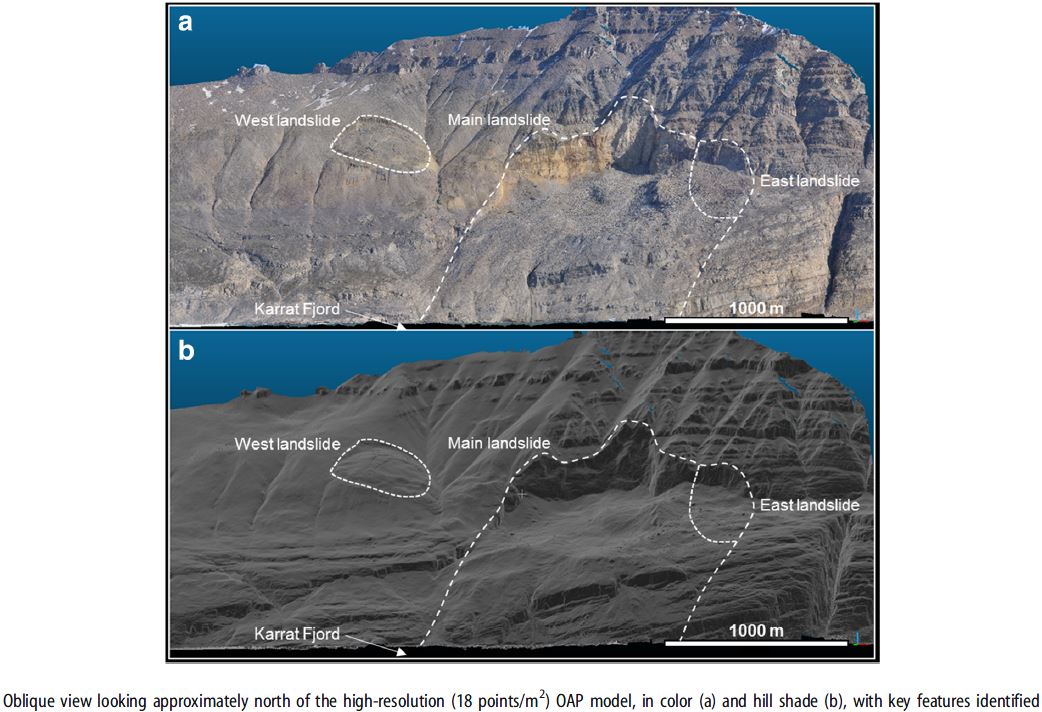
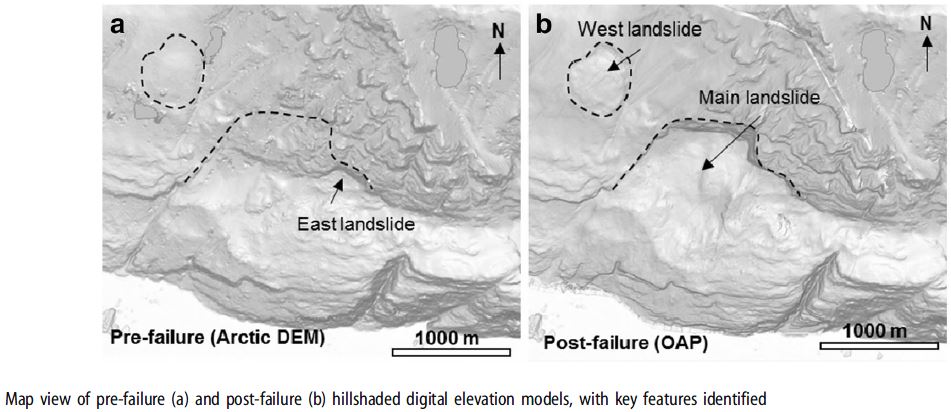
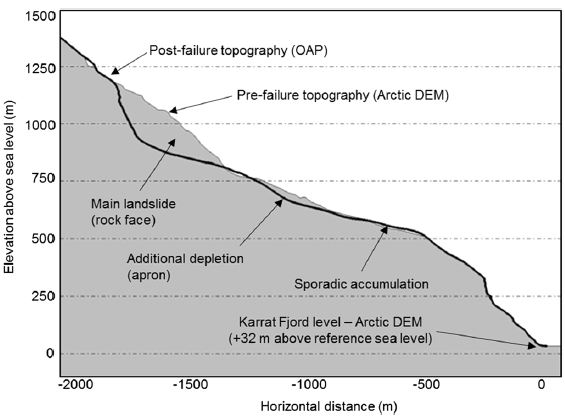
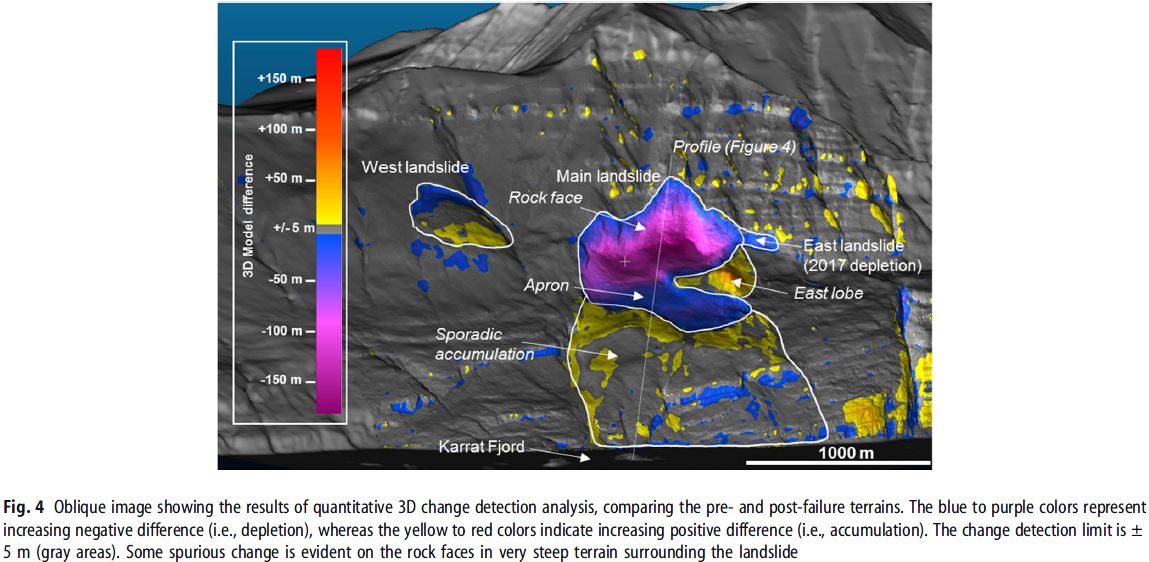
On 17 June 2017, a landslide-generated tsunami reached the village of Nuugaatsiaq, Greenland, leaving four persons missing and presumed dead. Through a 3D quantitative comparison with pre-failure topography, it was estimated that approximately 58 million m3 of rock and colluvium (talus) was mobilized during the landslide, 45 million m3 of which reached the fjord, resulting in a destructive tsunami. This event was classified as a tsunamigenic extremely rapid rock avalanche which likely released along a pre-existing metamorphic fabric, bounded laterally by slope-scale faults. The Karrat Fjord landslide occurred on a steep, south-facing mountain slope with total vertical relief of greater than 2100 m from sea level to ridgetop, over a horizontal distance of approximately 3100 m. The source area of the landslide was approximately mid-slope, and the material involved both in situ bedrock and colluvium. The slope itself is not glaciated, although adjacent north-facing and sheltered slopes are. Permafrost conditions are unknown. Bedrock geology is high-grade Archean gneiss and overlying paleo-Proterozoic schist and quartzite of the Karrat Group (Mott et al. 2013; Grocott and McCaffrey 2017). These are recognized to have a strong planar metamorphic fabric, related to bedding in the protolithic sedimentary rocks (Mott et al. 2013; Grocott and McCaffrey 2017), and local and regional thrust and extensional faulting are common throughout the area. References: Gauthier, D., Anderson, S.A., Fritz, H.M. et al. Landslides (2018) 15: 327. https://doi.org/10.1007/s10346-017-0926-4

Ponzano landslide

LCI : ITA1810071110
Main Information
Landslide Name : Ponzano landslide
Latitude : 42:46:30 N
Longitude : 13:42:25 E
Location
City / District : Civitella del Tronto
Province : Teramo
Country : Italy
Reporter
Reporter 1 : Lorenzo Solari
Reporter 2 :
Landslide Type
Material : Earth
Movement : Complex
Velocity (mm/sec) : Moderate
Depth (m) : Moderate-Shallow
Slope (degree) : Very gentle
Volume (m³) : Large
Date of Occurence
Date of Occurence : Feb 12, 2017
Other Information
Land Use Source area : Pasture, Human settlement, Road
Run-out/deposition area : Farming, Pasture
Other Activity : Currently active
Triggering Factor : Rainfall
Death(s) & Missing : No deaths and missing
Houses and other structural damage : 32 houses seriously damaged, 100 evacuees
Photo of landslide :
Google earth kmz file : landslide.kmz
Plan of landslide :
Cross section of landslide : -
Reference (paper/report) : Solari, L., Raspini, F., Del Soldato, M., Bianchini, S., Ciampalini, A., Ferrigno, F., Tucci, S. & Casagli, N. (2018). Satellite radar data for back-analyzing a landslide event: the Ponzano (Central Italy) case study. Landslides, 15(4), 773-782. doi:10.1007/s10346-018-0952-x (https://link.springer.com/article/10.1007/s10346-018-0952-x)
Testing graph : Testing graph1538906062.tif
Monitoring graph : Monitoring graph.tif
Video of moving landslides including 3D simulation : -
Description :

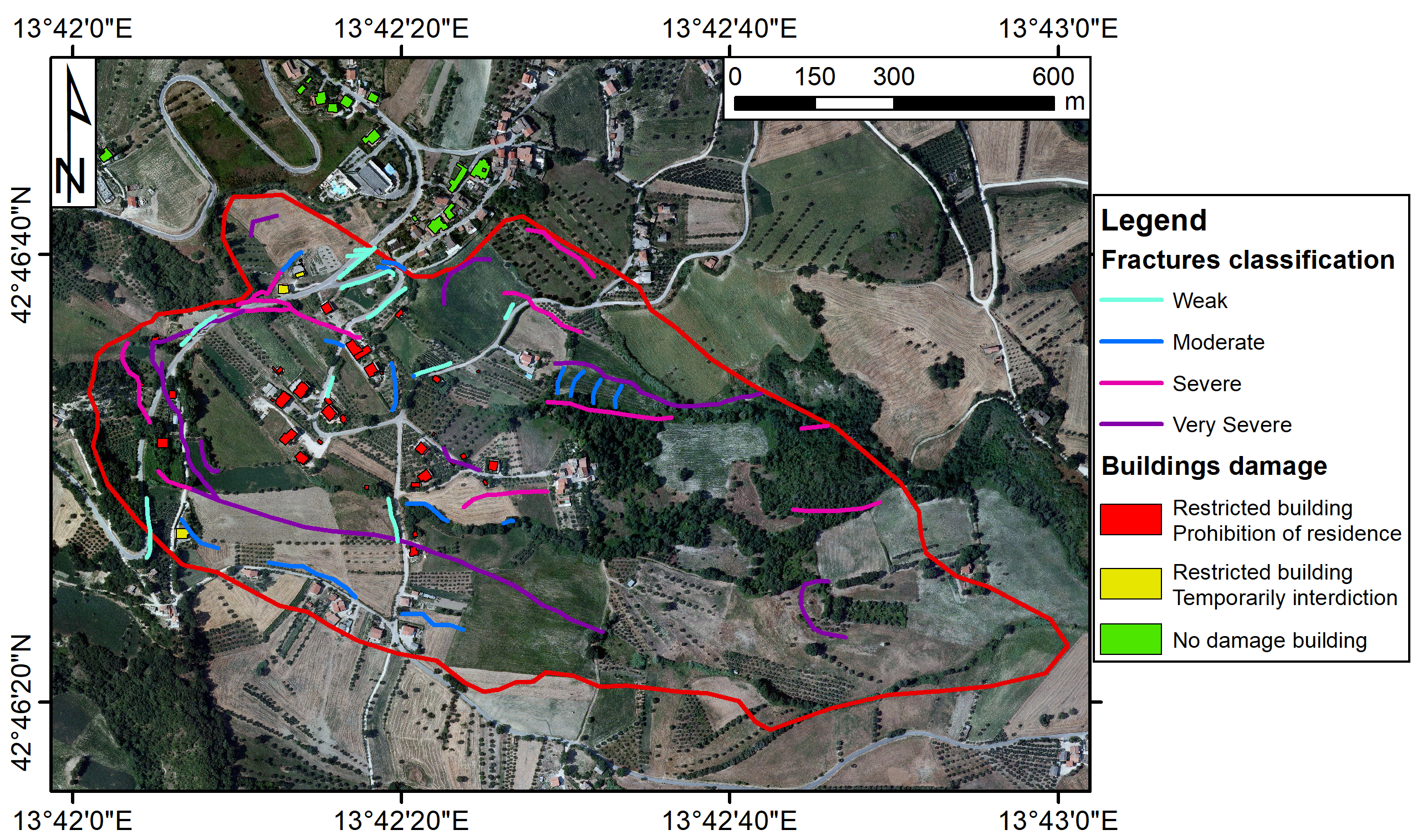
On 12th February 2017, a landslide involved an area of around 60 ha on the SE facing slope of the Ponzano village (Civitella del Tronto municipality, Teramo Province, Abruzzi Region, Central Italy). The landslide, with an estimated volume of about 7000000 cubic meters, was triggered by the combination of two factors: i) saturation of the slope after the direct and slow infiltration of water related to the snow melting due to the increase of temperature between the end of January 2017 and the beginning of February 2017; ii) intense rainfalls recorded, between 6th and 10th February 2017 with a cumulative value of 81 mm, representing the 93% of the total rainfall of February 2017. The landslide is a complex movement in which two major components can be recognized: (i) rotational sliding affecting the upper and crown portion; (ii) an earth flow-like geometry in the central and toe portion of the landslide, characterized by a rupture surface estimated 15 m below the ground level. The landslide failure of February 2017 produced maximum displacements of about 10 m in some sectors of the affected area. The SqueeSAR algorithm was applied to two C-band SAR datasets, composed by Radarsat-2 and Sentinel-1 images, spanning a nine-year time interval before the landslide occurrence. Moreover, the amplitude information carried by two TerraSAR-X images, acquired immediately before and after the event, was exploited to derive the total displacement generated by the landslide movement by means of the RMT (Rapid Motion Tracking) algorithm. The obtained results allowed describing the landslide behavior before and after its failure. In particular, the back-monitoring analysis showed that the landslide was already slowly moving, with deformation rates increasing from the Radarsat-2 to the Sentinel-1 monitored periods, 10 years before its complete mobilization. Reference paper: https://link.springer.com/article/10.1007/s10346-018-0952-x

San Fratello

LCI : ITA1810021245
Main Information
Landslide Name : San Fratello
Latitude : 38:00:50 N
Longitude : 14:36:15 E
Location
City / District : Messina/San Fratello municipality
Province : Sicily
Country : Italy
Reporter
Reporter 1 : william frodella
Reporter 2 :
Landslide Type
Material : Complex
Movement : Complex
Velocity (mm/sec) : Slow
Depth (m) : Moderate-Shallow
Slope (degree) : Gentle
Volume (m³) : Large
Date of Occurence
Date of Occurence : Feb 14, 2010
Other Information
Land Use Source area : Farming, Urban area, Road
Run-out/deposition area : Farming, Pasture
Other Activity : Currently active
Triggering Factor : Rainfall
Death(s) & Missing : -
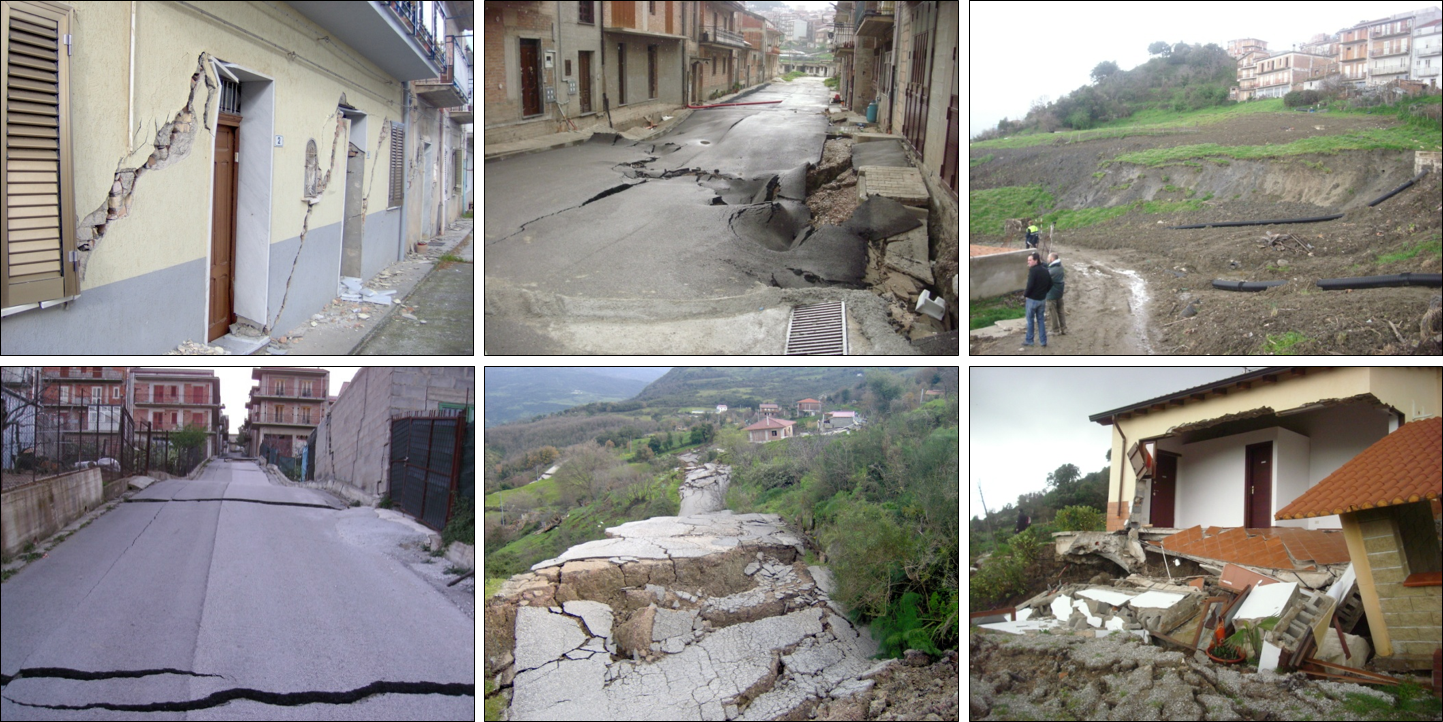
Houses and other structural damage : Intense slope deformation, severe damages to buildings, roadways, and piping system, about 2000 evacuees
Photo of landslide :
Google earth kmz file : San Fratello Landslide.kmz
Plan of landslide :
Cross section of landslide :
Reference (paper/report) : Frodella, W., Ciampalini, A., Bardi, F., Salvatici, T., Di Traglia, F., Basile, G., & Casagli, N. (2018). A method for assessing and managing landslide residual hazard in urban areas. Landslides, 15(2), 183-197. https://doi.org/10.1007/s10346-017-0875-y (https://link.springer.com/article/10.1007/s10346-017-0875-y)
Testing graph : Testing graph.tif
Monitoring graph : Control points monitoring graph.tif
Video of moving landslides including 3D simulation : -
Description :

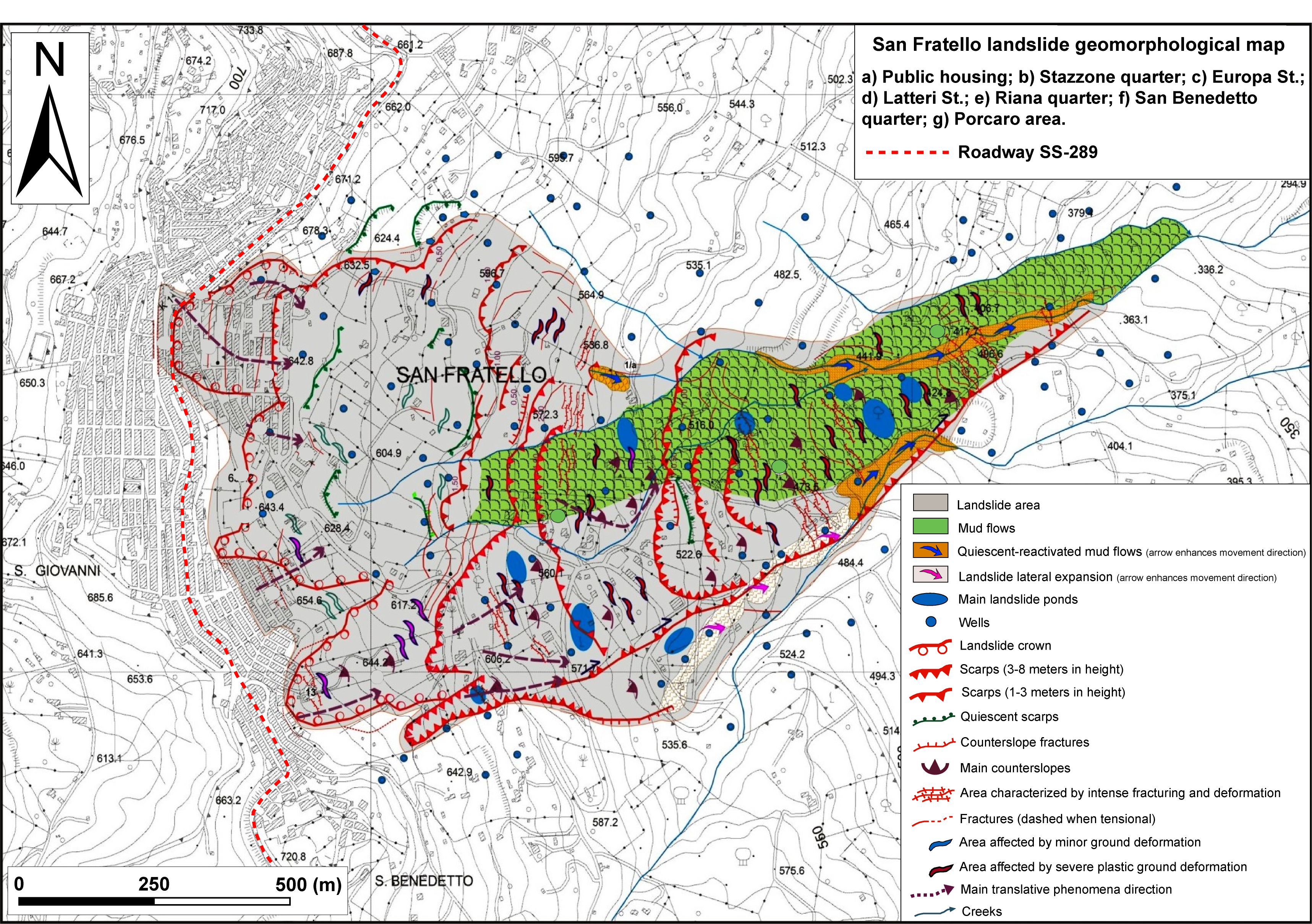
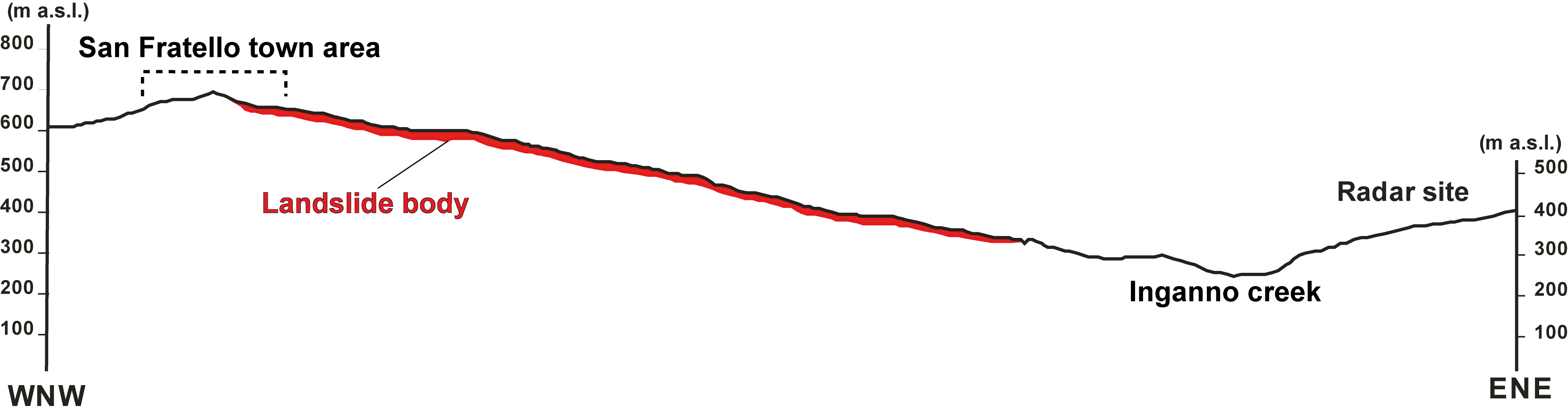
On February 14th 2010 a large landslide affected the urban centre of the San Fratello town (Sicily Island, Southern Italy), causing severe damages to buildings, roadways and infrastructures, as well as about 2000 evacuees. The landslide affects a 1.2 km2 portion of the Inganno creek Est facing slope, developing for a 450 m level drop with a maximum width of 1.5 km and length of 1.9 km. It can be classified as a complex roto-translational mass movement, about 20 x 106 m3 in size, which involved mainly the silty-clayey cover for an average thickness of 10 m, and only to a lesser extent the bedrock. In topmost sector the phenomenon developed a wide crown area (mainly in correspondence of the town quarter areas), minor scarps and tensional/traction fractures in the middle non-urbanized slope sector, and evolved downstream into a slow earth flow. The resulting ground deformations intensively modified the topographic slope surface, producing multiple scarps (characterized by heights between 5 and 10 m) and counter-slopes, also modifying the hydrographic network with the formation of several landslide ponds. Ground deformations intensively damaged the town structures, in particular: i) the most damaged area was the Stazzone quarter, where prevalent rotational phenomena developed traction fractures in the roadways and compressive fissures on the buildings facades; ii) in the Riana quarter translational sliding phenomena allowed the formation of wide ground traction fractures and sub-parallel fracture systems in the road pavement and secondary scarps; iii) in the San Benedetto and Porcaro quarters, both translational and rotational phenomena and local flows, caused the complete destruction of isolated buildings, roadways, water pipes and the sewer system; iv) in the upper sector of the town a transect of the Cesarò SS 289 roadway, was also severely damaged (https://link.springer.com/article/10.1007/s10346-017-0875-y).

Agnone Landslide

LCI : ITA1809291655
Main Information
Landslide Name : Agnone Landslide
Latitude : 41:48:03 N
Longitude : 14:19:36 E
Location
City / District : Agnone
Province : Isernia, Molise Region
Country : Italy
Reporter
Reporter 1 : Matteo Del Soldato
Reporter 2 :
Landslide Type
Material : Rock, Debris, Earth, Complex
Movement : Slide, Flow, Complex
Velocity (mm/sec) : Very Slow
Depth (m) : Deep-Moderate
Slope (degree) : Moderate
Volume (m³) : Large
Date of Occurence
Date of Occurence : Jan 24, 2003
Other Information
Land Use Source area : Farming, Human settlement, Road
Run-out/deposition area : Farming, Road, River
Other Activity : Currently active
Triggering Factor : Snow melting
Death(s) & Missing : -
Houses and other structural damage : 13
Photo of landslide :
Google earth kmz file : AgnoneLandslide.kmz
Plan of landslide :
Cross section of landslide :
Reference (paper/report) : https://link.springer.com/article/10.1007/s10346-018-1015-z https://link.springer.com/article/10.1007/s10064-018-1303-9 https://rua.ua.es/dspace/bitstream/10045/65268/1/2016_Del-Soldato_etal_RendOnlineSocGeolIt_139_final.pdf https://books.google.it/books?hl=it&lr=&id=FwrNBQAAQBAJ&oi=fnd&pg=PA299&dq=Agnone+landslide&ots=LtnRTcdgSq&sig=sc1E3Nnbg9njO3R_G5M25RFIq0k#v=onepage&q=Agnonelandslide&f=false
Testing graph : -
Monitoring graph : AgnoneLandslideMonitoring.tif
Video of moving landslides including 3D simulation : -
Description :

Landslides have been known in the municipality of Agnone since at least the beginning of the twentieth century. The oldest report describing an instability event refers to a phenomenon that occurred in March 1905 in the San Nicola Valley due to the combination of a period of intense rainfall combined with snow-melting. This event damaged the bridge that carried the main access road to the historical center of Agnone. The municipality of Agnone has been successively affected by several small and large landslide events. Archival and bibliographical landslide research, reported in the nationwide AVI Project, revealed more than 60 landslides that occurred in the municipality of Agnone and the surrounding territory. After an intense rainfall event that affected southern Italy between the 23rd and the 27th of January 2003, with more than 200 mm of rain falling over 72h, an important remobilization involved a large area of the historically dormant Agnone landslide due to an unusual increase in pore pressure. The event caused deformations over the whole basin and forcing the local authorities to adopt restrictive measures for 13 edifices occupied by 17 families located within and nearby the landslide. Furthermore, two country roads adjacent to the landslide remained closed due to the substantial damage caused by the reactivation. The mass movement subsequently reactivated in 2004, 2005 and between 2006 and 2007, induced the local administration to allocate resources for some urgent interventions to intercept superficial waters and drain a pond formed in the upper portion of the affected area, in addition to geomorphological reshaping work. Inclinometer and GPS stations were installed and the landslide was monitored by PS data. Sources: Del Soldato, M., Riquelme, A., Bianchini, S., Tomàs, R., Di Martire, D., De Vita, P., Moretti S. & Calcaterra, D. (2018). Multisource data integration to investigate one century of evolution for the Agnone landslide (Molise, southern Italy). Landslides, 1-16. Del Soldato, M., Di Martire, D., Bianchini, S., Tomás, R., De Vita, P., Ramondini, M., Casagli N. & Calcaterra, D. (2018). Assessment of landslide-induced damage to structures: the Agnone landslide case study (southern Italy). Bulletin of Engineering Geology and the Environment, 1-22.

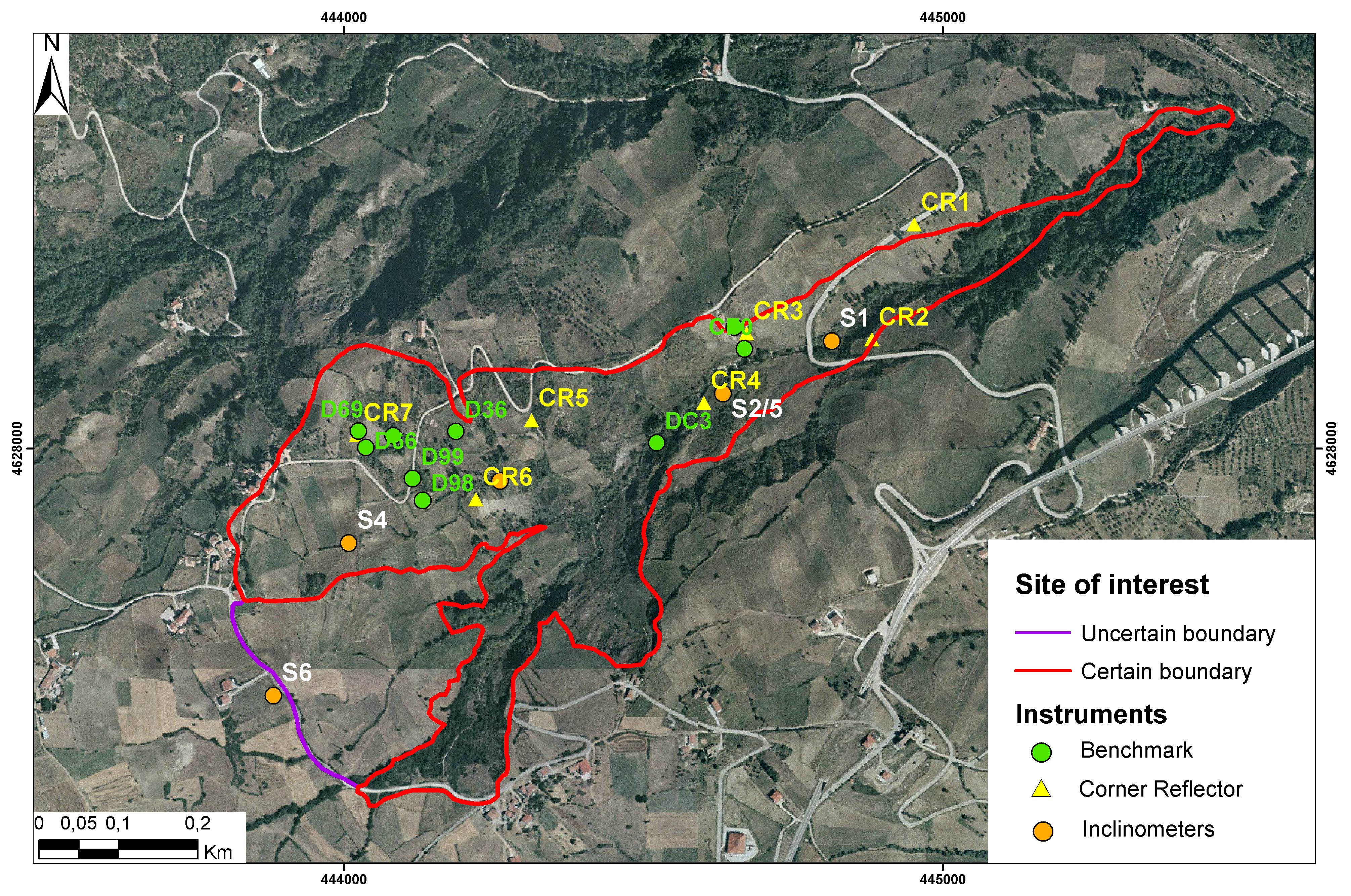
Randazzo Landslide

LCI : ITA1809251000
Main Information
Landslide Name : Randazzo Landslide
Latitude : 37:54:00.22 N
Longitude : 14:57:52.15 E
Location
City / District : Randazzo, Catania
Province : Sicliy
Country : Italy
Reporter
Reporter 1 : Simone Mineo
Reporter 2 : Giovanna Pappalardo
Landslide Type
Material : Rock, Debris, Earth
Movement : Complex
Velocity (mm/sec) : Rapid
Depth (m) : Deep-Moderate
Slope (degree) : Moderate
Volume (m³) : Very Large
Date of Occurence
Date of Occurence : Mar 20, 1996
Other Information
Land Use Source area : Farming, Pasture, Wildland, Road
Run-out/deposition area : Farming, Pasture, Wildland, River
Other Activity : -
Triggering Factor : Rainfall
Death(s) & Missing : -
Houses and other structural damage : Road SS116 and some houses
Photo of landslide :
Google earth kmz file : Randazzo Landslide.kmz
Plan of landslide :
Cross section of landslide :
Reference (paper/report) : Pappalardo G., Mineo S., Angrisani A.C., Di Martire D., Calcaterra D. Combining field data with infrared thermography and DInSAR surveys to evaluate the activity of landslides: the case study of Randazzo Landslide (NE Sicily). Landslides, 2018. DOI 10.1007/s10346-018-1026-9 https://rdcu.be/VcNp
Testing graph : Fig 13.tif
Monitoring graph : Fig 12.tif
Video of moving landslides including 3D simulation : -
Description :

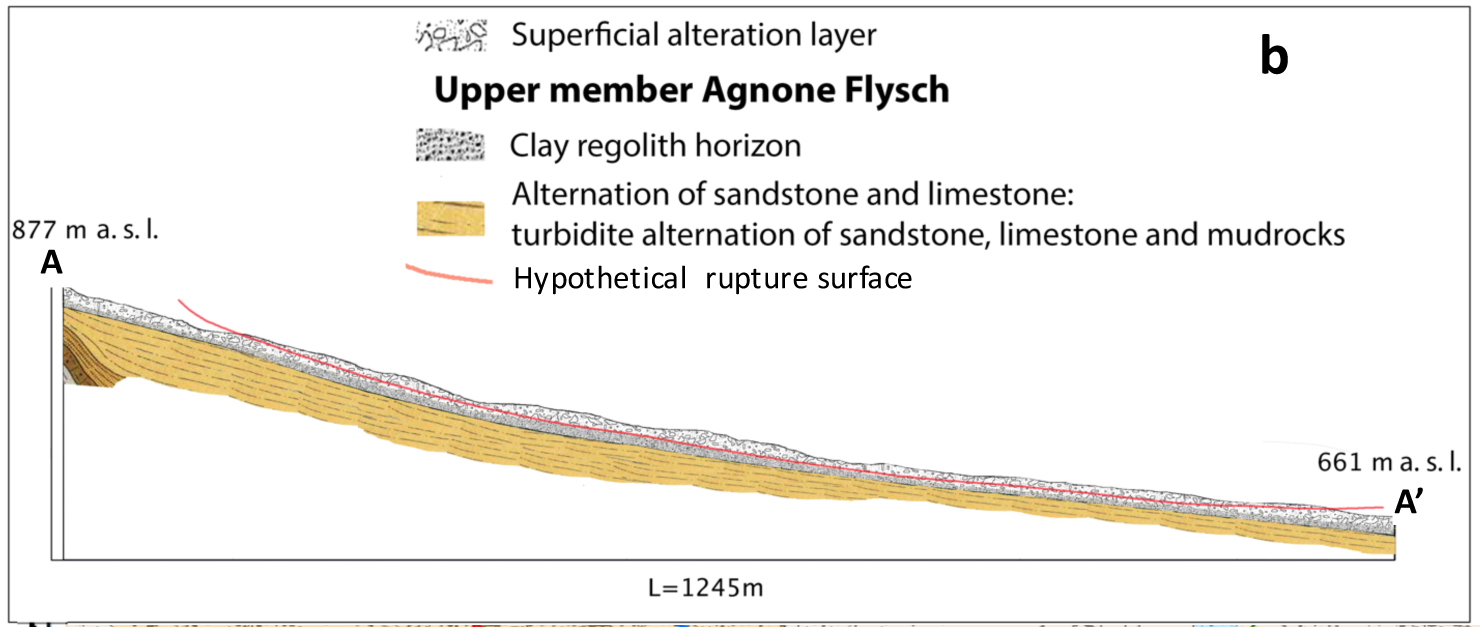
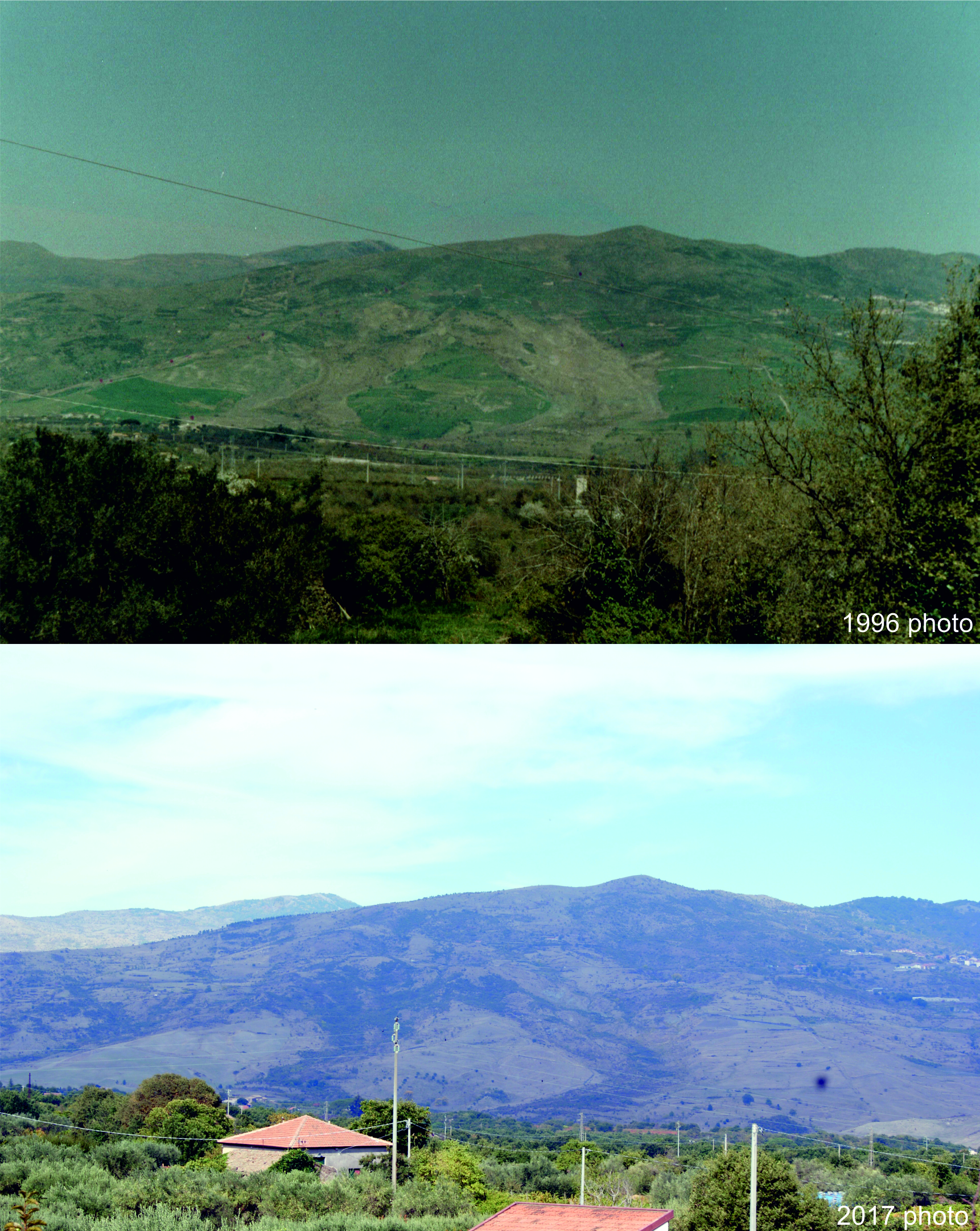
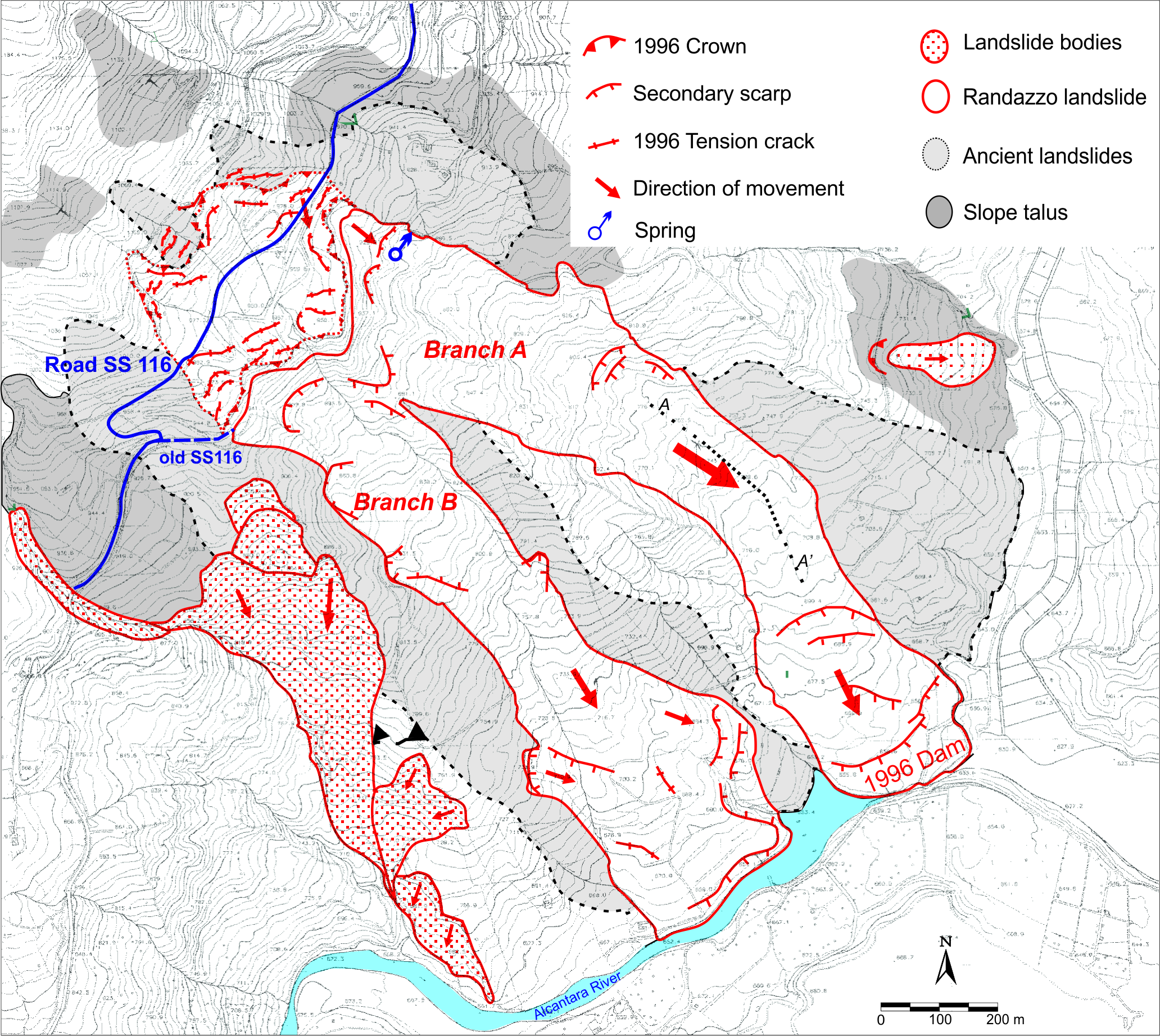
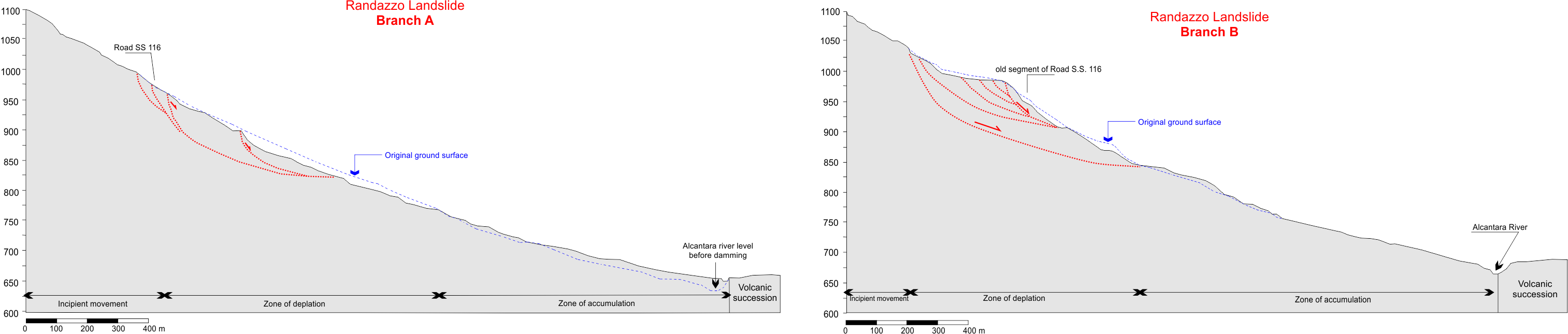
According to informal interviews to local people, the first movement of Randazzo Landslide (RL) occurred between August and September 1995, after an anomalous rainy month. It consisted in a series of slight rotational motions, which gave rise to a counter slope sector in the middle of the slope, where a new spring fed a small pond. After the following winter, on March 20th 1996, a further movement affected the slope at 900 m of elevation a.s.l. in the form of a rotational sliding (RLa). This movement represents the beginning of an unrelenting landslide, which soon involved the higher portions of the slope in the proximity of SS116. In a few days, the road itself was dislocated downslope by the landslide, while another independent slope movement was triggered south-west of the first landslide (RLb). On March 26th 1996, RLa showed the features of an earth flow, dark in color and visibly saturated with water, which was sliding towards the downstream Alcantara river. On the other hand, the retrogressive evolution of RLb had completely disrupted the roadway and the landslide body kept moving downslope, with an estimated speed of about 0.3–0.4 m/h. In the morning of March 28th 1996, RLa reached the Alcantara river, which was completely dammed within the next 5 days, when the RLa toe reached the volcanic rock scarp located on the opposite side of the valley. This event gave rise to the formation of a landslide lake, whose level quickly grew until a maximum height of 17.5 m, with a held volume of water of about 350,000 m3. The neighboring portions of the slope were affected by deformations and were soon incorporated by the RLa body. The dam was removed some months later to reduce the risk of flood at the downstream villages (Pappalardo et al., 2018- DOI 10.1007/s10346-018-1026-9)