

Ichinose landslide

LCI : JPN2410011750
Main Information
Landslide Name : Ichinose landslide
Latitude : 37:20:35.92 N
Longitude : 136:54:46.12 E
Location
City / District : Wajima
Province : Ishikawa
Country : Japan
Reporter
Reporter 1 : Doan Loi
Reporter 2 :
Landslide Type
Material : Earth
Movement : Slide
Velocity (mm/sec) : Very Rapid
Depth (m) : Deep
Slope (degree) : Gentle
Volume (m³) : Large
Date of Occurence
Date of Occurence : Jan 01, 2024
Other Information
Land Use Source area : Forest
Run-out/deposition area : Farming, Human settlement, Road
Other Activity : Active in the past
Triggering Factor : Earthquake
Death(s) & Missing : -
Houses and other structural damage : 10
Photo of landslide :
Google earth kmz file : Ichinose landslide1727772479.kmz
Plan of landslide :
Cross section of landslide :
Reference (paper/report) : https://link.springer.com/article/10.1007/s10346-024-02333-6
Testing graph :
Monitoring graph :
Video of moving landslides including 3D simulation : https://youtu.be/3yh2xIYmaJw
Description :

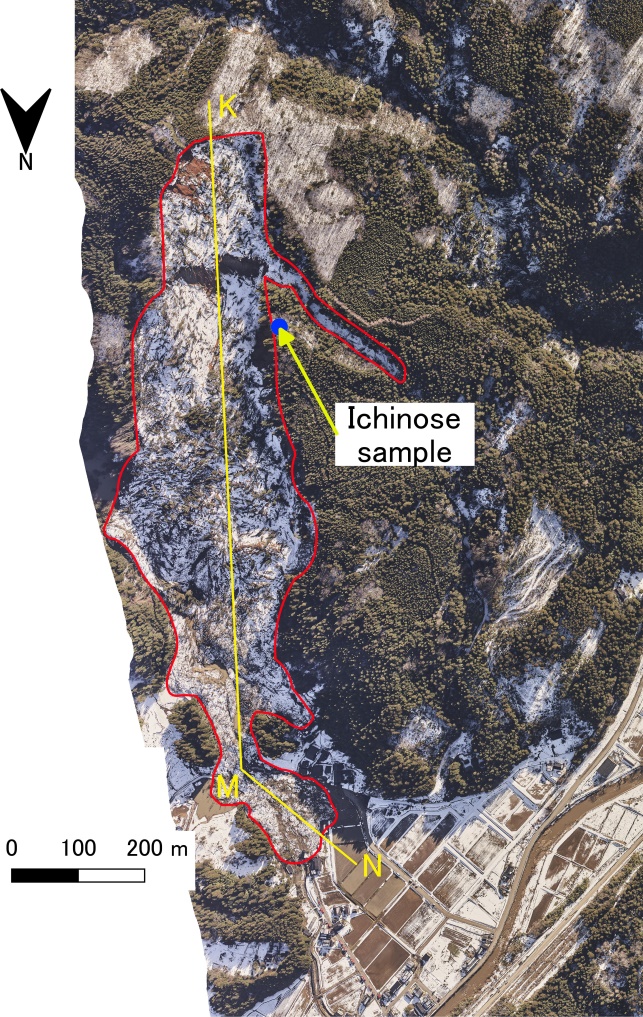
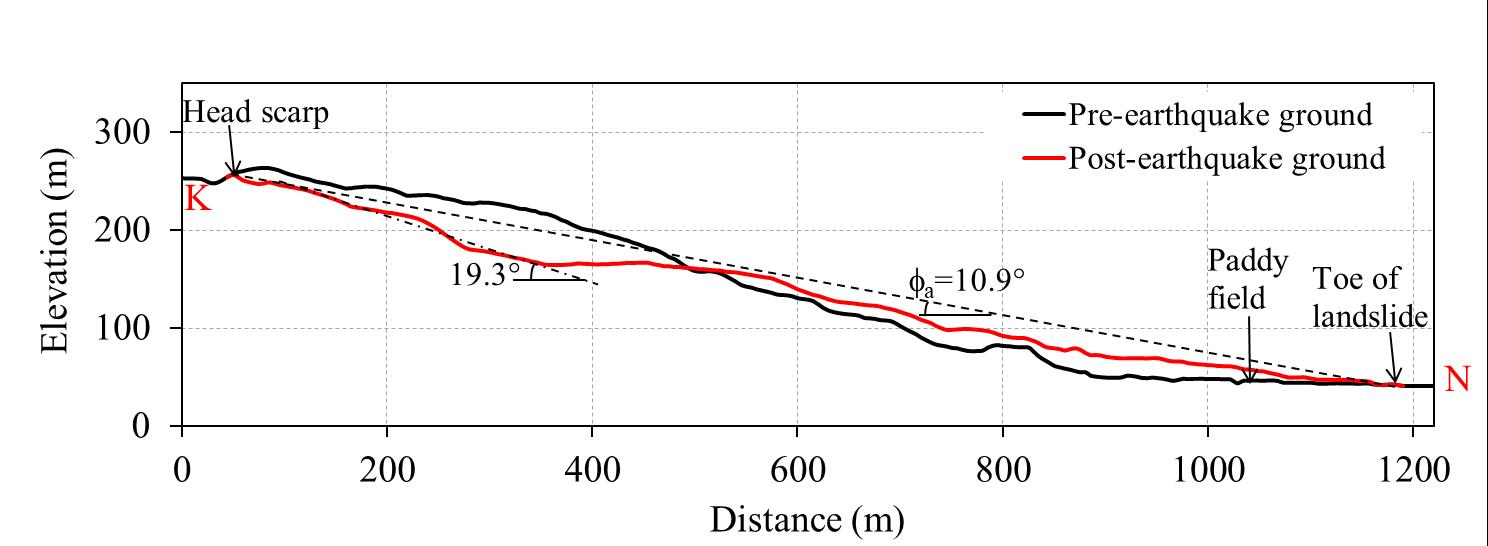
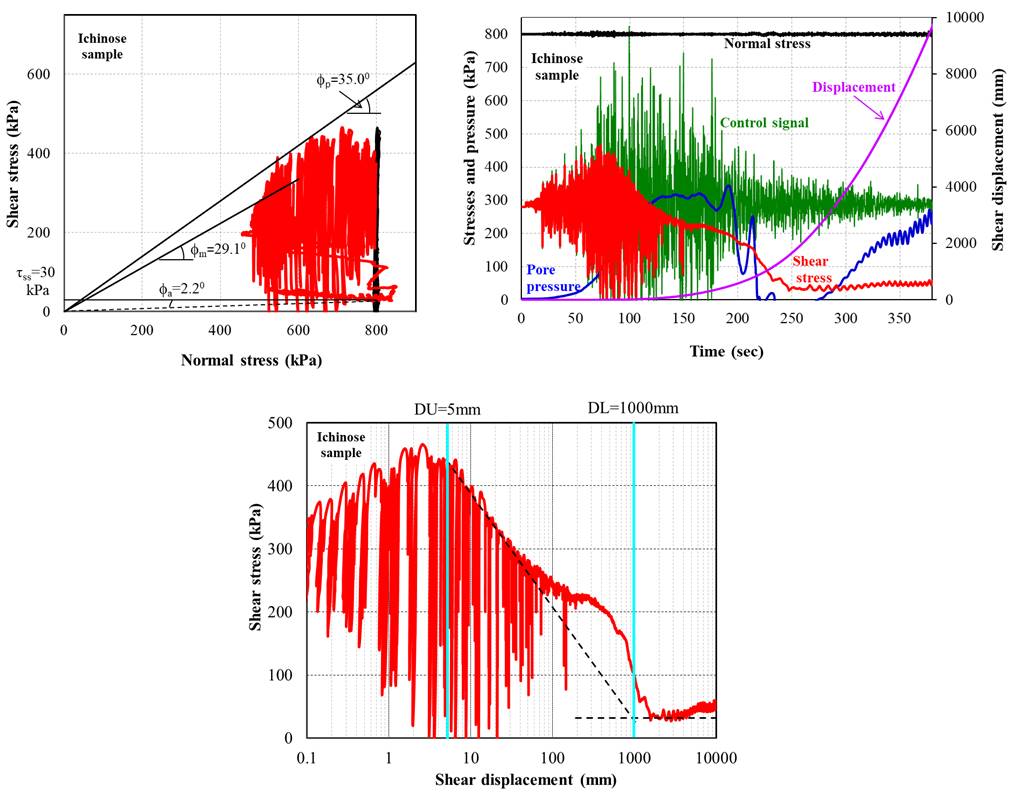
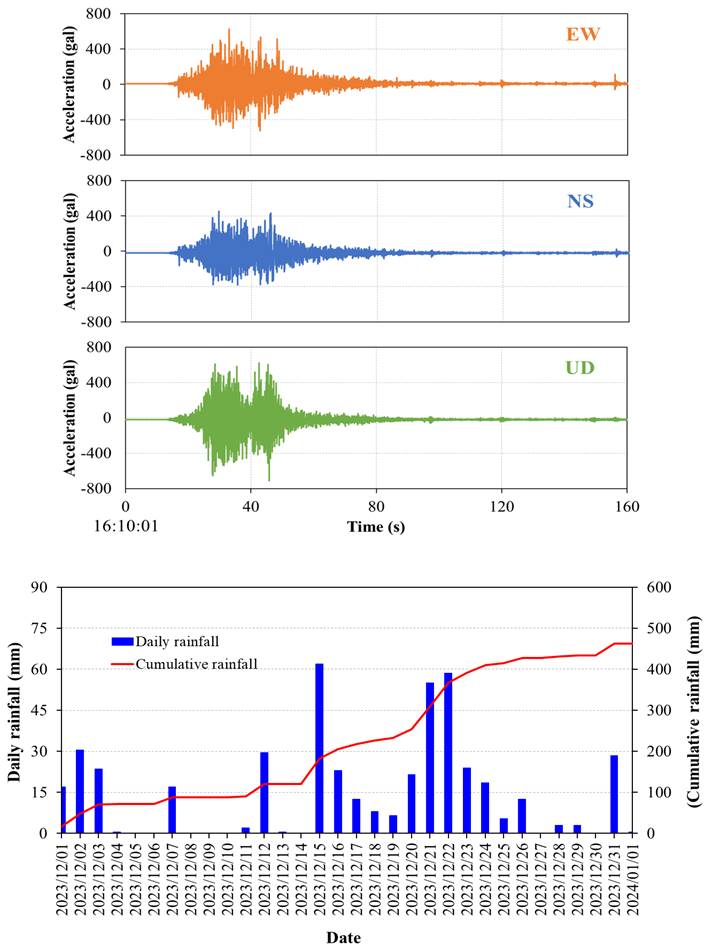
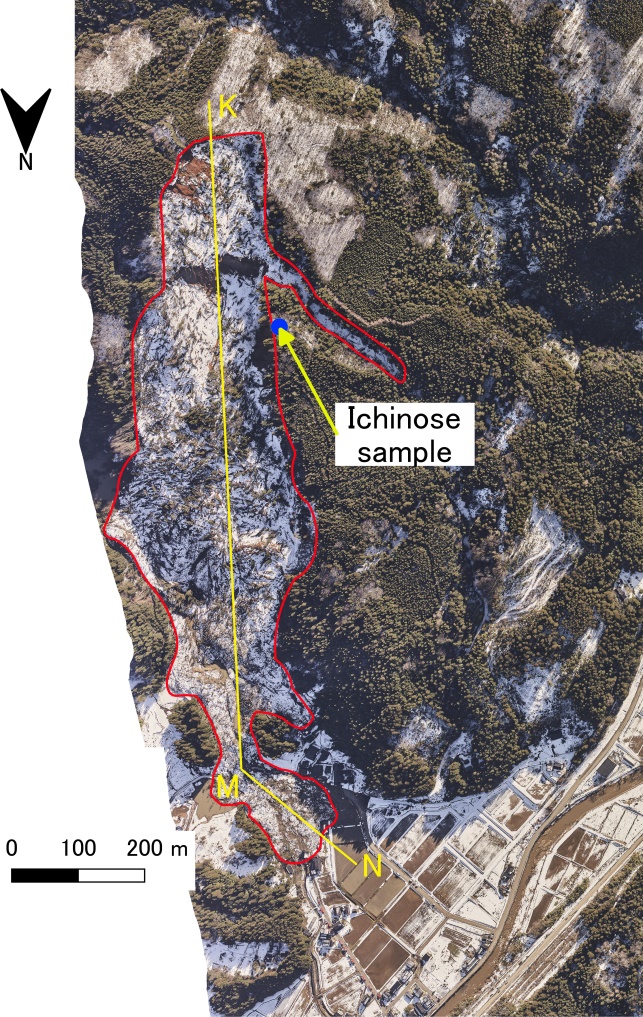
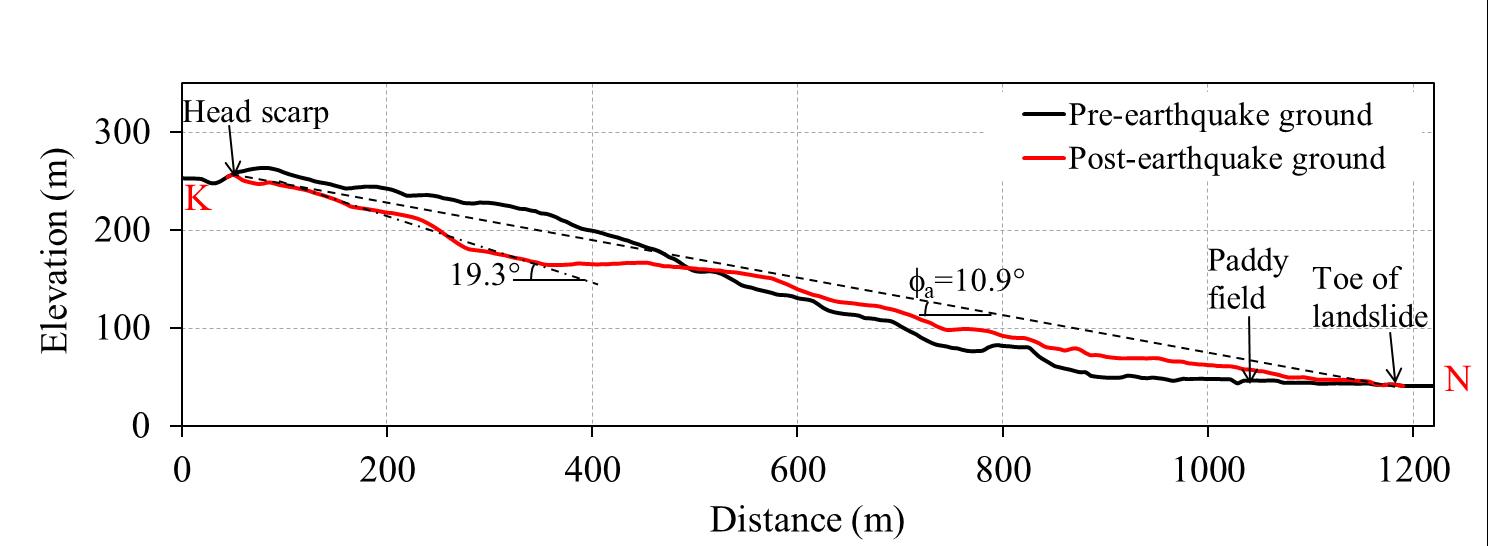
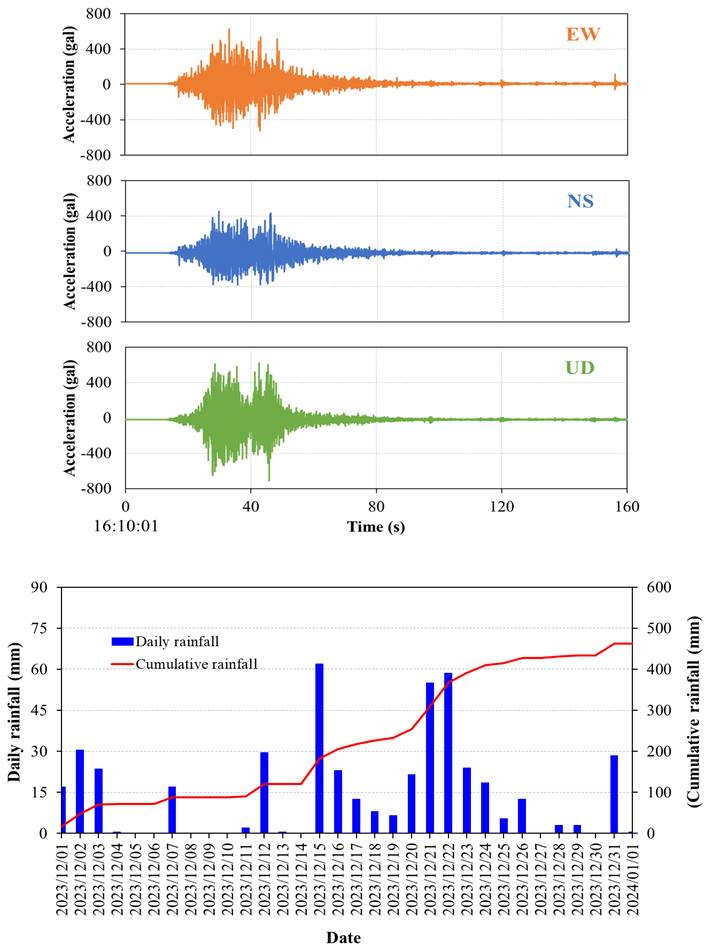
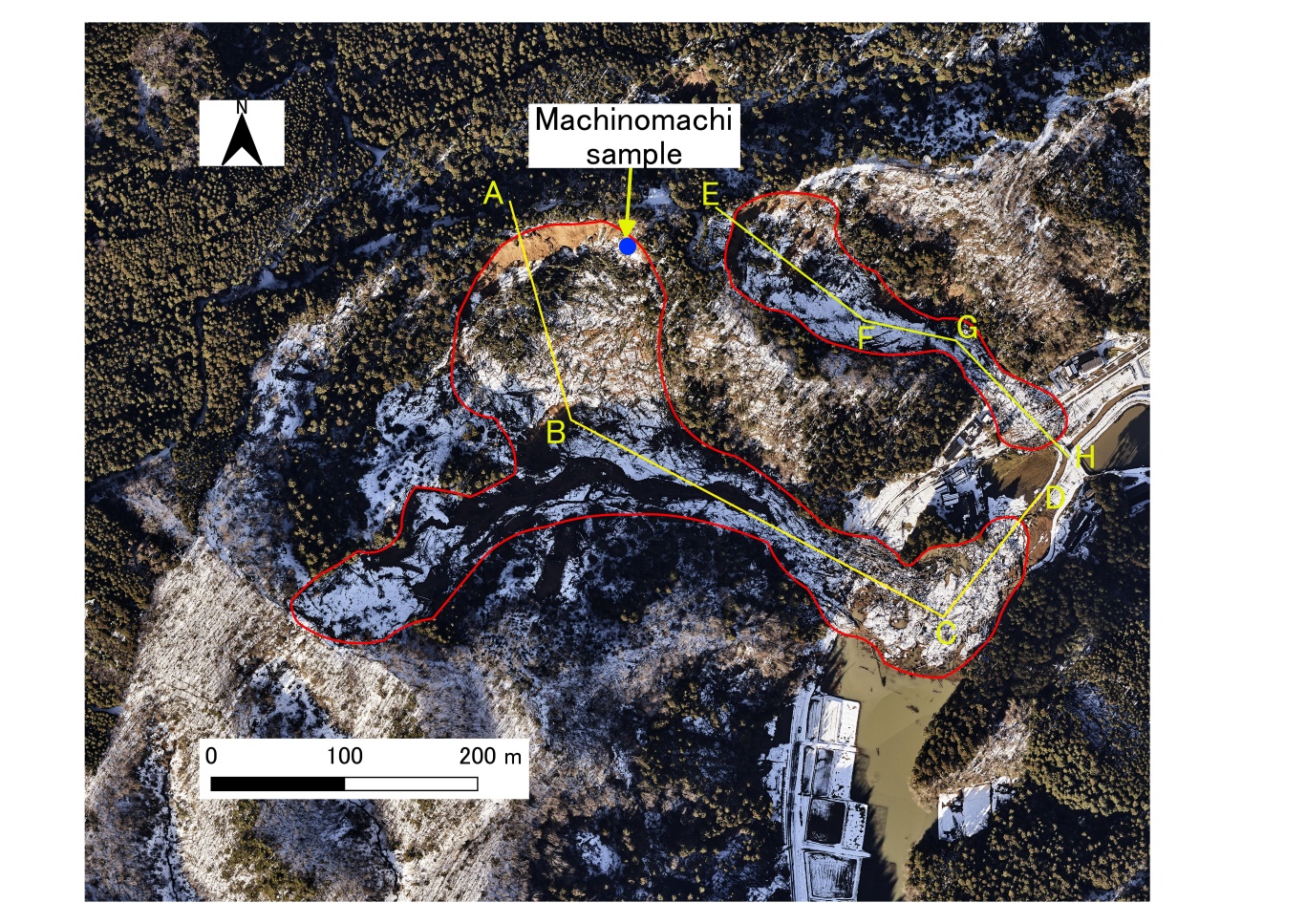
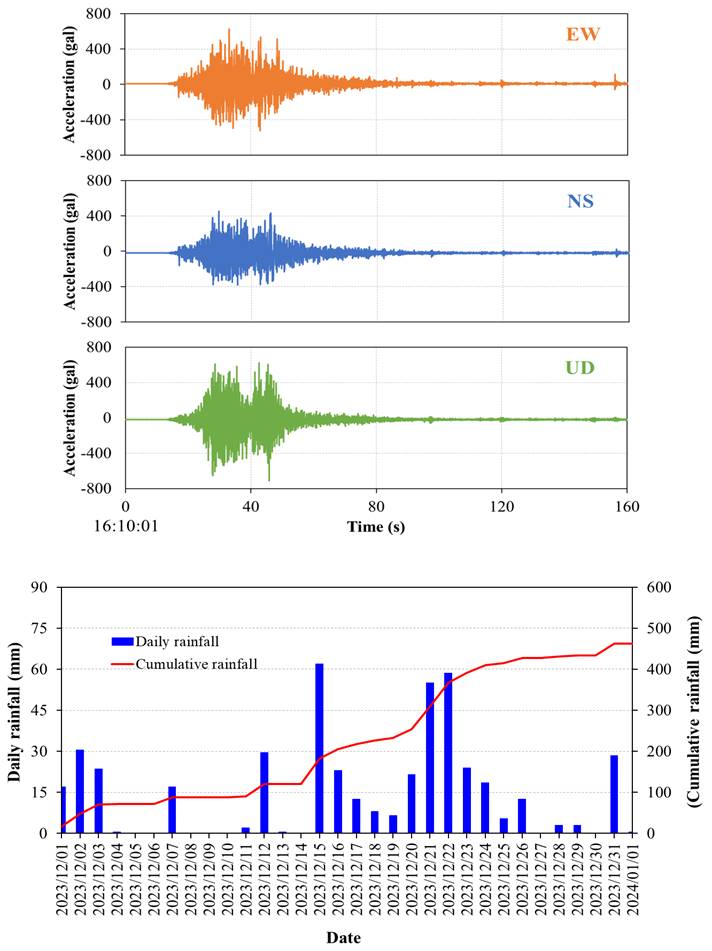
At 16:10 (JST) on January 1, 2024, an intense earthquake struck the Noto Peninsula area of Ishikawa Prefecture, Japan. The Japan Meteorological Agency (JMA) magnitude MJMA was 7.6, and the epicenter was 37.498° North and 137.242° East. The cascading effects of the Noto earthquake caused extensive damage on the Noto Peninsula, particularly in Wajima, Suzu, Noto, and Anamizu. As of 14:00 on March 26, this earthquake claimed 244 lives (15 people were reported as disaster-related deaths) and damaged 74,923 houses (Ishikawa Prefecture report, 2024). Shortly after the event, the Geospatial Information Authority of Japan mapped and published the locations of the landslides. The 2024 Noto Peninsula earthquake triggered more than 2300 landslides over a wide area. Although shallow, distributed landslides were common, long-traveling landslides caused significant damage. The Ichinose landslide was in Ichinose-cho, Wajima City, Ishikawa Prefecture, about 30 km from the epicenter. The slope was gentle, as the slope angle measured was less than 20°. The Ichinose landslide is about 440 m long, 200 m wide and 50 m thick. The apparent angle calculated from the line connecting the head scarp to the toe of the landslide was 10.9°, indicating high mobility. The displaced landslide mass traveled more than 1 km and deposited on a flat rice paddy. – – – – – Source: Loi, D.H., Jayakody, S., Sassa, K. et al. Landslides triggered by the 2024 Noto Peninsula earthquake. Landslides 21, 2583–2590 (2024). https://doi.org/10.1007/s10346-024-02333-6

Ichinose landslide

LCI : JPN2410011550
Main Information
Landslide Name : Ichinose landslide
Latitude : 37:20:35.92 N
Longitude : 136:54:46.12 E
Location
City / District : Wajima
Province : Ishikawa
Country : Japan
Reporter
Reporter 1 : Doan Loi
Reporter 2 :
Landslide Type
Material : Earth
Movement : Slide
Velocity (mm/sec) : Very Rapid
Depth (m) : Deep
Slope (degree) : Gentle
Volume (m³) : Large
Date of Occurence
Date of Occurence : Jan 01, 2024
Other Information
Land Use Source area : Forest
Run-out/deposition area : Farming, Human settlement, Road
Other Activity : Active in the past
Triggering Factor : Earthquake
Death(s) & Missing : -
Houses and other structural damage : 10
Photo of landslide :
Google earth kmz file : Ichinose landslide.kmz
Plan of landslide :
Cross section of landslide :
Reference (paper/report) : https://link.springer.com/article/10.1007/s10346-024-02333-6
Testing graph :
Monitoring graph :
Video of moving landslides including 3D simulation : https://youtu.be/3yh2xIYmaJw
Description :

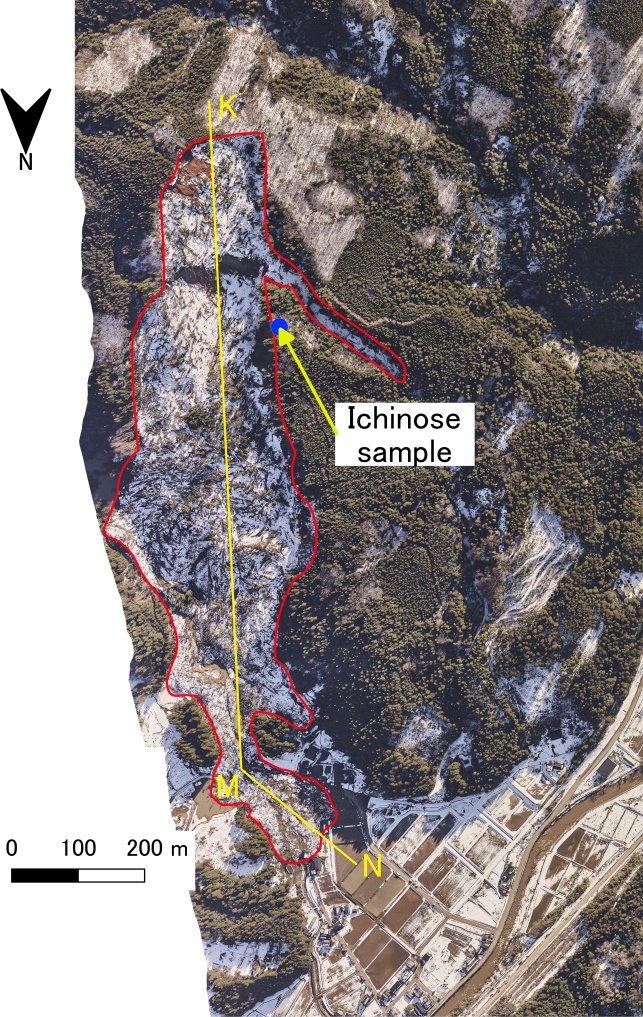
At 16:10 (JST) on January 1, 2024, an intense earthquake struck the Noto Peninsula area of Ishikawa Prefecture, Japan. The Japan Meteorological Agency (JMA) magnitude MJMA was 7.6, and the epicenter was 37.498° North and 137.242° East. The cascading effects of the Noto earthquake caused extensive damage on the Noto Peninsula, particularly in Wajima, Suzu, Noto, and Anamizu. As of 14:00 on March 26, this earthquake claimed 244 lives (15 people were reported as disaster-related deaths) and damaged 74,923 houses (Ishikawa Prefecture report, 2024). Shortly after the event, the Geospatial Information Authority of Japan mapped and published the locations of the landslides. The 2024 Noto Peninsula earthquake triggered more than 2300 landslides over a wide area. Although shallow, distributed landslides were common, long-traveling landslides caused significant damage. The Ichinose landslide was in Ichinose-cho, Wajima City, Ishikawa Prefecture, about 30 km from the epicenter. The slope was gentle, as the slope angle measured was less than 20°. The Ichinose landslide is about 440 m long, 200 m wide and 50 m thick. The apparent angle calculated from the line connecting the head scarp to the toe of the landslide was 10.9°, indicating high mobility. The displaced landslide mass traveled more than 1 km and deposited on a flat rice paddy. – – – – – Source: Loi, D.H., Jayakody, S., Sassa, K. et al. Landslides triggered by the 2024 Noto Peninsula earthquake. Landslides 21, 2583–2590 (2024). https://doi.org/10.1007/s10346-024-02333-6

Machinomachi landslide

LCI : JPN2410011530
Main Information
Landslide Name : Machinomachi landslide
Latitude : 37:25:5.8 N
Longitude : 137:4:3.99 E
Location
City / District : Wajima
Province : Ishikawa
Country : Japan
Reporter
Reporter 1 : Doan Loi
Reporter 2 : Loi Doan
Landslide Type
Material : Earth
Movement : Slide
Velocity (mm/sec) : Very Rapid
Depth (m) : Moderate-Shallow
Slope (degree) : Steep
Volume (m³) : Large-Moderate
Date of Occurence
Date of Occurence : Jan 01, 2024
Other Information
Land Use Source area : Forest
Run-out/deposition area : Forest, Farming, Human settlement, Road
Other Activity : Active in the past
Triggering Factor : Earthquake
Death(s) & Missing : -
Houses and other structural damage : 3
Photo of landslide :
Google earth kmz file : Machinomachi landslide.kmz
Plan of landslide :
Cross section of landslide :
Reference (paper/report) : https://link.springer.com/article/10.1007/s10346-024-02333-6
Testing graph :
Monitoring graph :
Video of moving landslides including 3D simulation : https://youtu.be/lS0Ju20B9zA
Description :

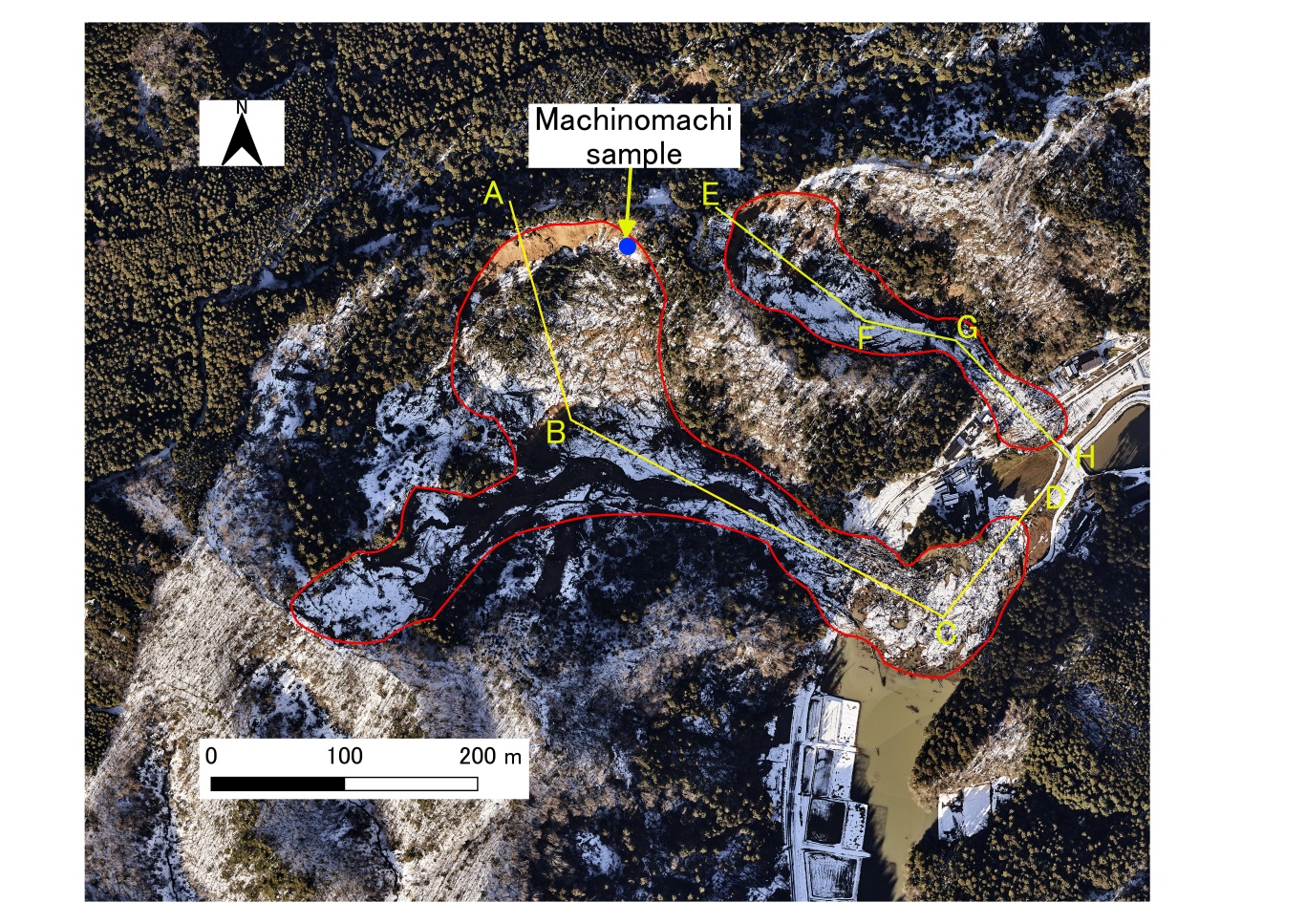
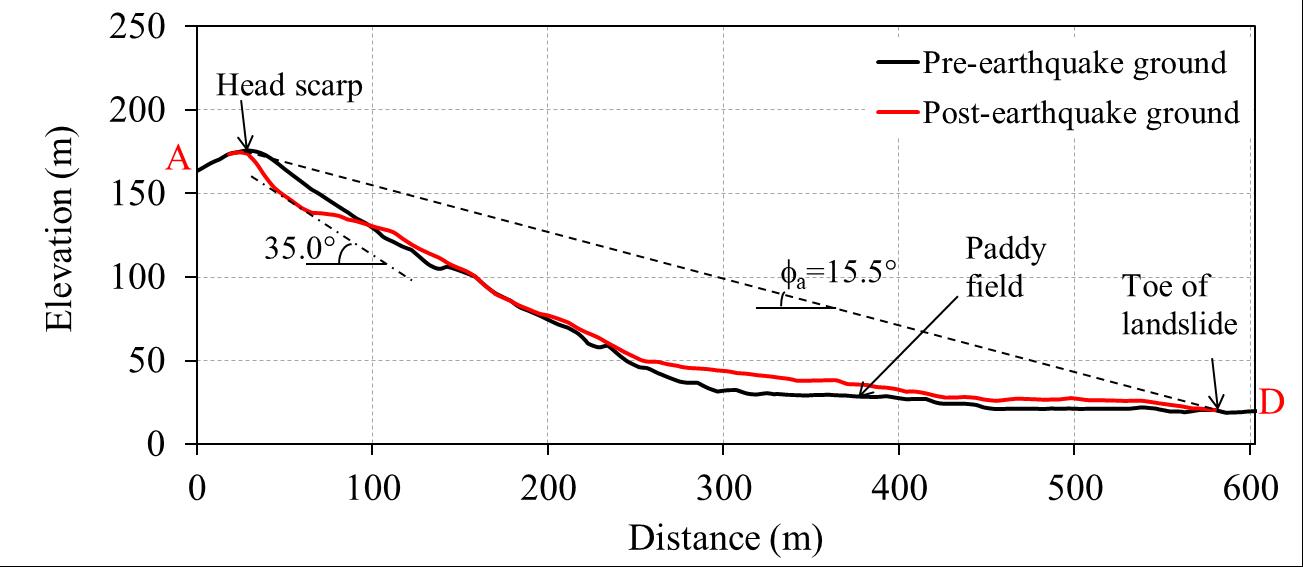
At 16:10 (JST) on January 1, 2024, an intense earthquake struck the Noto Peninsula area of Ishikawa Prefecture, Japan. The Japan Meteorological Agency (JMA) magnitude MJMA was 7.6, and the epicenter was 37.498° North and 137.242° East. The cascading effects of the Noto earthquake caused extensive damage on the Noto Peninsula, particularly in Wajima, Suzu, Noto, and Anamizu. As of 14:00 on March 26, this earthquake claimed 244 lives (15 people were reported as disaster-related deaths) and damaged 74,923 houses (Ishikawa Prefecture report, 2024). Shortly after the event, the Geospatial Information Authority of Japan mapped and published the locations of the landslides. The 2024 Noto Peninsula earthquake triggered more than 2300 landslides over a wide area. Although shallow, distributed landslides were common, long-traveling landslides caused significant damage. The Machinomachi landslide was in Machinomachi, Wajima City, Ishikawa Prefecture, about 30 km from the epicenter. The landslide block is about 80 m long, 160 m wide, and 20 m thick. The landslide occurred on a steep slope with an inclination of about 35°, and it moved over 550 m onto the flat paddy field. The apparent angle calculated from the line connecting the head scarp to the toe of the landslide was 15.5°, indicating high mobility. – – – – – Source: Loi, D.H., Jayakody, S., Sassa, K. et al. Landslides triggered by the 2024 Noto Peninsula earthquake. Landslides 21, 2583–2590 (2024). https://doi.org/10.1007/s10346-024-02333-6

Atami Debris Flow

LCI : JPN2407051420
Main Information
Landslide Name : Atami Debris Flow
Latitude : 35:7:19.03 N
Longitude : 139:4:18.65 E
Location
City / District : Atami
Province : Shizuoka
Country : Japan
Reporter
Reporter 1 : Doan Loi
Reporter 2 :
Landslide Type
Material : Debris
Movement : Slide
Velocity (mm/sec) : Extremely Rapid
Depth (m) : Moderate-Shallow
Slope (degree) : Steep
Volume (m³) : Moderate-Small
Date of Occurence
Date of Occurence : Jul 03, 2021
Other Information
Land Use Source area : Urban area
Run-out/deposition area : Urban area
Other Activity : -
Triggering Factor : Rainfall
Death(s) & Missing : 28
Houses and other structural damage : 54
Photo of landslide :
Google earth kmz file : 2021 Atami debris flow.kmz
Plan of landslide :
Cross section of landslide : -
Reference (paper/report) : https://link.springer.com/chapter/10.1007/978-3-031-16898-7_26
Testing graph : -
Monitoring graph : -
Video of moving landslides including 3D simulation : -
Description :

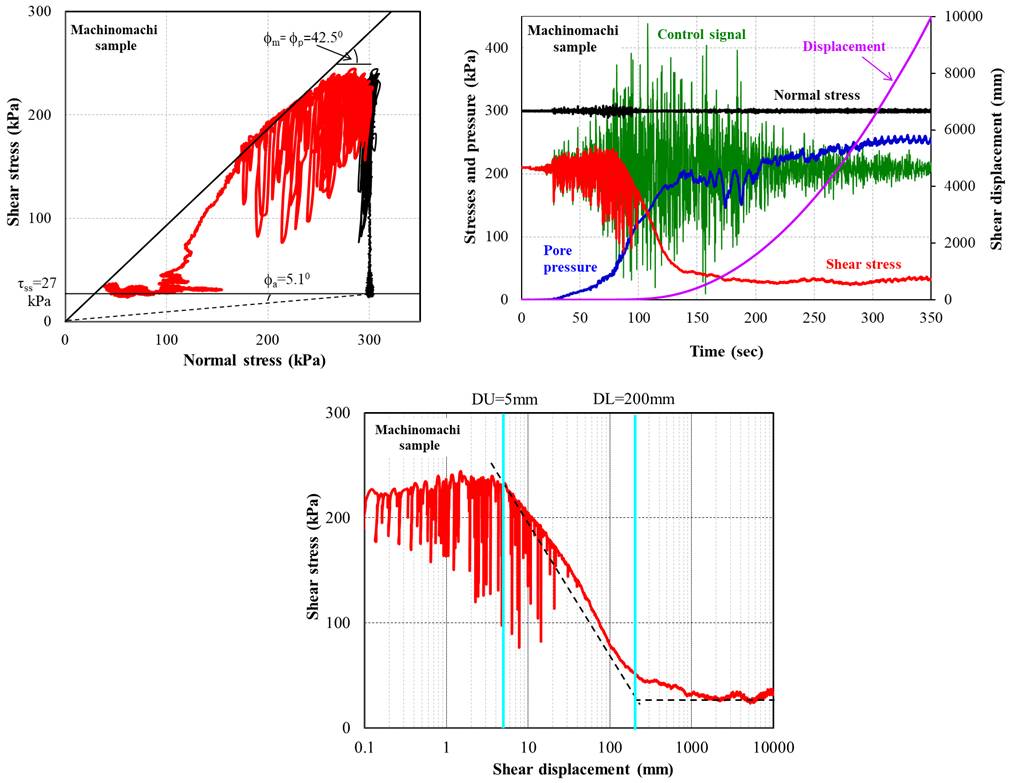
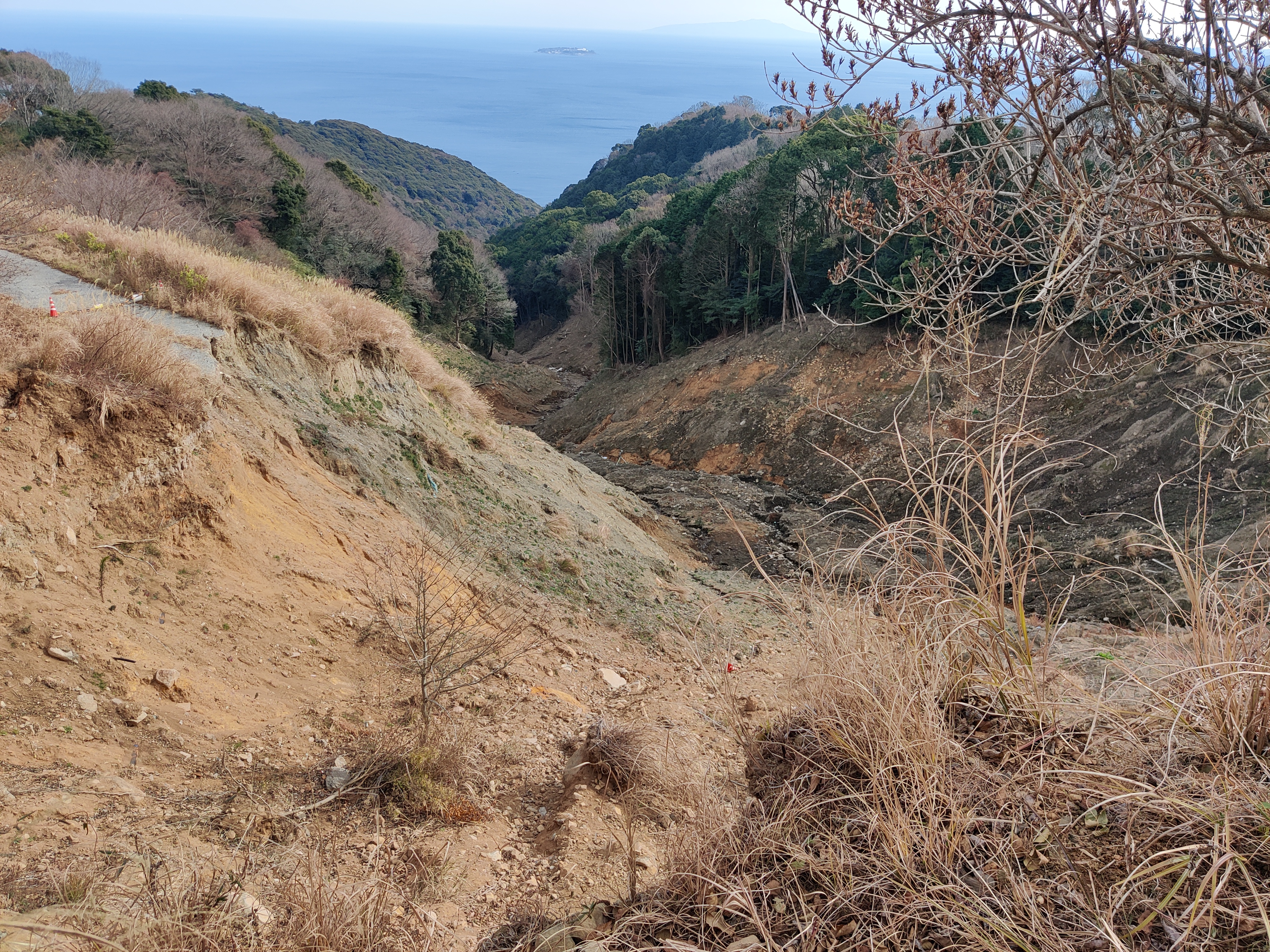
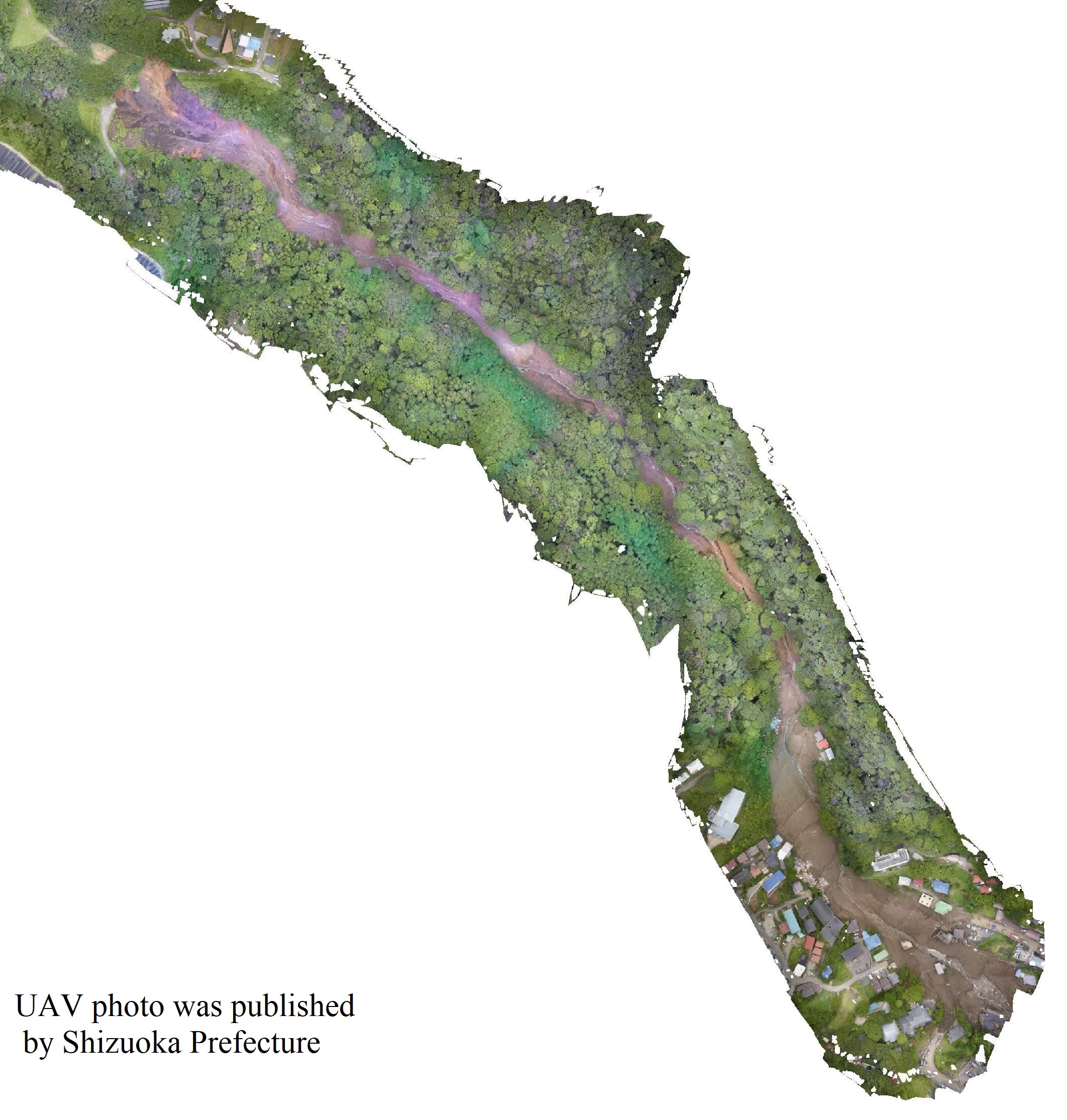
From 1 to 3 July 2021, extreme rainfall occurred in the Atami District, Shizuoka Prefecture, Japan causing a catastrophic debris flow on 3 July 2021. The Atami debris flow claimed 27 lives with one missing, three injuries and destroyed 54 houses, as of 10 February 2022 (Shizuoka Prefecture 2022). On 17 January 2022, International Consortium on Landslides (ICL) researchers investigated the landslide area. A sample was taken from immediately behind the exposed scar and sent to the Kyoto ICL-SATREPS office for ring shear tests. The underlying geology of the source area is andesite to basaltic andesite lava and pyroclastic deposits, which are products of Hakone Volcano. The ring shear test and computer simulation were conducted and published in the ICL open access book. Source LS-RAPID Manual with Video Tutorials Beena Ajmera, Hossein Emami Ahari, Doan Huy Loi, Hendy Setiawan, Khang Dang & Kyoji Sassa https://link.springer.com/chapter/10.1007/978-3-031-16898-7_26

Castelmola rockfall

LCI : ITA2105181230
Main Information
Landslide Name : Castelmola rockfall
Latitude : 37:51:32 N
Longitude : 15:16:41 E
Location
City / District : Castelmola
Province : Messina
Country : Italy
Reporter
Reporter 1 : Simone Mineo
Reporter 2 : Giovanna Pappalardo
Landslide Type
Material : Rock
Movement : Fall
Velocity (mm/sec) : -
Depth (m) : -
Slope (degree) : -
Volume (m³) : Very Small
Date of Occurence
Date of Occurence : Jan 05, 2019
Other Information
Land Use Source area : Urban area
Run-out/deposition area : Urban area, Human settlement, Road
Other Activity : Unknown
Triggering Factor : Rainfall
Death(s) & Missing : no
Houses and other structural damage : roads
Photo of landslide : -
Google earth kmz file : Castelmola rockfall.kmz
Plan of landslide : -
Cross section of landslide : -
Reference (paper/report) : A quick combined approach for the characterization of a cliff during a postrockfall emergency DOI 10.1007/s10346-019-01338-w
Testing graph : -
Monitoring graph : -
Video of moving landslides including 3D simulation : -
Description :

In the early afternoon of 5 January 2019, an intense rainfall event triggered the detachment of a significant volume of fractured limestone and dolostone, which slid along a dip-slope plane towards the impact point of the 2016 event. This produced a 6 × 9 m large cavity under the main square of Castelmola village famous for its panoramic view towards Taormina and the Ionian coastline, as the fallen rock mass was its hard basement. The rockfall was composed of about 25 main blocks (average volumes between 0.1 and 5 m3) and numerous smaller rock volumes, which crossed the slope as far as the SP-10 road. In particular, three main runoff sectors can be identified: the first one is located right at the foot of the vertical cliff, where a change in the slope aspect characterizes the morphology. This is the point where the block movement turns from free-fall into rolling/rebounds. The greatest volumes proceeded downstream towards the other runoff sectors, i.e., a pedestrian pathway and the main SP-10 road. The rockfall deposit shows a sort of gradation of volumes, with greatest blocks traveling a longer distance as far as the SP-10. In fact, 24 blocks stopped along a 30-m long segment of PP, damaging the road pavement and the railing. Three main blocks reached the bus terminal and the SP-10, with volumes ranging between 1.3 and 5 m3. Only 1 block invaded the SP-10, leading to its temporary disruption.

Kavalappara Landslide

LCI : IND2019808
Main Information
Landslide Name : Kavalappara Landslide
Latitude : 11:24:37.29 N
Longitude : 76:14:10.25 E
Location
City / District : Malappuram
Province : Kerala
Country : India
Reporter
Reporter 1 : Maneesha Vinodini Ramesh
Reporter 2 : Maneesha Vinodini Ramesh
Landslide Type
Material : Debris, Earth
Movement : Flow
Velocity (mm/sec) : Very Rapid
Depth (m) : Deep-Moderate
Slope (degree) : Steep
Volume (m³) : Large
Date of Occurence
Date of Occurence : Aug 08, 2019
Other Information
Land Use Source area : Farming, River
Run-out/deposition area : Human settlement, Road, River
Other Activity : Currently active
Triggering Factor : Human activity and rainfall
Death(s) & Missing : 69
Houses and other structural damage : over 39 houses and a walkover bridge were completely washed away
Photo of landslide :
Google earth kmz file : Kavalappara Landslide.kmz
Plan of landslide :
Cross section of landslide : -
Reference (paper/report) : Wadhawan, S. K., Singh, B., & Ramesh, M. V. (2020). Causative factors of landslides 2019: case study in Malappuram and Wayanad districts of Kerala, India. Landslides, 17(11), 2689-2697.
Testing graph : -
Monitoring graph : -
Video of moving landslides including 3D simulation : -
Description :

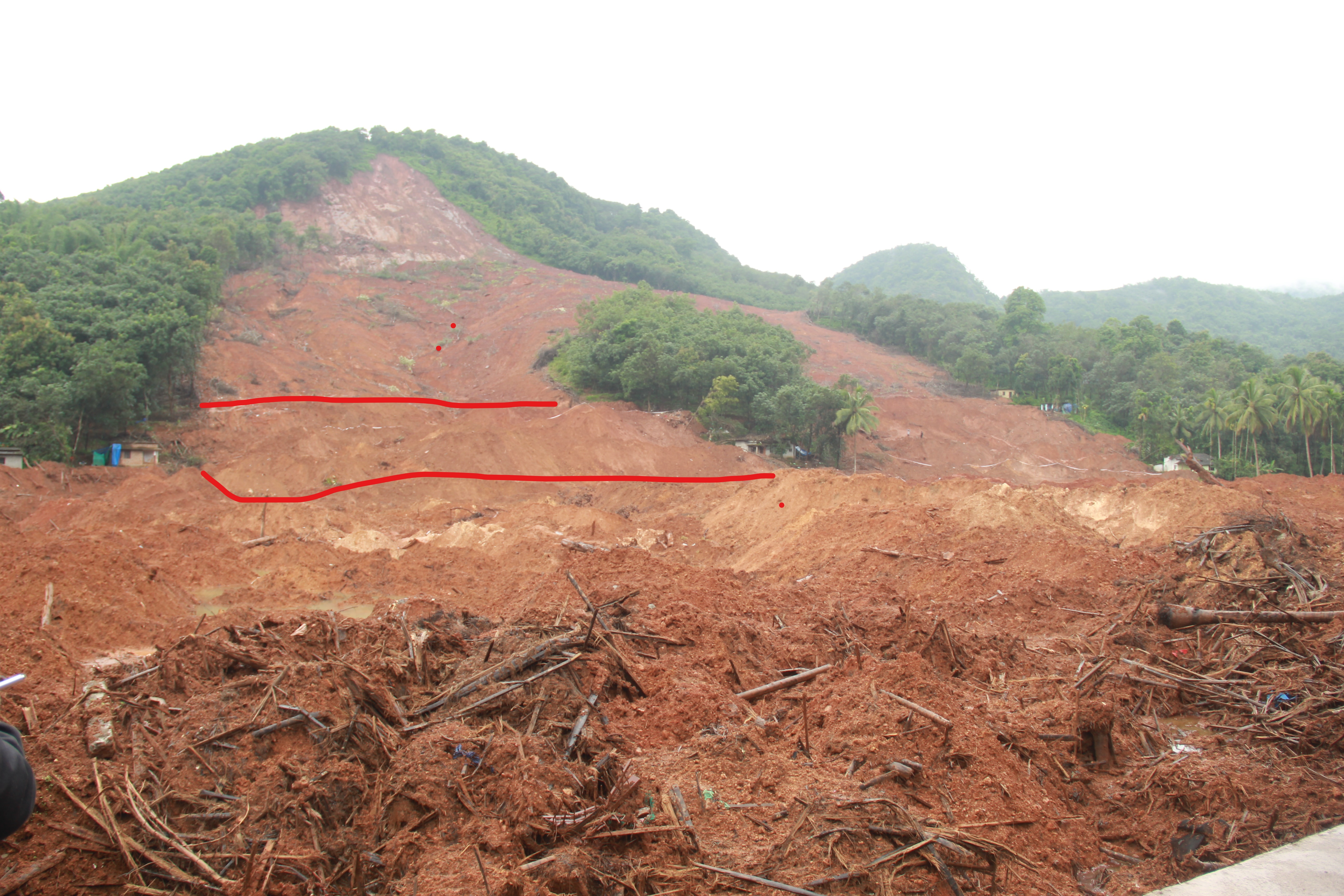
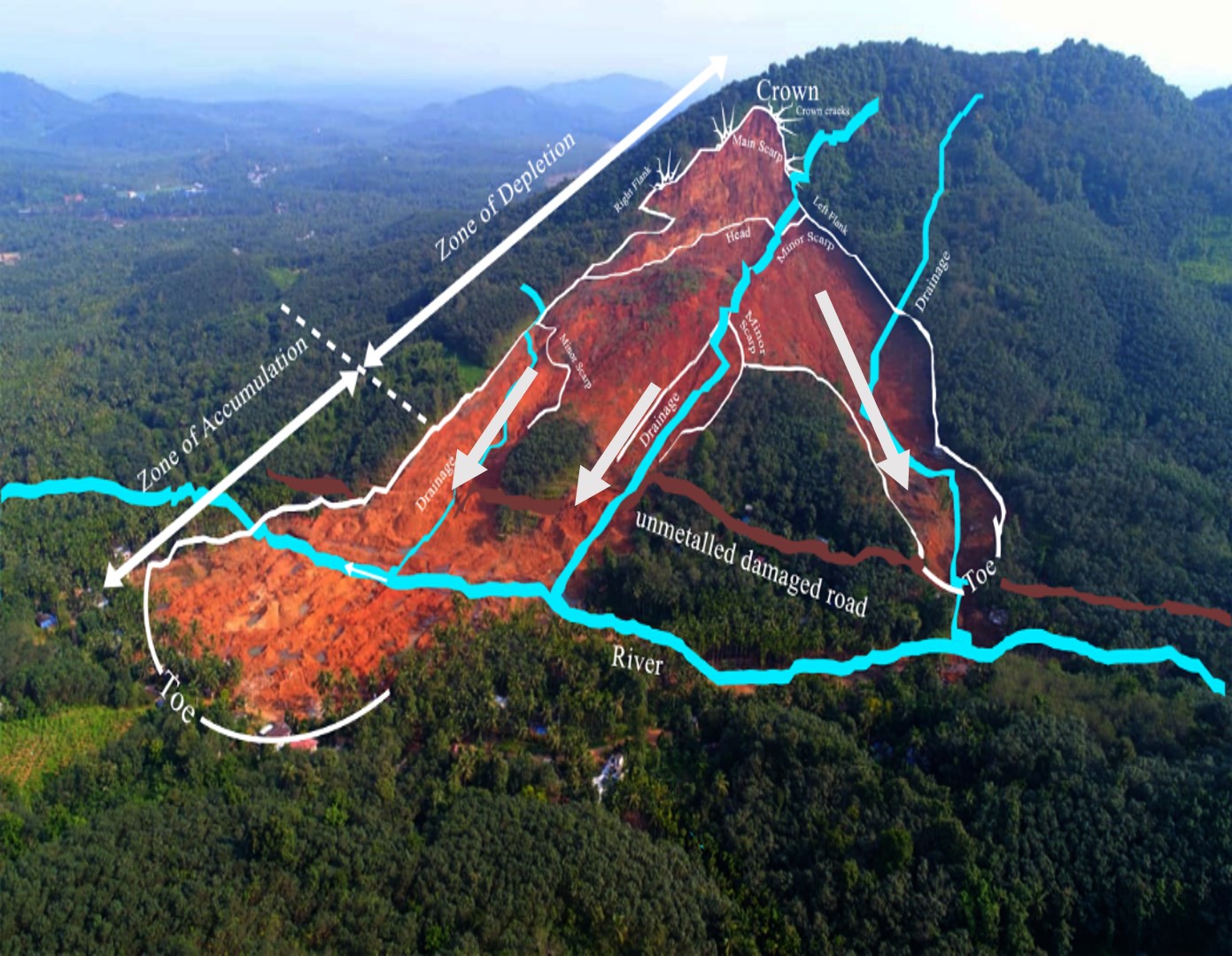
Month of August experienced heavy rainfall on the Western Ghat mountain ranges of southern India in 2019 with exceptionally heavy rainfall i.e. 400% over the normal average during 5 cumulative days resulting in the devastating landslide on 8th August 2019. It was difficult to estimate the actual loss however 69 casualties, 39 completely damaged houses along with roads, utilities and other infrastructure damages were recorded during our survey. The children and adults who managed to escape their death were completely traumatised and were unable to talk. Through field and desk geoscientific investigation it was found that the mismanagement of land use, unscientific slope modification, disruption of free flow of drainage, added with huge amounts of water due to heavy rainfall leading to supersaturation of highly weathered and structurally disposed debris material overlying Archaean bedrock and toe erosion due to flooded river resulted in this landslide. Although the slide happened in a rapid way but precursory signature as cracking and rumbling sound was heard before the actual event. However people were trapped and could not go away as their escape root was flooded. The landslide happened in the northern trifurcated downslope segments as the three 1st order drainage courses carried the discharge of debris and water. The communities living in high hazard prone areas need to be prepared as a resilient community by empowering them with deployment of multi-scale early warning and risk management systems.

Val Venosta (Vinschgau) 2010

LCI : ITA1204100903
Main Information
Landslide Name : Val Venosta (Vinschgau) 2010
Latitude : 46:37:25.84 N
Longitude : 10:52:33.88 E
Location
City / District : Laces (Latsch)
Province : provincia autonoma di Bolzano – Alto Adige (Autonome Provinz Bozen – Südtirol)
Country : Italy
Reporter
Reporter 1 : Marco Peli
Reporter 2 : Alex Sanzeni
Landslide Type
Material : Earth
Movement : Slide
Velocity (mm/sec) : -
Depth (m) : Shallow
Slope (degree) : Steep
Volume (m³) : Very Small
Date of Occurence
Date of Occurence : Apr 12, 2010
Other Information
Land Use Source area : Forest
Run-out/deposition area : Forest, Railways
Other Activity : Unknown
Triggering Factor : Others
Death(s) & Missing : 9
Houses and other structural damage : Railway line interrupted for around 50 days
Photo of landslide :
Google earth kmz file : 20210120_peli_landslideVV-site.kmz
Plan of landslide :
Cross section of landslide : -
Reference (paper/report) : https://doi.org/10.1007/s10346-019-01251-2
Testing graph : -
Monitoring graph : -
Video of moving landslides including 3D simulation : -
Description :

The landslide occurred in Val Venosta/Vinschgau Valley (Province of Bolzano, South Tyrol, Northern Italy) on the 12th of April 2010, aroun 9:03 in the morning. The event affected a natural slope that was formed as the result of the erosion produced by the flow of the Adige River on the cone of an alluvial deposit, an area of about 200 m2 in the central part of a hillside with average inclination of approximately 36° and length of 65 m. The slip surface (approximate length 20 m, width from 8 to 12 m) was located about 1.0 m below the slope profile, in the uppermost layers of a predominantly coarse, well-graded soil (see photo). The event was triggered by an accidental and extraordinary infiltration of water from a malfunctioning component of an irrigation system located on the uphill almost flat area (see plan). Although the slope appeared to be uniformly covered with vegetation, the landslide apparently occurred in an area where there were no trees. After the occurrence of the event, a number of activities were performed to characterize the area (before this report authors’ involvement). Samples collected from the slope near the slip surface show the different composition of the soil cover (30% silt, 35% sand, 30% gravel, Plasticity Index Ip = 2–6%) from the lower alluvial deposit (15% silt, 20% sand, 65% gravel and cobbles). Although the landslide dimensions were small, its consequences were catastrophic because it caused the loss of nine lives and the injury of 28 people, and it significantly damaged the local railway infrastructure.

Chiareggio landslide

LCI : ITA2012081700
Main Information
Landslide Name : Chiareggio landslide
Latitude : 46:19:10 N
Longitude : 9:47:65 E
Location
City / District : Chiesa in Val malenco
Province : Sondrio
Country : Italy
Reporter
Reporter 1 : Daniele Spizzichino
Reporter 2 :
Landslide Type
Material : Debris
Movement : Flow
Velocity (mm/sec) : Extremely Rapid
Depth (m) : Shallow
Slope (degree) : Extremely steep
Volume (m³) : Large-Moderate
Date of Occurence
Date of Occurence : Aug 12, 2020
Other Information
Land Use Source area : Forest
Run-out/deposition area : Road
Other Activity : Currently active
Triggering Factor : Rainfall
Death(s) & Missing : 3
Houses and other structural damage : 1
Photo of landslide : -
Google earth kmz file : -
Plan of landslide : -
Cross section of landslide : -
Reference (paper/report) : https://milano.repubblica.it/cronaca/2020/08/12/news/valtellina_frana_travolge_un_auto_morte_tre_persone-264499661/; https://www.youtube.com/watch?v=E4fc40vK6nw&feature=youtu.be
Testing graph : -
Monitoring graph : -
Video of moving landslides including 3D simulation : https://www.youtube.com/watch?v=E4fc40vK6nw&feature=youtu.be
Description :

The debris flow was triggered by extremly heavy rainfall, killing three person and The debris flow, triggered by short and intense rainfall, hit a car causing three victims in Chiareggio, a hamlet of Chiesa in Valmalenco (Sondrio). The road was temporary interrupted

Naga Landslide

LCI : PHL2009221500
Main Information
Landslide Name : Naga Landslide
Latitude : 10:12:30.58 N
Longitude : 123:45:32,57 E
Location
City / District : Naga
Province : Cebu
Country : Philippines
Reporter
Reporter 1 : John Romel Flora
Reporter 2 : Sandra Catane
Landslide Type
Material : Rock
Movement : Complex
Velocity (mm/sec) : Very Rapid
Depth (m) : Deep-Moderate
Slope (degree) : Extremely steep
Volume (m³) : Very Large
Date of Occurence
Date of Occurence : Sep 20, 2018
Other Information
Land Use Source area : Farming, Human settlement, Industrial use, Road
Run-out/deposition area : Farming, Urban area, Industrial use, Road, River
Other Activity : Active in the past
Triggering Factor : Human activity
Death(s) & Missing : 134
Houses and other structural damage : 57
Photo of landslide :
Google earth kmz file : Naga landslide extent.kmz
Plan of landslide :
Cross section of landslide :
Reference (paper/report) : https://link.springer.com/article/10.1007/s10346-019-01212-9
Testing graph : -
Monitoring graph : Naga Lsl Rainfall and Cracks.png
Video of moving landslides including 3D simulation : https://youtu.be/hseA0jvrksQ
Description :

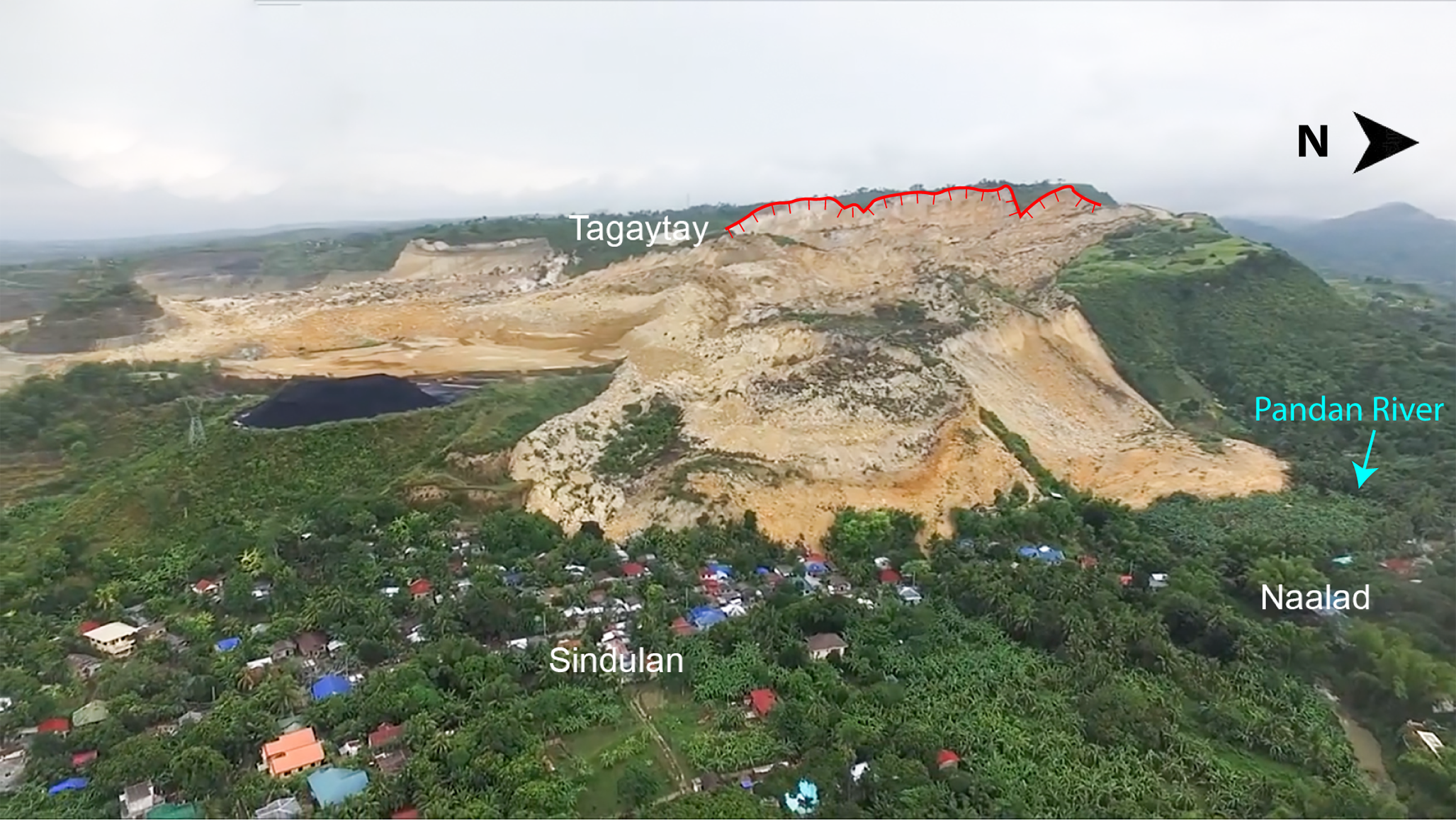
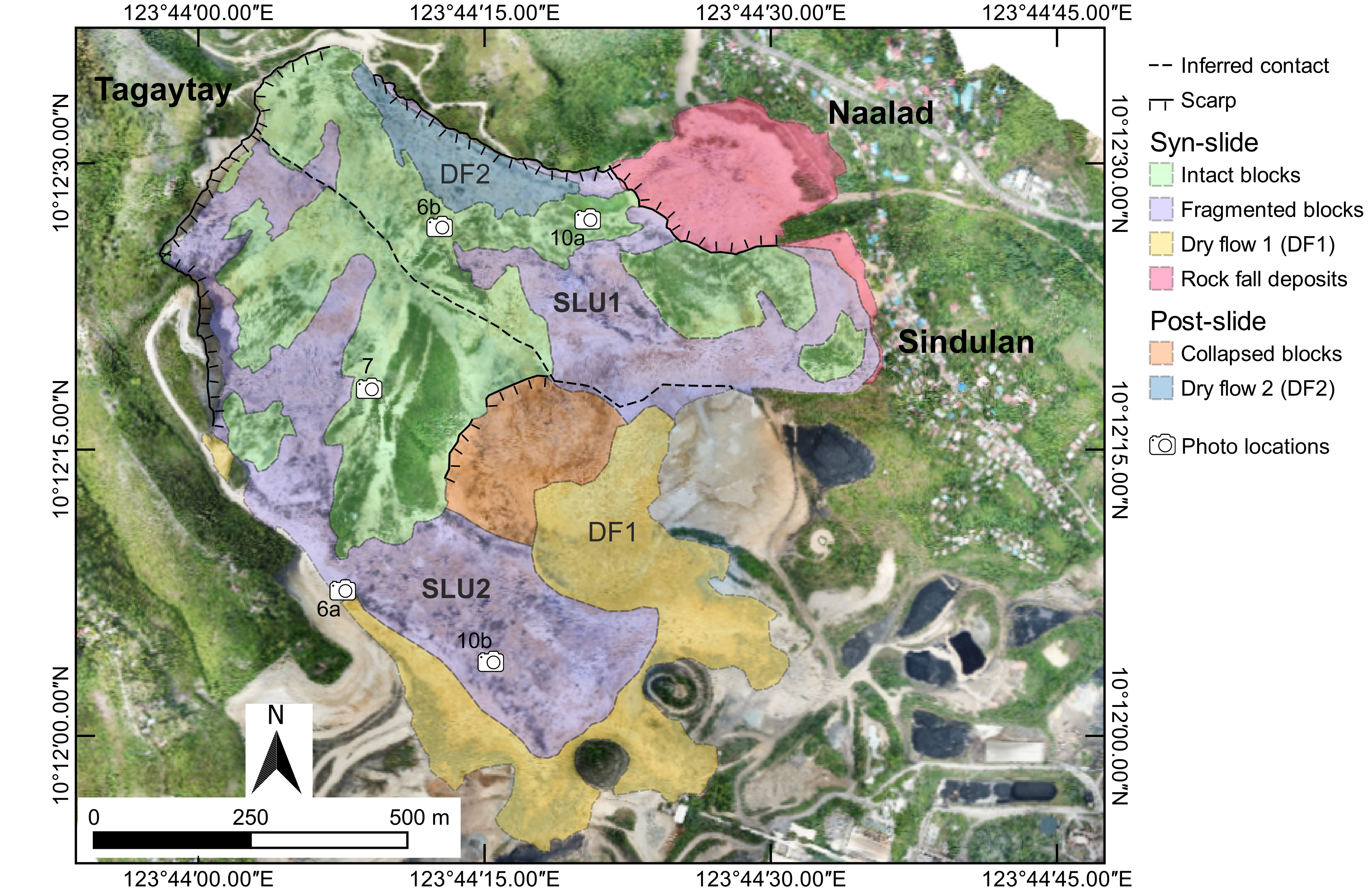
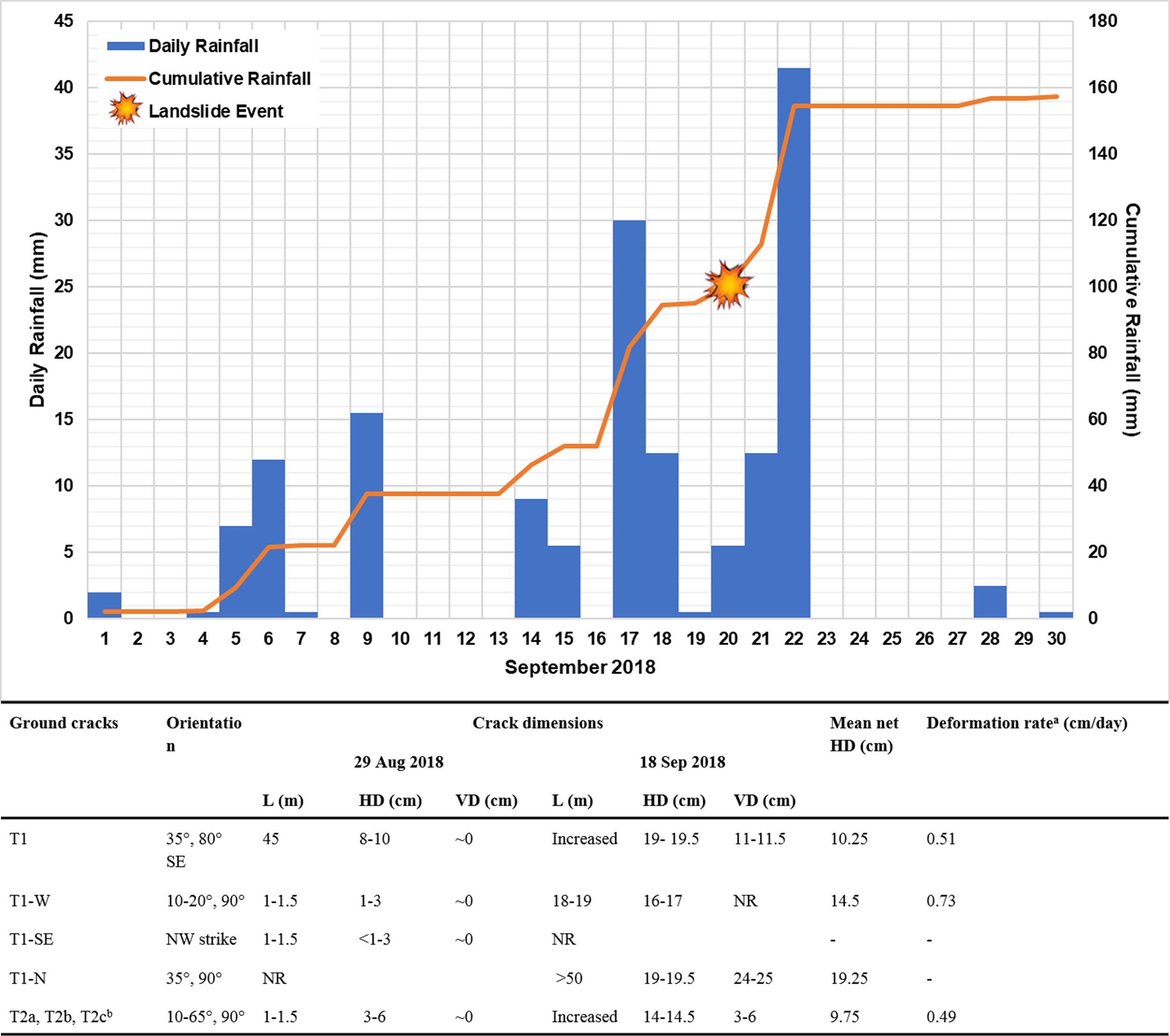
At 05:53 (UTC+08) on 20 September 2018, the extremely rapid Naga landslide devastated several villages of Naga City, Cebu Island, causing 134 casualties. The landslide destroyed 57 houses and led to the evacuation of 8252 people. Parts of the landslide dammed the nearby Pandan River, which was immediately excavated to prevent flooding of the city center downstream. Landslide deposits covered an area of about 9.46 × 10⁵ m2 with a maximum runout distance of 1.34 km, emplaced on built-up, industrial, and agricultural areas. The estimated total volume is at 27 million m3. The landslide slipped through a bedded limestone sequence of the Plio-Pleistocene Carcar Formation. A series of tension cracks at the source area were observed three (3) weeks before main failure, which probably indicated progressive deformation prior to failure. The event started as a translational slide which transformed in part to small grain flows and avalanches. Deposits exhibit a very irregular topography comprised of intact megablocks and smaller chaotic fragmented blocks that are spread across gently sloping terrain. The slope failure was possibly triggered by human activities that created steep slopes at the downslope portion of the failed mass.

Hooskanaden

LCI : USA2008031030
Main Information
Landslide Name : Hooskanaden
Latitude : 42:13:9.123 N
Longitude : 124:22:26.374 W
Location
City / District : Curry County
Province : Oregon
Country : United States
Reporter
Reporter 1 : Stefano Alberti
Reporter 2 : Ben Leshchinsky
Landslide Type
Material : Complex
Movement : Flow, Complex
Velocity (mm/sec) : Rapid
Depth (m) : Deep
Slope (degree) : Moderate
Volume (m³) : Large-Moderate
Date of Occurence
Date of Occurence : Feb 24, 2019
Other Information
Land Use Source area : Forest
Run-out/deposition area : Road
Other Activity : Currently active
Triggering Factor : Rainfall
Death(s) & Missing : -
Houses and other structural damage : 400,000,000$
Photo of landslide :
Google earth kmz file : Hooskanaden Landslide .kmz
Plan of landslide :
Cross section of landslide : -
Reference (paper/report) : https://link.springer.com/article/10.1007s10346-020-01466-8
Testing graph : -
Monitoring graph : 3.PNG
Video of moving landslides including 3D simulation : -
Description :

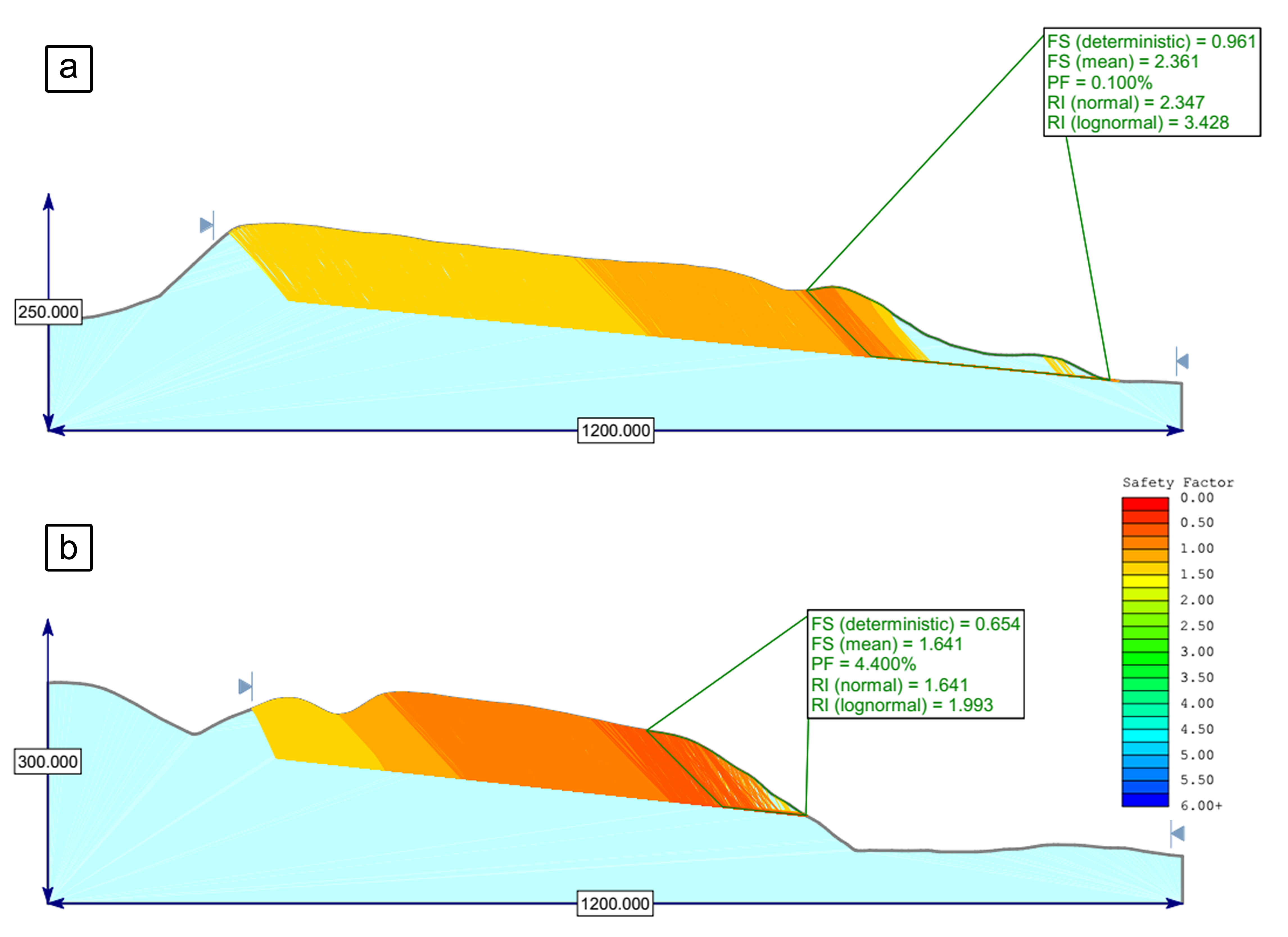
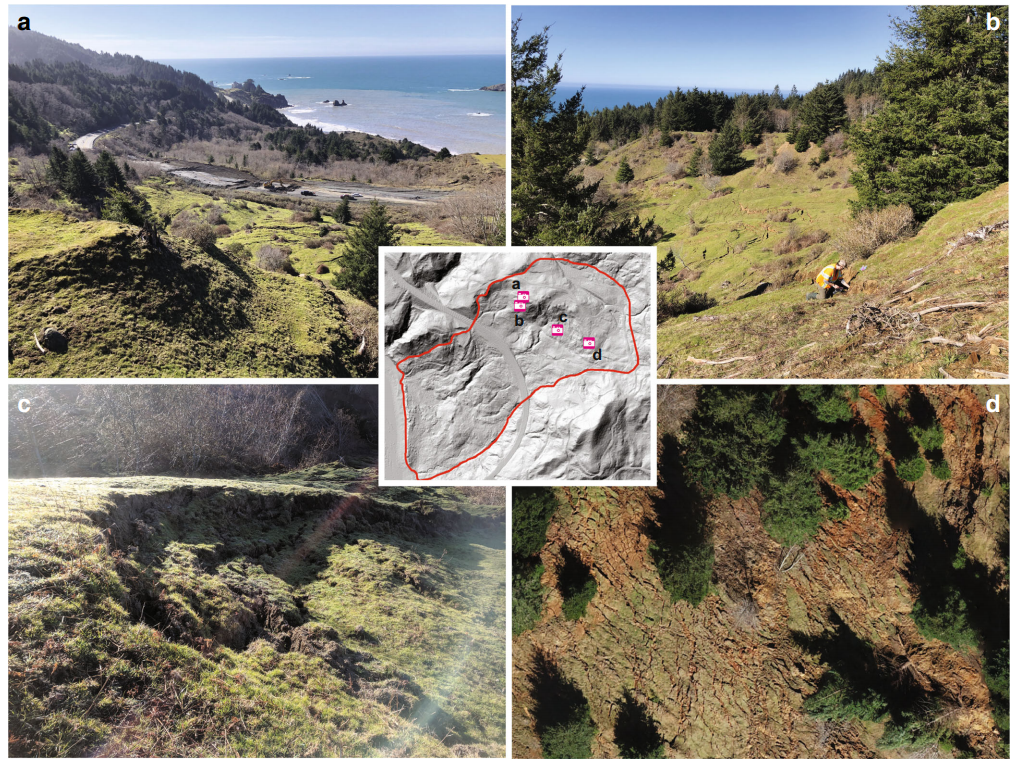
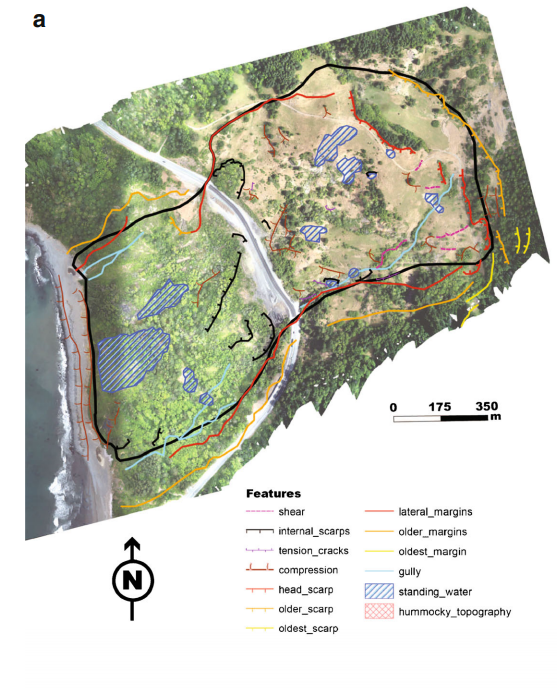
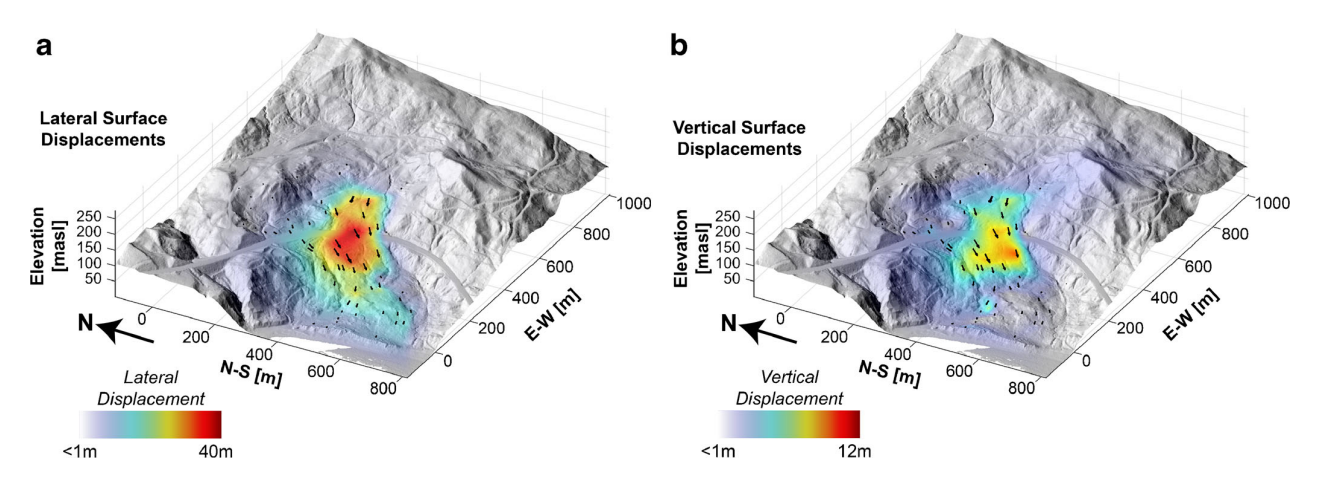
The Hooskanaden Landslide is an earthflow, which experienced a dramatic surge event beginning on February 24, 2019, closing US Highway 101 near mile point 343.5 for nearly 2 weeks. This ~ 1 km long surge event resulted in horizontal displacements of up to 45 m and uplift of 6 m at the toe located on a gravel beach adjacent to the Pacific Ocean. The Hooskanaden Landslide, likely active since the eighteenth century, exhibits regular activity with a recurrence interval of major surge events of approximately every 20 years, transitioning from slow to relatively rapid velocities. During the 2019 event, maximum displacement rates of approximately 60 cm/h were observed, slowly decreasing to 15 cm/h for a sustained period of approximately 2 weeks before the eventual return to baseline conditions (< 0.02 cm/h). — Source: Alberti, S., Senogles, A., Kingen, K., Booth, A., Castro, P., DeKoekkoek, J., … & Leshchinsky, B. (2020). The Hooskanaden Landslide: historic and recent surge behavior of an active earthflow on the Oregon Coast. Landslides, 1-14.